

[비즈한국] The 25th Criminal Division of the Seoul Central District Court (Presiding Judge Ji Gwi-yeon) sentenced former President Yoon Suk Yeol to life imprisonment on the afternoon of the 19th for his role as the leader of the insurrection regarding the 'December 3 Martial Law' incident. Previously, the special prosecutor for the insurrection had demanded the death penalty for the former president on the 13th of last month.
The court sentenced former Minister of National Defense Kim Yong-hyun, who was indicted alongside him, to 30 years in prison. Furthermore, former Defense Security Commander Roh Sang-won was sentenced to 18 years, former National Office of Investigation chief Cho Ji-ho to 12 years, former Seoul Metropolitan Police Agency chief Kim Bong-sik to 10 years, and former National Assembly Security chief Mok Hyun-tae to 3 years.
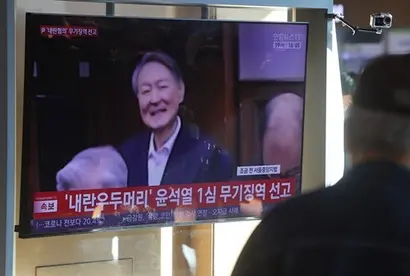
"The Core of the Martial Law Was Sending the Military to the National Assembly"
The court upheld both the charge of being the leader of an insurrection against the former president and the charge of participating in a critical mission of insurrection against former Minister Kim Yong-hyun. Presiding Judge Ji Gwi-yeon stated, "The core of this incident is that after declaring martial law, the military was deployed to the National Assembly through individuals like former Minister Kim Yong-hyun," adding, "The intent to disrupt the constitutional order is recognized."
The court determined the purpose of sending the military to the National Assembly and the National Election Commission by the former president was "to arrest key figures, including the Speaker of the National Assembly and the leaders of the ruling and opposition parties, in order to prevent discussions by lawmakers and the resolution to lift martial law." The court remarked, "It is sufficient to conclude that there was an intent to obstruct or paralyze the activities of the National Assembly and render it unable to function."
The claim raised by the special prosecutor that "former Minister Kim Yong-hyun delivered a list of 14 targets for arrest to former Counterintelligence Commander Yeo In-hyung" was also accepted as fact. The court clarified that "the president can also be the subject of a crime of insurrection with the intent to disrupt the constitutional order," and that the crime of insurrection is established when the authority of the National Assembly is infringed upon.
Regarding the argument raised by the former president's side that it was "martial law for the defense of liberal democracy," the court dismissed it, stating it was a "confusion of justification and purpose" and adding, "One cannot steal a candle simply because they are reading the Bible." The court judged the December 3 martial law to be a riot severe enough to disturb the peace of a region, considering the issuance of proclamations, the blockade of the National Assembly, the organization and operation of arrest squads, and the occupation of the National Election Commission and removal of servers.
Recognition of Investigative Authority of the CIO and Prosecution
As the reason for sentencing, the court pointed out, "The political neutrality of the military and police was significantly damaged by the martial law and the mobilization of troops and police, and South Korea's political status and international reputation have declined," adding, "Our society has been politically divided and placed in a state of extreme confrontation."
Referring to the early presidential election, subsequent administrative measures, and large-scale investigations and trials, the court assessed the situation as "causing immeasurable and massive damage in terms of social costs." It added that soldiers, police, and civil servants deployed to the scene have borne social criticism and legal responsibility, and trust in the legitimacy of superior orders has also been undermined.
The court ruled that investigations into crimes of insurrection or treason against a sitting president are possible, taking the position that the constitutional limitation on 'prosecution' does not include investigations. Furthermore, it held that both the Corruption Investigation Office for High-ranking Officials (CIO) and the prosecution can investigate the crime of insurrection as a 'related crime' to abuse of power, and that the prosecution also possesses the right to indict. The claim raised by the former president's side that "the CIO investigation was illegal" was not accepted.
However, the court did not accept the special prosecutor's claim that the former president had been preparing for martial law for about a year, citing a lack of evidence. Former Ministry of National Defense Investigation Headquarters head Kim Yong-gun and former National Office of Investigation official Yoon Seung-young were also acquitted, with the court citing a lack of evidence of their involvement.
With this ruling, the December 3 martial law incident has reached its first judicial conclusion, but given the high probability of an appeal by the former president's side, legal battles are expected to continue.