

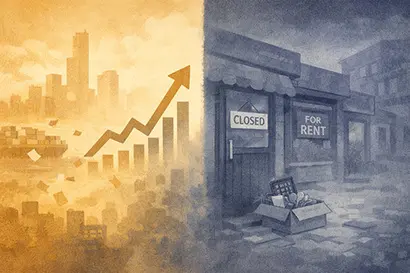
[비즈한국] Although the KOSPI index has surpassed the 5,500 mark to reach an all-time high and state-run research institutes have announced that the economy is recovering due to improved consumption, many citizens do not feel the benefits of rising stock prices or economic recovery. This is because the perceived economy is actually frozen, with the number of closing stores increasing for two consecutive years and the proportion of self-employed individuals falling to an all-time low.
The proportion of self-employed individuals citing poor business performance as the reason for closure reached a 14-year high, and the number of those who closed businesses after operating for more than five years hit the highest level in nine years. Amidst the worsening economy, the proportion of young people choosing to start their own businesses declined for the first time in nine years.
President Lee Jae-myung visited the Seochon Inwang Restaurant in Tongin Market, Jongno-gu, Seoul, on the 9th to meet with merchants and residents and have dinner. At the meeting, President Lee said, "Exports are recovering and stock prices are rising, but when you actually come to a restaurant and eat a meal, you can feel why the public says they are struggling."
President Lee added, "If the public cannot feel it, we cannot yet say that the economy has improved," stating that "policy achievements should be verified in the daily lives of the people, not just in statistics." He expressed his regret that the warmth from the KOSPI index reaching an all-time high and the semiconductor-led export recovery has not yet reached local commercial districts.
On the same day, the Korea Development Institute (KDI) stated in its 'February 2026 Economic Trends' that "our economy is maintaining a moderate production growth trend, centered on the service industry, following improvements in consumption." However, the actual flow is not at a level that the public can feel, as President Lee feared. From the perspective of the public, it is difficult to feel that consumption is improving when stores are closing every day and commercial vacancies are increasing.
According to the National Data Center, there were 5.62 million self-employed people last year (2025), a decrease of 37,000 compared to 2024. The number of self-employed individuals fell to 5.513 million in 2021 in the aftermath of the COVID-19 pandemic, then shifted to an upward trend to 5.632 million in 2022 and 5.689 million in 2023. However, it decreased to 5.657 million in 2024 due to the 'three highs' (high interest rates, high exchange rates, high inflation) and further declined to 5.62 million in 2025.
As the number of self-employed individuals decreased, their share of total employment fell to an all-time low. The share of self-employed individuals maintained the 20% range at 20.02% in 2023, but it fell below 20% to 19.80% in 2024 and further dropped to 19.53% in 2025.
As the decline in the number of self-employed individuals continues, indicators of business closure are also worsening. According to the National Tax Service's National Tax Statistics Portal, the number of self-employed people who closed their businesses in 2024 was 1,008,282, surpassing 1 million for the first time in history. The number of closed businesses was 867,292 in 2022, increased to 986,487 in 2023, and crossed the 1 million mark in 2024.
In particular, the proportion of businesses that closed after operating for more than five years reached 29.11%, nearing 30%. This is the highest level in nine years since the 29.90% recorded in 2015. It is also 1.26 percentage points higher than the 27.85% recorded in 2023. Half of the self-employed who decided to close their businesses cited poor business performance as the reason. Out of those who closed in 2024, 506,198, or 50.20%, cited business failure. This is the highest figure in 14 years since 2010, when the proportion of responses citing business failure reached 50.23% in the aftermath of the global financial crisis.
As more self-employed people, even those with long-standing businesses, close down due to worsening economic conditions and poor business performance, the entrepreneurial challenge among young people is also cooling down. The proportion of new business owners under the age of 30 increased every year from 9.09% in 2015 to 13.60% in 2023, but it recorded 12.45% in 2024, marking the first decline in nine years.