

[비즈한국] As the Lunar New Year holiday approaches, adults find themselves in a bit of a dilemma. How much should I give my elementary school nephew for New Year's money? Search engines are flooded with "appropriate amounts for each grade level," and people around you might say, "In this economy, shouldn't you give at least 30,000 won?" If I pull out a 50,000 won bill, I worry it looks like I'm trying too hard, but if I put in 10,000 won, I wonder if it's too little. If you have two or three nephews, the worry becomes even more complex. Before we know it, New Year's money has turned into a practical math problem trailing behind a warm greeting.
However, this question takes on a completely different meaning if you shift your perspective. It’s the moment you stop asking "how much is appropriate" and start asking "what kind of experience will this money be for the child?" New Year's money is the first form of "social money" a child encounters outside of parental control. Regular pocket money is usually governed by rules and restrictions. In contrast, holiday money is money that appears suddenly. It has no conditions, no deadlines, and no predefined purpose. Therefore, rather than just cash, New Year's money is more like the first free capital given to a child.
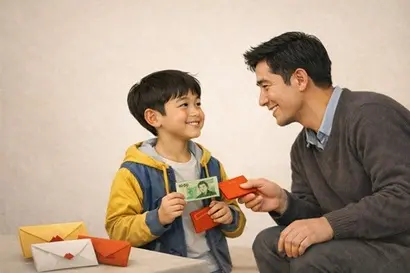
This freedom creates problems. When an elementary schooler is given an amount that exceeds their self-control, most of it flows into immediate consumption. They spend it all at once on game items or whatever is currently trendy. A few days later, almost nothing remains. Adults might think, "As expected, kids still don't know how to use money," but in reality, the child has learned something else: the experience that "money is something to be spent as soon as it's received."
Larger amounts create a different scenario. Parents intervene. They follow up with, "Let's put this in the bank," or "Give this to Mom for safekeeping." At that moment, the owner of the money stops being the child and becomes the adult. The child loses the opportunity to judge for themselves and returns to being under control. Even though the amount grew, the economic experience actually diminished.
Conversely, an amount that a child can manage creates an entirely different flow. They write down what they want on a list, wait if they don't have enough, and decide for themselves what to buy first. Sometimes they spend impulsively and regret it. That regret is also a valuable experience. It teaches them through practice that money is finite and that choices always come with sacrifices. This is the starting point of economic sensibility.
There is also a problem that arises when New Year's money becomes a subject of comparison. When the conversation revolves around who got how much or which relative gave the most, children naturally start measuring relationships by monetary value. A simple perception might form, like, "Is the uncle who gives more a better uncle?" Regardless of the adult's intentions, the size of the money can be misinterpreted as a measure of a relationship. This, too, is an economic and social signal that the child is learning.
Therefore, the benchmark for New Year's money for elementary schoolers is not the inflation rate or an online average. The key is whether the amount is within a scale the child can judge for themselves and whether they can handle the results of their choices. If it's too little, no experience is gained; if it's too much, the control disappears. Somewhere in between lies the "appropriate amount" where a child can have their first practice in handling money.
We cannot teach a child how to be rich through New Year's money. However, we can let them experience how to think, how to share, and how to wait when they receive money. A holiday envelope doesn't have to be a tool for increasing consumption; it can be the first practical tool for learning how to manage money.
In the end, the issue of New Year's money isn't about the amount. It's about whether the child has a choice and whether they can learn from that choice. New Year's money is not just pocket money; it is a small capital for the child to practice economics for the first time.