

[비즈한국] The official weapon capabilities of the KF-21 Boramae, which were previously only hinted at through scattered data from Seoul ADEX and the Singapore Airshow, have finally been confirmed. The KF-21’s maximum payload capacity is approximately 7.7 tons (16,800 lbs). While it may appear inferior to competing models on paper, it has been confirmed that its actual strike capability, required for large-scale full-scale warfare, is equal to or even superior to its rivals.
The KF-21 is a medium-class fighter equipped with two General Electric (GE) F414-GE-400K engines. In terms of class, it is a direct competitor to Boeing’s F/A-18E/F Super Hornet and Dassault’s Rafale. While its economic efficiency in terms of introduction and maintenance costs was already well-regarded, specific comparisons regarding its air-to-air and precision ground-strike capabilities were difficult. However, the recently revealed detailed operational capabilities for each of its 10 hardpoints are sufficient to dispel such concerns.
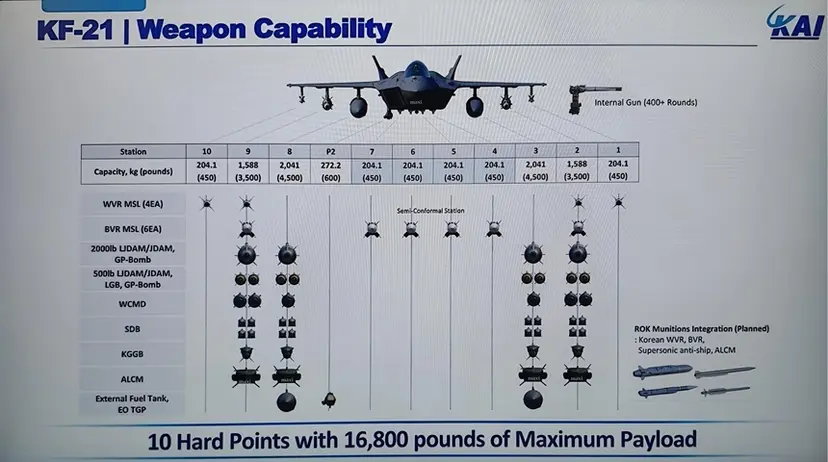
In raw numbers, the Rafale can carry 9.5 tons across 14 hardpoints, and the Super Hornet can carry about 8 tons across 11 hardpoints, both surpassing the KF-21 (10 locations, 7.62 tons). However, the key to fighter armament is not just “carrying more,” but “how to operate them without interference.” Actual weapon combinations vary significantly depending on aerodynamic flow, spacing between pylons, and internal wiring design.
The KF-21’s efficiency is maximized in air-to-air combat capability. The KF-21 can mount missiles at a total of 8 locations, including semi-conformal stations under the fuselage, and it primarily operates with 6 ‘Meteor’ long-range air-to-air missiles. In contrast, while the Rafale has more hardpoints, its actual capacity for Meteor missiles is limited to 4. Although the Super Hornet can carry more missiles, its actual operational capacity for air-to-air missiles converges to a level similar to the KF-21 once external fuel tanks are mounted to ensure operational range.
Its air-to-ground strike capability is also overwhelming in terms of practical efficiency. The KF-21 can operate up to 16 Small Diameter Bombs (SDB), which is the same level as the larger Super Hornet. This contrasts with the Rafale, which, despite theoretically being able to carry 12 Hammer guided bombs, typically operates with only about 6 in actual combat due to interference issues between weapons.
The difference is especially pronounced in the operation of long-range air-to-ground missiles, which have high strategic value. While the Rafale can theoretically carry up to 3 Storm Shadow long-range air-to-ground missiles, it is rarely loaded with 3 in reality, often limited to 1 or 2 due to flight range and takeoff/landing weight constraints. Conversely, the KF-21 has secured a weight design and wiring capable of operating four large air-to-ground missiles, reflecting the unique operational environment of the South Korean Air Force (striking underground strategic targets in North Korea). This suggests that the KF-21 holds an advantage in large-scale firepower projection during the early stages of a full-scale war.
This gap widens even further during multi-role mission execution, where offensive air superiority operations must be performed after ground attacks. When the Rafale is loaded with air-to-ground weapons, its air-to-air missile capacity drops sharply to 4, limiting its ability to respond to sudden dogfights. As 2 missiles are typically used per enemy aircraft, leaving at least 2 in reserve is essential, meaning the Rafale only has one effective opportunity to attack enemy aircraft during multi-role missions. In contrast, the KF-21 can retain 6 air-to-air missiles even while carrying large air-to-ground missiles and auxiliary fuel tanks, giving it 3 opportunities to attack enemy aircraft. This means it can continue to perform offensive air superiority missions even after completing its strike objective.
Of course, it is true that the Super Hornet still leads in terms of scalability, such as being able to mount up to 14 AIM-120 AMRAAM medium-range air-to-air missiles using adapters. Additionally, the KGGB (Korean GPS-Guided Bomb) currently used by our military weighs only 500 pounds (226kg) but can only be carried in sets of 4, necessitating the development of multi-bomb racks to increase the operational efficiency of KGGB and domestically produced guided bombs.
Beyond this, the KF-21’s “practical weapon capability” should be continuously evolved—such as by mounting small guided bombs on the semi-conformal fuselage hardpoints currently dedicated to Meteor missiles, or by increasing the size of auxiliary fuel tanks to enhance long-range flight capabilities—to simultaneously boost our military’s power and improve export competitiveness.