

[비즈한국] Germany, one of the largest streaming markets in Europe, has laid down a new rule for global OTT (Over-the-Top) platforms like Netflix and Amazon: “Spend the money you earn in Germany back on German content.” Rather than a simple 'cultural promotion' slogan, this policy is being viewed as a quasi-tax industrial measure, as it calculates investment amounts based on the platform's domestic revenue and mandates reinvestment into local production costs. As debates surrounding 'OTT contribution funds' and domestic production investment obligations continue in South Korea, the mechanism Germany is designing is drawing renewed attention.
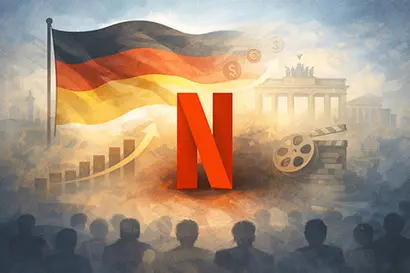
Reuters reported on the 5th (local time), citing an announcement from the German Ministry of Culture, that the German government is pushing for a plan to mandate streaming platforms and TV broadcasters to reinvest at least 8% of their annual revenue generated in Germany into the German film and video industry. In the same report, Reuters noted, “An 'option' has also been proposed where if platforms and broadcasters choose to invest 12% or more, they will be exempted from some complex regulations, such as mandatory German-language production requirements.” Separately, the German government has also announced plans to increase public support, such as film production subsidies, to 250 million euros per year.
This measure is rooted in the cost pressures facing the German film production scene. Reuters stated that while German production had seen growth for some time thanks to global OTT demand, the burden of production costs has recently increased due to rising labor, energy, and material costs. The German government argues that as the profits platforms earn in the German market grow, those profits should flow back as 'sustainable capital' for the local production ecosystem. The Ministry of Culture described this scheme as “not a symbol, but actual investment promotion,” setting a goal to boost jobs, added value, and creative capabilities simultaneously.
A notable aspect is that Germany has offered not only the 'stick' of regulation but also the 'carrot' of deregulation. The structure proposed by Germany is to mandate an 8% reinvestment as a baseline, while offering to reduce some regulatory burdens if companies voluntarily invest 12% or more. Although it appears to be a choice on the surface, for platforms, it effectively forces them to calculate whether to “pay more to face fewer regulations or pay less and face stricter obligations,” leading some in the industry to interpret this as a mechanism to force the sharing of production costs. Reuters also cited the mandatory German-language production requirement as an example of an item exempted upon 12% investment.
However, there are still 'blank spaces.' Reuters, citing German media, reported that while the relevant legislation is expected to receive cabinet approval before early April 2026, it is not yet clear what penalties (such as fines) will be imposed if platforms fail to comply. In other words, while the broad framework has been revealed, the enforcement means are likely to be specified during the upcoming legislative process.
The fact that Germany has played this card shows it is aligned with a broader trend across Europe. According to Reuters, Germany is joining several other European countries, including France and Italy, that have already mandated domestic production investments for streaming providers. This signifies that Europe has begun to manage OTTs not just as 'content distribution channels,' but as industrial infrastructure that re-circulates funds back into the local production ecosystem.
Once this system is actually implemented, the next point of interest will be where global OTTs like Netflix and Amazon will pass on the costs. If the investment obligation is structured as a fixed cost, there may be incentives to absorb some of it through subscription fee increases or adjustments to ad unit prices. Conversely, platforms might try to efficiently fulfill the 'mandatory investment' by reallocating their European production portfolios to focus on Germany. As the revenue in the German market grows, so does the 'money that must be spent back in Germany,' meaning platforms will likely have to redesign their entire approach, including contracting methods with German production companies, production cost calculations, and even copyright structures.
For the South Korean content industry, this rule is not just 'local German news.' There is concern that if a certain level of global OTT production budget becomes 'locked in' to Germany, competition with Korean projects within the limited global production budget pool could become more intense. Conversely, once Germany becomes a mandatory investment market, it could open paths for Korean production companies to design “Korean-style content that meets German investment requirements” through co-productions with German firms, the establishment of local German subsidiaries or studios, and the utilization of European staff and locations.