

[비즈한국] It is no exaggeration to say that the world's largest electronics and IT exhibition, CES 2026, held last month, served as the stage that signaled the full-scale beginning of the race for mass-producing humanoid robots. In particular, Boston Dynamics' 'Atlas'—acquired by Hyundai Motor005380 Group—and Tesla's 'Optimus' effectively formed a duopoly, garnering attention daily. With Chinese manufacturing companies like UNITREE and UBTECH also rapidly catching up based on government support and a massive domestic industrial ecosystem, some observers argue that the humanoid competition is evolving into a technology war centered around Korea, the U.S., and China.
Amidst this intense competition, a company that has been growing its presence in the 'mechanics powerhouse' Germany, albeit with relatively less spotlight, has emerged. It is the Munich-based robot startup 'Agile Robots'.
The Arrival of the 'Made in Germany' Humanoid
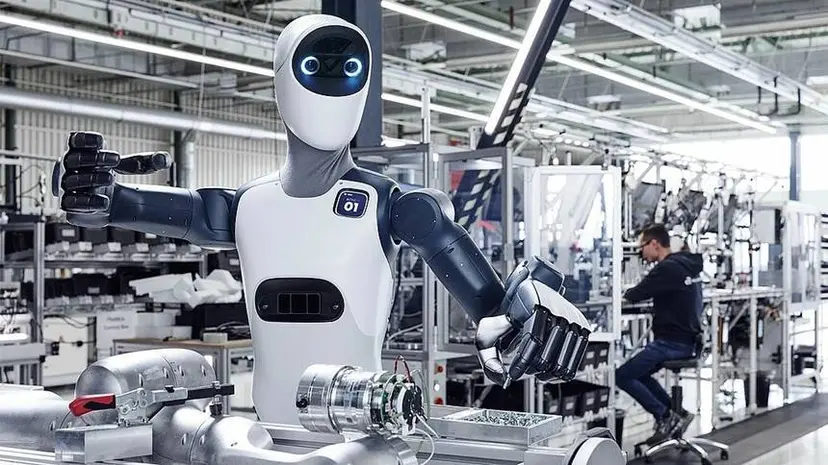
Agile Robots unveiled the industrial humanoid 'Agile ONE' last November. Agile Robots is a deep-tech startup founded by researchers from the German Aerospace Center (DLR) and has been rapidly building its presence based on precision control and robotic manipulation technology. Having developed within the German manufacturing ecosystem, which centers on the automotive and machinery industries, it is recognized for focusing on technological development with practical usability in mind rather than flashy demonstrations.
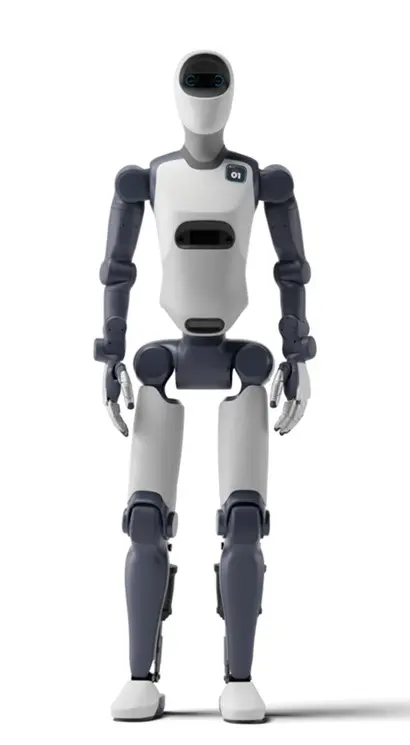
Agile ONE is also a robot that reflects this philosophy. This humanoid, standing about 174cm tall and weighing 69kg, can lift up to 20kg and moves at a speed of approximately 7km/h. While it may not look vastly different from competing models at first glance, a clear direction can be read in its structural design.
Its joint system, equipped with a total of 71 Degrees of Freedom (DoF), is designed to replicate human-like movements. It is particularly characterized by its emphasis on fine motion control for the hands and upper body. Degrees of Freedom is an index indicating the number of axes a robot can move, and generally, a higher value allows for more precise operation. While DoF alone does not immediately equate to technical superiority, the difficulty of control increases as the number of joints rises.
The design of Agile ONE shows a distinct orientation in that it prioritizes securing 'manipulation' capabilities over mobility. In the robotics industry, performing tasks using hands is considered much harder than walking. This is because every object has different weight, friction, and strength, requiring delicate force regulation. One must hold a paper cup softly enough not to crush it, yet grasp metal parts firmly enough not to drop them. Such precision manipulation is considered a key factor determining a robot's utility on actual production lines.
Why Focus on Manipulation?
At this point, Agile ONE takes a slightly different path than its competitors. If Boston Dynamics demonstrates its mechanical capabilities through high-level motion control, Tesla aims to expand its general labor capabilities based on AI learning. Agile Robots, on the other hand, prioritizes the manufacturing environment, which involves many repetitive, precision tasks.
This is evident in a design that prioritizes stability and predictability over high-difficulty performance. It is a point where the German engineering philosophy, which values reliability over speed or spectacle, becomes apparent.
The 'Physical AI' emphasized by Agile Robots also follows this same logic. It refers to an intelligence that goes beyond AI processing data on a screen to perceive objects, regulate force, and perform tasks in the actual physical environment. If generative AI has reached the stage of understanding language, the robotics industry is now shifting toward a competition of AI that understands physics.
Another Weapon Germany Possesses: The Manufacturing Ecosystem
Where will humanoids find their first place in our daily lives? Many think of home robots, but industrial sites are being discussed as a much more realistic stage. This is because work environments are relatively controlled and involve many repetitive processes, making them advantageous for verifying the utility of robots.

In this regard, Germany is a country with noteworthy conditions. It has a broad manufacturing base not only to develop robots but also to deploy and operate them. Global automakers such as Volkswagen, BMW, and Mercedes-Benz, along with major companies in the precision machinery, chemical, and electronics industries, are spread across Germany. These companies are currently facing challenges such as a shortage of skilled labor, rising labor costs, and the need for flexibility in manufacturing processes. Therefore, for Agile ONE, German manufacturing sites can serve as the optimal 'testbed' for robots to evolve, rather than just being a market for sales.
If it can prove 'how well it works like a human' rather than 'how much it moves like a human' in actual industrial applications, the prestige of the manufacturing powerhouse that 'Made in Germany' has symbolized can continue even in the humanoid era.
Writer Lee Jung-woo has 17 years of experience as a journalist, covering a wide range of fields including major industries such as automobiles, secondary batteries, and heavy industry, as well as environment, education, health and welfare, and foreign affairs and national security. In particular, he has covered structural changes in industry on-site, focusing on mobility, energy transition, and sustainability. He currently resides in Berlin, Germany, and serves as a partner at the startup accelerator '123 Factory'.