

[비즈한국] The Donald Trump administration has initiated aggressive regulations to hold Big Tech companies accountable for the skyrocketing electricity demand and rising residential electricity costs caused by the expansion of AI data centers. This move is interpreted as an attempt to alleviate the political burden associated with the surge in residential electricity bills since his return to office in 2025. It also provides significant implications for South Korea’s energy policy, which faces challenges regarding power grid strain due to increased data centers and the need for regional distribution.
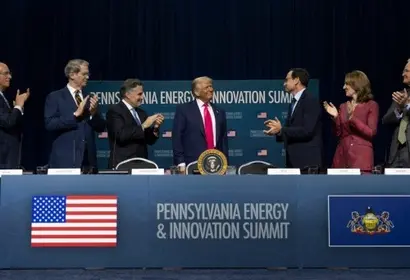
According to a report by Politico on the 9th (local time), the Trump administration has decided to require Big Tech firms to participate in a new agreement that regulates the expansion of AI data centers. The draft agreement obtained by 'Politico' includes provisions to ensure that energy-intensive data centers do not lead to higher residential electricity rates, increased water supply burdens, or compromised power grid stability. It also includes requirements for Big Tech companies to shoulder the costs of building new infrastructure.
While it is not yet known which companies will participate in this agreement, once finalized, major AI firms such as OpenAI, Microsoft (MS), Google, Amazon, and Meta are expected to be required to adhere to broad principles regarding energy, water, and local communities.
As early as January, President Trump emphasized on social media, "I do not want Americans to pay more for electricity because of data centers," adding, "Big Tech firms building data centers must bear the costs themselves." Subsequently, he pressured Big Tech companies to participate in emergency wholesale power auctions held by PJM, the largest power grid operator in the U.S., to cover the costs of building power infrastructure.
Ultimately, Microsoft declared that it would absorb higher electricity rates to operate its data centers in a community-friendly manner. Amazon also stated it would invest in power grid infrastructure to mitigate consumer rate hikes.
The U.S. Republican Party is also showing moves to hold Big Tech accountable for rising electricity bills. According to an 'Axios' report on February 5, U.S. Republican Senator Josh Hawley plans to introduce the 'Guaranteeing Rate Insulation from Data Centers Act.' The core of this bill is to ensure that consumer utility bills do not rise due to data centers. It is expected to include provisions granting priority access to the power grid for consumers and mandating that new data centers use their own power sources separate from the grid.
Such measures stem from the fact that electricity prices have risen due to the explosion of AI data centers. According to data from the Energy Information Administration (EIA), an agency under the U.S. Department of Energy, residential electricity prices have risen by 12.7% since January 2025, when President Trump returned to the White House. Concerns have also been consistently raised that the massive electricity consumption of data centers could drive prices even higher. For the U.S. administration, which has fully supported data center development, this inevitably becomes a political burden. 'Politico' analyzed that Trump’s latest agreement is an attempt aimed at the midterm elections.
The surge in electricity demand caused by data centers is expected to accelerate further. The International Energy Agency's (IEA) 'Electricity 2026' report predicted that approximately 50% of the growth in U.S. electricity demand over the next 10 years would come from data centers. U.S. power demand is expected to increase by more than 420 TWh (terawatt-hours) from 2025 to 2030, with data centers accounting for about half of that. Data centers are one of the primary reasons why the U.S. total electricity demand growth rate is projected to average 2% annually from 2026 to 2030. This is double the growth rate from 2016 to 2025.
In response to the Trump administration’s actions, companies are focusing heavily on building their own power grids. Companies benefiting from this have also emerged. Bloom Energy, a distributed power company based on solid oxide fuel cells (SOFC), provides power sources that directly supply electricity on-site via SOFCs using natural gas at data centers. Over the past year, Bloom Energy's stock price has soared by more than 400%.
The U.S. policy of having companies share the burden of electricity price hikes caused by data centers carries significant implications for South Korea as well. Of course, the electricity pricing systems in South Korea and the U.S. are different. South Korea is slower to reflect market factors, and with sufficient reserve power currently available, the impact of data centers is expected to be minimal in the short term. However, in the long term, if large-scale data centers continue to be built and facilities become concentrated in the metropolitan area, it could lead to strain on the power grid and a sharp increase in transmission and distribution costs.
Kang Min-young, a researcher at the Institute for Climate Transition, noted, "Companies that build and operate data centers need to transparently disclose the impact of their business on the climate and environment, and increase the use of PPAs (Power Purchase Agreements) or their own renewable energy facilities. The government should guide and support the decentralized construction of data centers in regions rich in renewable energy."
The government maintains the position that it needs to monitor the demand for hyperscale data centers. An official from the Ministry of Climate, Energy and Environment stated, "We are calculating data center demand in the 12th Basic Plan for Electricity Supply and Demand," adding, "Once hyperscale-level demand emerges, policies concerning grid strain and regional distribution will likely become more visible."