

[비즈한국] Kakao Pay377300 achieved a meaningful breakthrough in profitability by posting its first-ever annual profit last year. However, on the very day of its earnings release, the company was hit with a penalty of approximately 13 billion KRW and an institutional warning, adding a burden to its future path. In particular, as an institutional warning can influence the financial authorities' approval processes for new business licenses, concerns have been raised that it could act as a variable in the company's pursuit of new ventures.

Breaking the 'Perpetual Loss' Stigma with First Annual Profit
According to the 2025 financial results disclosed by Kakao Pay on the 6th, the company's annual revenue last year grew by 25% year-on-year to 958.4 billion KRW. It recorded an operating profit of 50.4 billion KRW, achieving its first annual profit in history. The diversification of the business portfolio is cited as the background for this performance improvement. The profit structure, which had been centered on payment services, has been distributed across the financial and platform sectors. In particular, financial service revenue surged by 59% year-on-year, accounting for 40% of total revenue and emerging as a core growth engine.
Subsidiaries that had been weighing down consolidated performance due to heavy initial investment burdens have also established stable profit structures, contributing to the improvement. Kakao Pay Securities capitalized on the recovery trend in the stock market, recording a record-high trading volume of 45 trillion KRW, a 159% increase year-on-year. Consequently, its revenue reached 242 billion KRW and operating profit 42.7 billion KRW last year. Kakao Pay Insurance also continued its growth trend, fueled by a diversified product portfolio and expanded sales channels. Its direct premiums written in the fourth quarter recorded 19.6 billion KRW, an 87% increase compared to the same period last year.
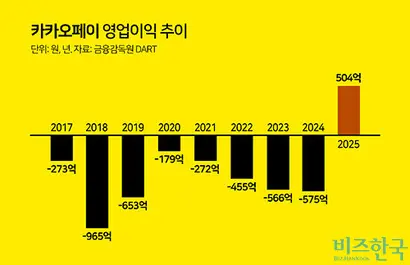
Since its launch in 2017, Kakao Pay had been a 'perpetual loss' company that never turned an annual profit. Following an operating loss of 27.3 billion KRW in its first year, it posted deficits of 96.5 billion KRW in 2018, 65.3 billion KRW in 2019, and 17.9 billion KRW in 2020. Even after its IPO in 2021, it continued to post an operating loss of 27.2 billion KRW, and with the added burden of subsidiary investments, losses deepened to 45.5 billion KRW in 2022, 56.6 billion KRW in 2023, and 57.5 billion KRW in 2024.
However, the trend changed last year. After succeeding in turning a profit in the first quarter of 2025 with 4.4 billion KRW in operating profit, the scale of improvement grew to 9.3 billion KRW in the second quarter and 15.8 billion KRW in the third. In the fourth quarter, it recorded 20.8 billion KRW, surpassing the 20 billion KRW mark for the first time on a quarterly basis.
Kakao Pay explained, "We have established a turn-around trend by balancing growth and internal stability. We are strengthening the profit base of our payment business and continuing to grow externally across all business sectors, including our financial subsidiaries."

Challenging the Personal Information Protection Commission's Decision via Administrative Litigation
While the hurdle of profitability has been cleared, Kakao Pay faces another challenge in the form of judicial risks. On the 6th, the day of its earnings release, the Financial Supervisory Service (FSS) imposed a severe sanction on Kakao Pay, issuing an institutional warning and a penalty of approximately 13 billion KRW. Two executives received sanctions equivalent to a warning and a cautionary warning, respectively, while three employees were subject to salary reduction and reprimand. The FSS recommended a penalty of approximately 15 billion KRW to the Financial Services Commission through its Sanctions Review Committee in April 2025. The final level of the penalty was determined after approximately 10 months of deliberation.
This action stems from the confirmed fact that personal credit information was provided to third parties without customer consent. According to the FSS investigation, Kakao Pay provided approximately 54.2 billion records (cumulative 40.45 million individuals) of personal credit information to Alipay without customer consent between August 27, 2018, and May 21, 2024. The transferred information was found to include not only encrypted customer identification information but also sensitive data such as phone numbers, email addresses, and payment history.
A notable aspect of this sanction is the institutional warning. An institutional warning is considered a relatively high level of severe sanction among the steps taken against financial institutions. According to relevant regulations, a financial institution that receives an institutional warning cannot enter into new businesses requiring licenses from financial authorities for one year from the date the disposition is finalized. Furthermore, it can serve as a disqualification factor in major shareholder eligibility reviews, potentially limiting the company's ability to acquire other financial institutions or engage in equity investments.
Kakao Pay has recently been expanding into financial areas such as loans, insurance, and investments. This year, the company revealed its plans to take a proactive stance on next-generation financial sectors, including stablecoins, blockchain, and security token offerings (STO). Shin Won-keun, CEO of Kakao Pay, stated during the earnings conference call on the 6th, "We believe that opportunities linked to the stablecoin business, currently undergoing legislation, as well as blockchain and STO, will become important new business areas for Kakao Pay, and we intend to prepare for them steadily."
The stablecoins and STOs emphasized by CEO Shin all premise on strict licensing or registration procedures according to the guidelines of financial authorities. While it is a time to accelerate the preemption of the next-generation financial market based on the first-ever annual profit, concerns are being raised that this institutional warning could create variables in the process of pursuing these new businesses.
Industry insiders believe it is highly likely that Kakao Pay will pursue legal action against the FSS sanctions. There is speculation that the company will not easily accept the penalty, given that the institutional warning could act as a burden on its future business strategy. In fact, regarding the personal information provision behavior that served as the basis for this FSS sanction, the Personal Information Protection Commission had previously imposed a fine of 5.968 billion KRW for violations of the Personal Information Protection Act. At the time, Kakao Pay filed an administrative lawsuit challenging the decision, and the trial is currently ongoing.
A Kakao Pay representative stated, "Kakao Pay fully clarified that the information was transferred according to lawful procedures to prevent fraudulent transactions, but we are disappointed that the authorities had a different legal interpretation. We will carefully review the reasons for the financial authorities' decision and determine our future response measures."