

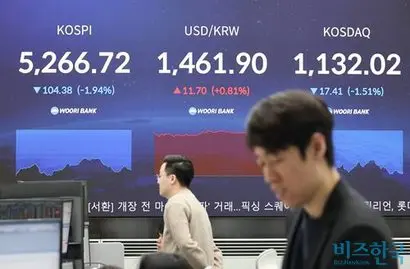
[비즈한국] Despite a lukewarm performance during the broader stock market boom, the KOSDAQ has finally rebounded, recently surpassing the 1,100-point mark. Financial authorities previously implemented the 'KOSDAQ Market Trust + Innovation Enhancement Plan,' which significantly tightened delisting criteria with the goal of qualitative improvement in the KOSDAQ market. While government efforts have raised expectations for resolving the 'KOSDAQ discount,' investors are advised to exercise caution as losses are anticipated during the process of weeding out insolvent companies.
With structural reforms of the KOSDAQ market currently underway, the status of delistings is drawing attention. According to Korea Exchange disclosures, between January 1, 2026, and February 10, 2026, 13 companies (including SPACs) were slated for delisting from the KOSDAQ market. In the same period in previous years, the number of delisted companies was 2 in 2022, 1 in 2023, 8 in 2024, and 4 in 2025.
Excluding SPACs from the 13 companies, six firms were exited: KH Mirae Mulsan, Jangwon Tech174880, KH Construction226360, Pureun Sonamu, Intromedic150840, and PharmAbcine208340. The most frequent reason for delisting was failure to meet audit opinion requirements (KH Mirae Mulsan, Jangwon Tech, KH Construction, and Pureun Sonamu). Other reasons included issues with corporate continuity and management transparency (Intromedic and PharmAbcine). These companies had triggers for delisting that emerged two to three years ago.
An examination of the reasons for delisting for KOSDAQ-listed companies (excluding SPACs) in 2025 shows that the largest number of exits (14 companies) were due to 'issues with corporate continuity and management transparency,' which indicate deficits or problems with internal controls and governance. This was followed by failure to meet audit opinion requirements (5 companies) and voluntary delisting applications (2 companies). Other reasons included failure to submit business reports (1 company), absorption-merger (1 company), and becoming a wholly-owned subsidiary of another entity (1 company).
Financial authorities announced a plan in December 2025 to improve the KOSDAQ market. The plan is divided into four main areas: strengthening the independence, autonomy, and competitiveness of the KOSDAQ division; redesigning listing reviews and delisting processes to address the 'high-birth, high-death' structure; creating conditions for stable institutional investor entry; and enhancing investor protection to foster a trustworthy market.
The 'high-birth, high-death' structure refers to the principle of facilitating the listing of innovative technology firms while swiftly exiting insolvent ones. Authorities explained the purpose of the reform, stating, "While the KOSDAQ market has grown in size, such as the number of listed companies and market capitalization, it has failed to fully recover the trust lost since the IT bubble burst. Problems like delayed exits of insolvent firms and avoidance by institutional investors have emerged."
Consequently, delisting has become easier for firms listed under the special technology track. While these firms are granted a five-year exemption period from delisting, they become subject to delisting if they engage in a business entirely different from the technology recognized at the time of listing during this period. The rationale is that the company's technical prowess and growth potential can no longer be justified. The Exchange has also increased the number of review staff in the KOSDAQ division to streamline the delisting process.
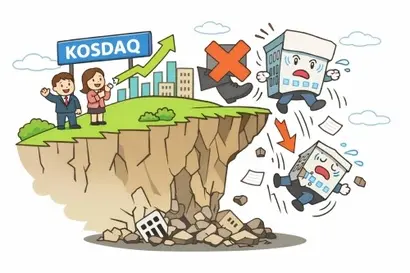
Previously, in January 2025, authorities also tightened delisting criteria through the 'IPO and Delisting System Improvement Plan,' which included raising market capitalization and sales requirements, shortening improvement periods, and strengthening audit opinion requirements. As a result, starting this year, companies on the KOSDAQ market with a market cap of less than 15 billion won, or sales of less than 3 billion won (for those with a market cap of 60 billion won or less), are subject to delisting. The criteria will be raised incrementally: to less than 20 billion won market cap or 5 billion won in sales by 2027; 30 billion won market cap or 7.5 billion won in sales by 2028; and 10 billion won in sales by 2029.
The requirements for 'failure to meet audit opinions,' which accounts for the largest portion of delisting reasons, have also been tightened. Audit opinions are categorized as unqualified, qualified, adverse, and disclaimer; qualified, adverse, and disclaimer are considered 'failure to meet requirements.' Companies receiving such opinions for two consecutive years are immediately delisted. Following these tightened requirements, the number of companies delisted in 2025 increased 2.5-fold compared to the three-year average (2022-2024). According to the Exchange, the number of delisted companies was 16 in 2022, 8 in 2023, 20 in 2024, and rose to 38 in 2025.
Expectations are rising that the KOSDAQ market environment will improve as the government weeds out insolvent companies. Baek Jun-ki, an analyst at NH Investment & Securities, noted, "Strengthening delistings of insolvent firms, along with commercial law amendments and the passage of bills related to public tender offers, will act as factors to resolve the KOSDAQ discount. If the KOSDAQ improvement plan creates entry conditions for institutional investors, we can expect significant corporate value enhancement for companies with strong earnings potential."
Meanwhile, existing investors are expected to face unavoidable losses during the delisting process of insolvent firms. The stock prices of KH Construction, KH Mirae Mulsan, PharmAbcine, Intromedic, and Pureun Sonamu, which were delisted in January this year, plummeted by more than 90% on the first day of clearing trades, eventually falling by up to 99%. Even if traded in the non-listed market, they are essentially worthless.
As March approaches—the settlement period for the 2025 fiscal year—further damages are anticipated. On February 9, the Korea Exchange advised, "Important disclosures or significant measures such as delistings are often accompanied by the settlement period, which can lead to unexpected losses. Please exercise caution when investing in companies with insufficient management stability or poor financial standing."