

[비즈한국] In situations where hundreds of thousands of people gather, such as the Seoul Fireworks Festival, traffic often concentrates on specific base stations, frequently causing communication delays. In the past, skilled engineers had to change base station settings in real-time to respond, but now, AI agents monitor multiple base stations simultaneously and automatically control overloads to prevent quality degradation. According to LG Uplus032640, this method was already applied to the commercial network during last year's Seoul Fireworks Festival.
There are also situations where there is no alarm for equipment failure, yet customers experience dropped calls or pixelated IPTV screens. These so-called 'hidden quality issues,' which were not caught by existing systems and led to customer complaints, have now become a domain for AI. The system learns from approximately 900 types of data to detect minute signs of abnormality, analyze the exact cause, and resolve the issue.
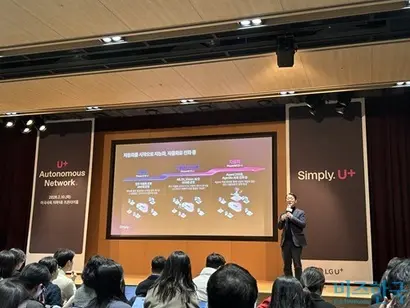
LG Uplus is moving forward with an 'Autonomous Network' strategy, where AI detects, analyzes, and responds to failures across its entire communication network. The goal is to overcome the limitations of existing human-dependent operation methods and build a 'no-downtime, no-inconvenience' network that resolves issues before customers even feel them. The company expects this will enable faster response times to failures, improve customer-perceived quality, and enhance operational efficiency.
The Era of 40 Billion IoT Devices in 4 Years: "Human-Centered Operation Has Limitations"
On this day, LG Uplus held a press conference at LG Science Park in Gangseo-gu, Seoul, to unveil the concept of its autonomous network, application cases in commercial networks, and future plans. The autonomous network proposed by LG Uplus refers to a stage where AI independently analyzes situations, makes decisions, and performs actions.
Explaining the background, Kwon Jun-hyeok, Head of the Network Division at LG Uplus, said, "In the near future, by 2030, 40 billion devices are expected to be connected to IoT (Internet of Things) networks. The limitations of human-centered operation are clear," adding, "IoT and machine devices have no room to 'tolerate inconvenience.' A no-downtime, no-inconvenience network is an essential requirement."
To achieve this, LG Uplus has introduced 'AION,' the core platform for autonomous operations, into its commercial network. This is the result of an evolution that began with simple Robotic Process Automation (RPA) in 2018, moved through intelligence in 2021, and reached the current agent-based autonomous stage. AION is a network operation platform that combines digital twins with AI analysis to handle failure response, quality management, and traffic control. According to the company, since the introduction of AION, quality-related complaints from mobile customers have decreased by 70%, and from home customers by 56%.
Park Seong-woo, Head of the Network AX Group at LG Uplus, stated, "Previously, humans performed the perception, analysis, judgment, and action phases, but in an autonomous network, the AI agent performs these processes while humans take on a supervisory role." It is a structure where humans provide only the 'intent' and the agent handles the execution. Currently, about 210 AI agents are in operation, and the company plans to gradually expand the scope of application.
Autonomous 'Central Offices': "Stability Before Level Numbers"
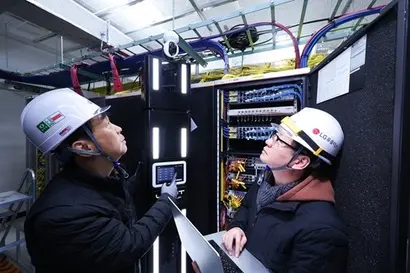
The management of 'central offices' (hubs for telecommunication equipment), which are physical communication infrastructures, was also presented as a core part of the autonomous strategy. LG Uplus operates about 5,000 central offices nationwide, many of which are unmanned. As these offices house the foundational equipment for mobile communication, high-speed internet, and IPTV services, stable management is paramount, as even a minor issue can lead to large-scale failures.
LG Uplus has built a 'Digital Twin' that reproduces the actual environment of these central offices in a virtual space. The digital twin reflects internal layouts, equipment placement, and environmental information such as power, temperature, and humidity in real-time, enabling remote situational awareness at the same level as being on-site. In the event of a failure, the company explains that it can immediately identify the state of the central office and the location of the equipment, thereby reducing response time.
Inside the central offices, the autonomous robot 'U-BOT' performs actual inspection tasks. The robot moves throughout the facility to collect equipment status and environmental data, and this information is linked to the digital twin and AI analysis systems to be reflected in operations.
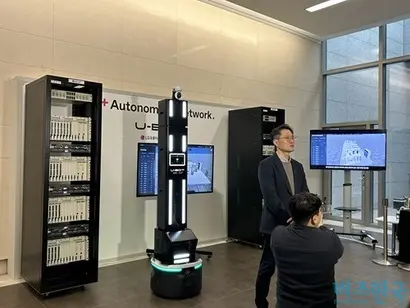
Park Seong-woo, Head of the Network AX Group at LG Uplus, stated, "We can immediately check the location of faulty equipment and environmental information in a 3D digital twin environment identical to the actual central office, and robots collect data while moving to reflect it in operations." However, he also made it clear that "humanoids or action robots are an area that can only be considered after stability is secured." He added that proof-of-concept testing is currently underway in some central offices, and the scope of application will be expanded gradually once stability is confirmed.
Kwon Jun-hyeok, Head of the Network Division at LG Uplus, emphasized, "U-BOT and digital twins are not 'just for the sake of using robots,' but are a means to identify the situation in unmanned central offices remotely and as accurately as possible."
The technology base leverages LG Group's internal technical capabilities. LG AI Research's large language model 'EXAONE' was applied, and the hardware was developed in cooperation with Bear Robotics. Group Head Park said, "In AI-related areas, we are also seeking cooperation with domestic software companies and solution partners."
LG Uplus intends to advance its autonomous network in stages, prioritizing the stability of its commercial network over completing it in a short period. Division Head Kwon noted, "We are implementing autonomy based on over 7 years of actual operating experience, not just textbook concepts," adding, "Stability is more important than the level number itself, and we will approach commercial network application very conservatively."
He clearly drew a line against concerns about workforce restructuring due to AI introduction. Division Head Kwon explained, "We are not considering personnel reallocation or reduction at all. Employees with the most on-site experience are directly participating in agent development, and the goal is to transition roles so that humans can focus on more valuable work."
Regarding questions about competitors' capabilities, he cited global certifications as evidence. Lee Sang-heon, in charge of Network Advanced Development at LG Uplus, stated, "It is difficult to accurately grasp the situation of competitors," but added, "As of now, (LG Uplus) is the only one in Korea that has received and is undergoing evaluation by TM Forum (a global telecommunications industry association)."