

[비즈한국] Smooth, smooth. Bumpy, bumpy. Uneven, uneven. The phrases Kany repeated while studying for a Korean language exam lingered in people's ears for a while. His unique sense of rhythm probably played a part. But as soon as I heard his lyrics, something unexpected came to mind: the Cosmic Microwave Background (CMB). Kany's song captures the essence of the CMB to a surprising degree.
The cosmic microwave background is smooth, flat, and uneven.
The CMB is the most powerful evidence for the Big Bang theory. According to the Big Bang theory, the universe was initially concentrated at a much higher density than it is today. Consequently, it was much hotter. However, as the universe suddenly began to expand, its heat spread evenly and cooled. The current universe has cooled to a very low temperature, just 2.7 degrees above absolute zero. The CMB is the remnant of that heat, which was distributed evenly and cooled down as the universe expanded after the Big Bang.
In 1964, physicists Penzias and Wilson detected inexplicable noise using a horn-shaped antenna at Bell Labs. Though very weak, the noise was detected uniformly from every direction in the sky. While they were initially unaware of its origin, they eventually realized the signal was not from Earth but from the universe itself. The CMB initially detected by Penzias and Wilson is very smooth. It shows that the entire universe has cooled evenly to a perfectly uniform temperature. This smoothness demonstrates that the universe has indeed expanded in a perfectly uniform and isotropic manner, just as the Big Bang theory predicts.
Furthermore, the degree to which the current universe has cooled reveals how rapidly it has expanded over time. The fate of the universe is determined by the gravity exerted by the matter within it and the amount of dark energy pushing it to expand further. The universe has no boundary and no fixed size, so the matter and energy of the universe are expressed in terms of density. If the density of the universe were too high, gravity would be overwhelming, and the universe would collapse. If the density were too sparse, the universe would have dissipated long ago with uncontrollable expansion.
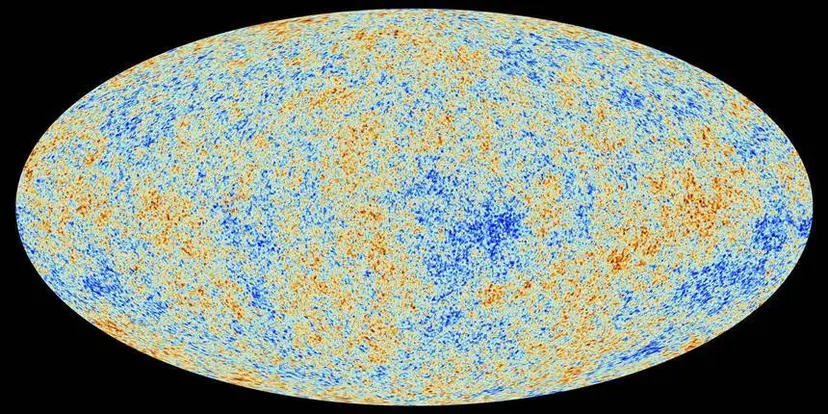
CMB observations reveal that the universe is an incredibly precise world. It is filled with just enough matter and energy to reach the critical density—neither too much nor too little. Ordinary matter and dark matter account for 30% of this total critical density, with dark energy accounting for the remaining 70%, summing up perfectly to reach the critical density. This implies that the spacetime of the universe is perfectly flat. The universe's spacetime is flat—in other words, it has no curvature. This means that light in the universe always travels in a straight line without bending. The CMB shows that the universe is not only smooth but also flat.
But that is not all. Since the first observations by Penzias and Wilson, astronomers now observe the CMB with more sensitive space telescopes. They have mapped the distribution of the universe's remnant heat much more cleanly, without interference from Earth's radio waves. Looking at the most recent map drawn by the Planck satellite, the CMB no longer looks entirely smooth. It reveals a grainy and uneven appearance. The map uses red and blue to represent temperatures that are just one hundred-thousandth of a degree higher or lower than the average. In other words, while the CMB appears smooth from a macro perspective, it reveals striking, uneven differences when looked at with sensitive detail.
These uneven temperature differences represent differences in the density of the early universe. By chance, some areas were slightly denser or less dense than their surroundings. These small density differences created slight variations in gravity. Matter gradually gathered in the higher-density regions, eventually creating stronger gravity and attracting even more matter. This is how galaxies and galaxy clusters were born. The uneven temperature fluctuations—the density fluctuations—confirmed by the CMB in more sensitive telescopes, served as the seeds for the galaxies that formed the large-scale structure of the universe today.
Thus, the three expressions Kany sang—smooth, flat, and uneven—precisely match the characteristics of the universe as described by the CMB. From an astronomer's perspective, Kany inadvertently sang about the most perfect cosmic evolution. The CMB now perfectly explains and proves our Big Bang theory. However, a famous mystery remains unsolved.
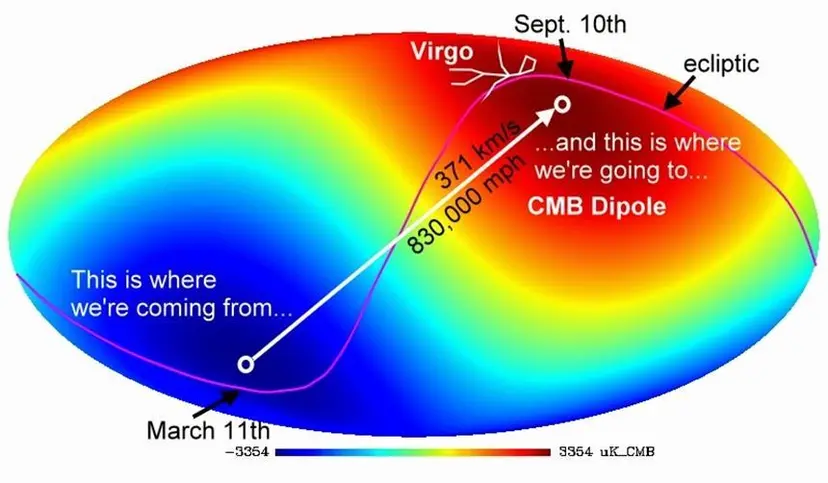
The CMB is, ultimately, a map of radio waves and light pouring in from all directions. However, there is a significant issue when observing this light: the observer's own movement influences the observation. Light from the direction we are moving toward undergoes a Doppler effect, where the wavelength shortens (blueshift), while light from the direction we are moving away from undergoes a Doppler effect, where the wavelength lengthens (redshift).
The Earth orbits the Sun, and the Sun orbits the galaxy. Our galaxy is also moving rapidly through space along with other neighboring galaxies. Consequently, we are not stationary observers in the universe. Therefore, while we observe the CMB, we are moving toward one half of the sky, and the other half is receding behind us. Half experiences blueshift, and the other half experiences redshift. This is exactly reflected when observing the actual CMB. As seen on the map, half appears red and half blue. This is called the dipole of the CMB.
Some people say this looks like the Taegeuk symbol, but it has nothing to do with it. It simply shows that half the universe appears hotter than the average, while the other half appears colder. Because we are trying to map a three-dimensional spherical universe onto a flat surface, it becomes distorted into an ellipse. Additionally, the direction in which the Earth is moving relative to the CMB is significantly tilted relative to the Milky Way disk. Since this diagram represents the Milky Way along the x-axis, the directions of the hotter and colder parts of the universe appear slightly rotated, making it look like the Taegeuk symbol.
Regardless, through observations of the CMB experiencing blueshift and redshift in halves, we realized that the Earth we inhabit is moving at a high speed of 360 km/s relative to the CMB. This is due to our own motion. Therefore, if we measured this using distant background galaxies, which we can consider almost stationary from our perspective, we should get a similar value. We naturally assumed this would be the case.
However, recent observations show unexpected results. If we are moving rapidly through space, we should be able to see a larger number of galaxies in the direction we are heading. This is because light becomes brighter in that direction due to the Doppler effect, combined with a 'light aberration' effect that makes light appear to bend toward the direction of travel. In this study, astronomers used the LOFAR radio telescope, which observes low-frequency radio waves, to observe the flashes of radio galaxies like quasars at the far edge of the universe and analyzed their distribution statistically.
The result was surprising: a dipole over three times stronger than what was inferred from the existing CMB was revealed. In other words, we are racing through space at nearly three times the speed we originally expected. There are only two ways to explain this confounding result: either the quasars at the edge of the universe are not distributed uniformly, as we expected, but have an anisotropy where they are clustered in one direction, or the fundamental physical laws regarding the formation of the universe's large-scale structure may need to be completely revised. Either way, both interpretations defy our expectations.
Reference
https://journals.aps.org/prl/abstract/10.1103/6z32-3zf4
About the author, Ji Ung-bae: He loves cats and the universe. After watching 'Galaxy Express 999' as a child, he dreamed of sharing the beauty of the universe. Currently an assistant professor in the Faculty of Liberal Arts at Sejong University, he engages in various science communication activities, including lectures and writing. He has written books such as 'A Piece of the Universe Every Day,' 'Scientists of the Starry Universe,' 'Knowable Even if Unreachable,' and 'Strange Questions That Come to Mind When Looking at the Universe,' and translated books such as 'The Hitchhiker's Guide to the Real Universe,' 'How I Killed Pluto,' 'Quantum Life,' and 'Cosmigraphics.'