

[비즈한국] As the focal point of the global electric vehicle (EV) market shifts from high-end to mass-market models, the rankings of manufacturers are undergoing significant changes. According to year-end results, Hyundai Motor005380 Group maintained steady growth in non-Chinese markets but slipped to 4th place, losing the 3rd spot to China’s BYD, which leveraged its price competitiveness.
Expanding Non-Chinese Market Share with Mass-Market Models
According to SNE Research, an energy-specialized market research firm, a total of 7.662 million electric vehicles were registered in the global market excluding China in 2025, a 26.6% increase compared to the previous year. Volkswagen took the No. 1 spot with 1.266 million units, surpassing Tesla, while Tesla remained at 2nd place with 1.01 million units, a 10.7% decrease from the previous year.
A notable change occurred in the top-tier rankings. BYD sold 627,000 units in markets outside of China, a 141.8% surge from the previous year, boosting its market share to 8.2%. In contrast, Hyundai Motor Group sold 609,000 units, growing 11.8% from the previous year, but its market share dropped to 7.9%. This was the first time the group was overtaken by BYD in annual sales volume. BYD’s growth is attributed to the diversification of its product lineup, which centers on commercial and small vehicles. This is because mass-market EVs are gaining attention as the EV market experiences a "chasm," or a period of stagnant demand.
Hyundai Motor Group also saw its performance driven mainly by mass-market models. SNE Research explained that specifically, the Ioniq 5 and EV3 led the performance, while small and strategic models like the Inster (domestic name: Casper) EV and EV5 have successfully established themselves in the global market.
On the other hand, flagship models such as the EV6, EV9, and Kona Electric saw sluggish sales and could not maintain the growth trends of the past. In the North American market, the group maintained 3rd place behind Tesla and GM with sales of approximately 166,000 units, but a decline in price competitiveness appears inevitable if future tariff hikes become a reality. Hyundai Motor Group plans to compensate for this through the operation of its production base in Georgia, USA, the Hyundai Motor Group Metaplant America (HMGMA).
Targeting Korea, the 'Home Ground of Hyundai,' with the Dolphin
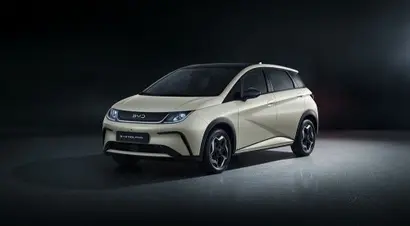
Having expanded its global market share, BYD is now extending its offensive into the Korean market. BYD Korea announced on February 5th that it would unveil the small electric hatchback 'Dolphin' and begin sales on the 11th.
The domestic launch price of the Dolphin starts at 24.5 million KRW before subsidies. Even the Dolphin Active, a high-performance trim, is priced at 29.2 million KRW, well under 30 million KRW, which is expected to trigger price competition in the domestic mass-market EV sector. The Dolphin is expected to compete with Hyundai's Casper Electric and Kia's Ray, which are in a similar price range.
The Dolphin offers a driving range of 354km and is equipped with a Vehicle to Load (V2L) function that converts battery power into standard household electricity, as well as a 10.1-inch touch display compatible with TMAP navigation.
Moving forward, the global EV market is expected to shift from competition based on technological superiority to competition based on cost reduction and supply chain security. SNE Research forecasts that while the EV market will continue to grow at a moderate pace in 2026, volatility by region will increase due to changes in tariffs and subsidies.
In particular, as Chinese companies are increasing overseas production bases and local procurement ratios to mitigate the burden of oversupply, competition for domestic companies to secure their footing is expected to intensify. For automakers like Hyundai Motor Group, the speed of optimizing product mix, pricing strategies, and localizing component supply chains will be the key variables in defending market share.