

[비즈한국] Following U.S. President Donald Trump's decision to play the tariff hike card again, citing legislative delays in the Korean National Assembly, political circles have moved quickly to respond. On the afternoon of the 9th, the National Assembly held a plenary session and passed a resolution to form a 'One-Point Special Committee' dedicated to implementing agreements on investment in the U.S.
This is the National Assembly's official response to heightened trade risks following President Trump's public pressure on January 26 via social media, where he asked, "Why is the Korean National Assembly not approving the agreement?" Analysts suggest that the launch of this special committee carries a defensive nature, aimed not only at refining domestic law but also at preemptively neutralizing the U.S. administration's pretext for tariff retaliation.
Ruling and Opposition Parties Suddenly Launch One-Point Special Committee
As President Trump signaled that he would raise tariffs on Korean automobiles and pharmaceuticals from the current 15% to 25%, targeting the legislative vacuum, political momentum has intensified. The government and the ruling party held an emergency high-level consultation at the Prime Minister's residence in Samcheong-dong, Seoul, on the 8th to finalize a 'legislative blitz' plan to appease the U.S. administration's dissatisfaction.
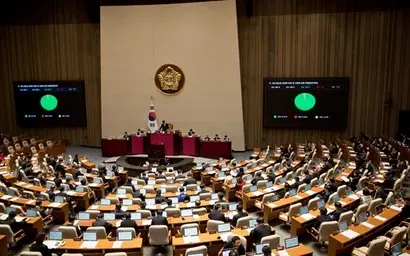
The government shared the understanding that visible action by the National Assembly is the top priority to prevent the U.S. from publishing tariff hikes in the Federal Register, and the opposition party also agreed to the formation of the special committee without preconditions, citing the national interest. The special committee, which passed the plenary session that day, is composed of a total of 16 members: 8 from the Democratic Party of Korea, 7 from the People Power Party, and 1 from a non-negotiating group. The People Power Party will chair the committee. The structure is designed to concentrate discussions that were previously scattered among the National Policy, Strategy and Finance, and Industry committees into the special committee.
The National Assembly has set a deadline to finalize the bill no later than March 9 and has entered a month-long period of intensive deliberation.
The special act currently proposed in the National Assembly is centered on building governance to systematically manage the $350 billion investment in the U.S. agreed upon by both countries. The main points include the establishment of a Korea-U.S. Strategic Investment Corporation, the creation of a strategic investment fund, and setting an annual remittance limit of approximately $20 billion. This serves as a safety net to mitigate the shock that large-scale capital movement could have on the domestic foreign exchange market.
The government plans to enhance the quality of the bill by proactively reviewing provisions for increased transparency, such as stronger reporting requirements to the National Assembly, which the opposition party has demanded. At the same time, the government's stance is to coordinate detailed issues without infringing on corporate autonomy.
Core Task of the Special Committee: Establishing Governance for $350 Billion in U.S. Investments
Behind the $350 billion investment scale promised by our government lies a structural risk involving corporate burdens. While the possibility of domestic shipbuilders expanding local investments in connection with the 'MASGA' project—aimed at rebuilding the U.S. shipbuilding industry—is being discussed, it is by no means an easy task. This is because they must maintain global competitiveness while absorbing high labor and material costs in the U.S.
Another variable is the Alaska gas pipeline construction project. Although the U.S. side has mentioned the possibility of participation in the project in the context of energy cooperation, there are concerns that if long-term investments or purchase commitments are made without sufficient verification of business viability, it could lead to financial burdens for domestic companies and the public sector. Considering the massive initial investment costs and uncertain profit structure, a cautious approach arguing that economic feasibility reviews and risk-sharing structures must be clarified during the special committee's discussions is gaining traction.
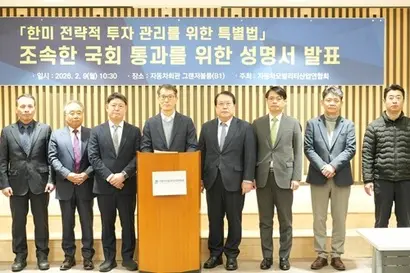
With analysis indicating that a 25% tariff hike could result in additional costs of up to 11 trillion won per year, the automotive industry has entered an emergency state. Industry players and economic organizations are appealing for the resolution of trade risks through prompt legislation, stating that tariff uncertainty is significantly shaking corporate management and investment plans.
The success or failure of this special committee depends on how quickly it can neutralize the pretext for tariff hikes put forward by the Trump administration. There is just over a month left until the legislation is completed. The prevailing analysis is that strategic flexibility is required to parallel National Assembly legislation with behind-the-scenes negotiations with the U.S. side.