

[비즈한국] February 2026 is heating up the global financial markets. Korea's KOSPI is hitting all-time highs day after day, and the U.S. Dow Jones Industrial Average has historicallly surpassed the 50,000-point mark. Stock markets in Japan, India, and Europe are also showing simultaneous, rapid surges, signaling a global stock market decoupling. This bull market is not confined to any specific country or single issue; it is analyzed as the result of three intersecting axes: technological innovation (AI), macroeconomic policy (interest rates), and the mitigation of geopolitical risks (trade agreements).
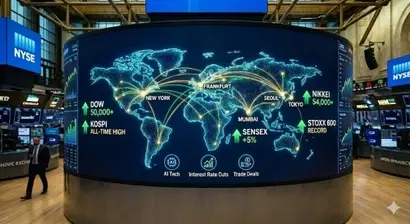
Dow surpasses the 'dream number' of 50,000… driven by AI earnings
The U.S. New York stock market is considered the epicenter of this global relay rally. On the 6th (local time), the Dow Jones Industrial Average broke through the 50,000-point threshold for the first time in history. The S&P 500 and Nasdaq indices are also reaching record highs every day.
The core engine of this rise is the AI (artificial intelligence) industry. Big tech companies, including Nvidia, are releasing earnings that consistently exceed market expectations, dispelling the "AI bubble" theory held by some. AI technology is spreading beyond semiconductors to the broader industry, including software, data centers, and power infrastructure, driving up the stock prices of related companies.
This bull market is highly likely to persist for some time, given that a structure has been established where expectations are translating into actual revenue generation. In particular, the prevailing market view is that there is sufficient room for further gains as the virtuous cycle of big tech companies' capital expenditures (CAPEX) translating into actual sales growth has been proven.
The return of the semiconductor belt… rewriting the history of Korean and Japanese stock markets
The breeze from U.S. tech stocks is also influencing Asian markets, which are key to the semiconductor supply chain. Korea's KOSPI (Korea Composite Stock Price Index) has broken through 5,000 for the first time, setting new records, with possibilities of hitting 6,000 and 7,000 being discussed.
This growth is led by earnings improvements in domestic semiconductor giants such as Samsung Electronics005930 and SK Hynix000660, alongside a heavy influx of foreign buying. As demand for AI-specific semiconductors, such as HBM (High Bandwidth Memory), explodes, the valuation of Korean manufacturing is being reassessed. With analysis suggesting that the semiconductor market has entered an "AI supercycle" beyond historical supply-demand cycles, there is high expectation for the resolution of the chronic undervaluation of the domestic market, known as the "Korea Discount."
The Japanese stock market is also showing a steep upward trend. The Nikkei 225 index surpassed the 54,000 mark on the 3rd, hitting an all-time high. The weak yen has bolstered the performance of export companies, and the Japanese government's corporate value-up program has attracted foreign investors. In particular, Japan's semiconductor materials, components, and equipment companies are assessed as having supported the index's rise as they benefited from the restructuring of the global supply chain.
European participation and rate cut expectations… the prelude to a liquidity rally
European stock markets are also showing strength. This is because the European Central Bank (ECB) preemptively cut interest rates before the U.S. Federal Reserve, supplying liquidity to the market, and the U.S.-led AI rally is spreading to European tech stocks. As energy prices stabilize and inflation is brought under control, the sense of relief that the economy has entered a "Goldilocks" phase—a state where the economy is neither too hot nor too cold—is also contributing to the recovery of investment sentiment.
The Stoxx 600, a pan-European index composed of 600 major blue-chip companies listed across 17 European countries including the UK, France, Germany, and Switzerland, surpassed 611.65 on this day, reaching an all-time high.
The market expects the upward trend in European stocks to continue for the time being. The analysis suggests that global capital inflows are likely to persist as the valuation attractiveness (relative undervaluation) compared to the U.S. S&P 500 becomes more prominent. In particular, the 11 major European blue-chip stocks known as 'GRANOLAS' are maintaining solid earnings growth in the healthcare and AI semiconductor sectors, which is expected to provide a firm floor for the index.
India, where 'policy uncertainty is resolved', surges as trade barriers drop
If the strength of developed market stocks is attributed to the earnings of tech stocks, emerging markets are responding to shifts in trade policy. India's Sensex and Nifty indices rose more than 5% as it concluded trade negotiations with the U.S. earlier this month.
India and the U.S. agreed to lower reciprocal tariff rates to around 18%. The stock prices of major Indian companies that directly benefit from the tariff cuts, such as Tata Motors (automobiles) and Infosys (IT services), surged, pulling up the indices. As tariff uncertainty is resolved, India is emerging as an attractive investment destination, drawing attention as an alternative to the global supply chain. If the "Make in India" manufacturing initiative gains momentum, foreign direct investment is expected to further accelerate.
Experts diagnose that this bull market has entered a stage where it is spreading beyond simple liquidity supply into the real economy. In a report on the 4th, Scott Wren, Senior Global Market Strategist at the Wells Fargo Investment Institute, emphasized, "Capital investment following the construction of artificial intelligence (AI) and broad automation infrastructure will cause profits to flow into other segments of the market, including the industrials and utilities sectors," adding that "such investments will play a key role in economic growth."