

[비즈한국] As real estate prices in Korea have skyrocketed, the home ownership rate for householders aged 39 or younger—those starting their careers, establishing families, and raising children—has fallen to a level barely holding above 10%. Conversely, the home ownership rate for householders aged 60 and older has surpassed 40%, widening the gap.
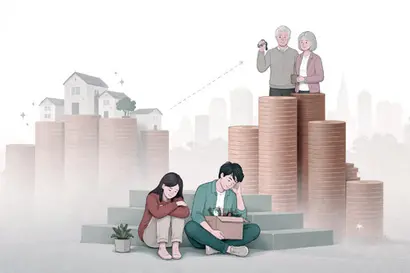
Furthermore, in the case of high-priced homes exceeding 600 million won, nearly half of the owners were aged 60 or older, while the ownership share of householders aged 39 or younger has declined with each passing year. Due to rising real estate prices, it is becoming increasingly difficult for young adults to purchase homes in their preferred residential areas. Consequently, attention is focused on whether the messages from President Lee Jae-myung, who has been launching an offensive to stabilize real estate prices, will prove effective.
Since his New Year's press conference on January 21 and the announcement of housing supply measures for the metropolitan area on the 29th, President Lee has been expressing his will to stabilize real estate prices through social media daily. In particular, on the 3rd, President Lee shared an article on X (formerly Twitter) titled “Conservative and economic media shedding tears for multi-home owners... Is the government’s normalization of real estate the problem?” and stated, “I ask those who are saddened by the tears of multi-home owners seeking unearned income: Do you not see the tears of blood shed by millions of young people who are giving up on marriage and childbirth due to high housing costs?” He added, “They say money is the devil, but surely their conscience hasn’t been taken away by the devil, has it?”
President Lee also emphasized, “For the sake of a sensible and prosperous country, we will stop ruinous real estate speculation by any means necessary,” adding, “There are plenty of policy tools available if one doesn’t calculate immediate personal gains and losses.” The reason President Lee mentions young people as a justification for controlling housing prices is that rising real estate costs place an enormous burden on those just starting out in society. In fact, the share of home ownership among householders aged 39 or younger, which once approached 20%, has fallen to a level barely holding at 10%.
According to the National Data Agency and others, the share of total homeowners held by householders aged 39 or younger was 18.49% in 2012. However, this share has steadily declined, falling below 15% to 14.70% in 2018. The downward trend continued, dropping to 13.89% in 2019, 12.85% in 2021, and 11.86% in 2022. It fell to 11.08% in 2023 and 10.61% in 2024, leaving the 10% mark on the verge of collapse.
While the home ownership share for householders aged 39 or younger plummeted, the share for those aged 60 or older increased rapidly. The share of householders aged 60 and older among total homeowners, which was 27.71% in 2012, surpassed the 30% mark in 2015 at 30.26%. It then broke through 35% to reach 36.40% in 2020, and in 2023, it even crossed the 40% threshold to hit 40.43%. The share of home ownership for householders aged 60 and older continued to rise, reaching 41.65% in 2024.
As the share of home ownership for householders aged 39 or younger has decreased while that for householders aged 60 or older has increased, the gap in home ownership between the two age groups has widened further. In 2012, the home ownership share for householders aged 60 or older was 1.5 times that of those aged 39 or younger, but it became 2.0 times in 2016, climbed to 3.3 times in 2022, and recorded 3.9 times in 2024, widening the disparity. The gap in home ownership has expanded to almost four times the size.
The even greater problem is that the entry point to residential areas preferred by young people is becoming increasingly narrow. In fact, among homes owned by householders aged 39 or younger, the share of high-priced homes exceeding 600 million won has been decreasing recently. Among owners of homes priced over 600 million won, the share held by householders aged 39 or younger was 6.44% in 2016 when the relevant survey began, but it fell to 5.94% in 2023 and 5.73% in 2024. Conversely, the share of home ownership for householders aged 60 and older among those owning homes worth over 600 million won increased from 42.12% in 2016 to 45.41% in 2024.