

[비즈한국] The Lee Jae-myung administration has revealed its intention to expand the scope of its strategy for securing science and technology talent to include the military service system. The plan is to expand alternative service for scientific and technical personnel and introduce a 'National Researcher' system. This is interpreted as a strategic move to prevent the brain drain of domestic talent overseas and to protect the momentum for economic growth by redefining the military as a space where cutting-edge technology is accumulated and utilized.
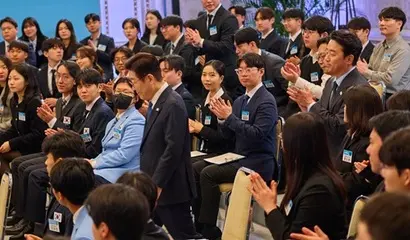
President Lee Jae-myung hinted at the possibility of a comprehensive reform of the military system during the 'Conversation with Future Scientists' event held at the Blue House Guest House on the 5th. President Lee emphasized the need to transition the existing troop-centered military structure toward one focused on technology and expertise, stating, "I will change the system so that military service becomes an opportunity to learn cutting-edge weapon systems and technologies, rather than a time that consumes one's youth."
The explanation is that the expansion of alternative service for scientific and technical talent and the reform of the military system are being reviewed in tandem. This reflects the realization that the structure where male scientific and technical talent—who are obligated to fulfill military service—are forced to leave research fields for a certain period results not only in personal losses but also in national waste.
Along with the expansion of alternative service, the idea of having research units within the military was also presented as a potential solution. Ha Jung-woo, the Presidential Secretary for AI Future Planning, stated, "We are actually in talks with the Military Manpower Administration, and Minister of National Defense An Gyu-back is also forward-looking, so we will organize and announce it separately." Presidential science scholarship recipients and international science olympiad winners attended the event.
President Lee said, "I am thinking of changing the military itself on a large scale," adding, "If the military has been focused on troop numbers and infantry until now, it is now moving entirely toward a competition of equipment and weapons." He continued, "We are reviewing a system reform so that military service becomes a time to master cutting-edge weapon systems, equipment, and technology."
This direction is being materialized through discussions on reforming the 'Specialized Research Personnel' system. In particular, it is reported that plans to expand the allocation of specialized research personnel to major corporate research institutions, with a focus on the artificial intelligence (AI) sector, are under review. This is interpreted as a realistic judgment that there is no luxury to separate high-level personnel from industrial fields amidst the intensifying global technology hegemony race.
In the past, it was possible to serve as specialized research personnel at major corporate research labs, but in 2013, new assignments for major companies were suspended to secure research and development (R&D) personnel for small and medium-sized enterprises (SMEs). Since then, even job transfers from SMEs to large corporations during service have been restricted, making it virtually impossible for someone to serve as a specialized research professional at a large company, except for those in supplementary service.
The operational method of the specialized research personnel system can be adjusted through the Enforcement Decree of the Military Service Act and notices from the Military Manpower Administration, so resuming assignments to major corporate research institutions can be done through administrative authority alone. However, legislative procedures such as amending the Military Service Act are required to expand the target and scope of alternative service or to institutionalize military service exemptions as a pillar of talent policy. As policy adjustments that the government can implement immediately are separated from long-term institutional reforms, the debate surrounding the balance between military service equity and industrial competitiveness is expected to intensify in future discussions.
This policy direction is part of the government's 'AI Top 3 Power (G3)' strategy. Recently, AI education policy has also emerged as a major issue. On the same day, the National Artificial Intelligence Strategy Committee and the National Education Commission announced their cooperation to build a mid-to-long-term talent cultivation system suitable for the era of AI transformation. The vision is to go beyond simple coding education or short-term technical acquisition and foster talent by linking educational policy with AI strategy at the national level.
Previously, the government has been pushing for: △Expanding AI computing infrastructure including the early acquisition of 50,000 GPUs, △Support for the development of proprietary AI foundation models, △Securing super-gap AI leading technologies and talent to reach the top 5 in global AI talent capability, and △Social innovation in areas like healthcare, education, and finance based on AI technology.
Support for those engaged in scientific and technical research is also expected to expand. President Lee mentioned the 'National Scholarship System' and said, "In the future, we will even introduce a 'National Researcher' system to pave the way for people to live proudly and honorably while engaging in science and technology research throughout their lives." The National Researcher system is a policy where the government manages researchers as assets. The government plans to select 20 researchers with world-class research achievements each year for 5 years, totaling 100 people, and provide them with an annual research support fund of 100 million won.
Comments were also made keeping in mind the controversy over R&D budget cuts that arose during the previous administration. Emphasizing the consistency and continuity of science and technology policy, President Lee stated, "We will ensure that the research environment is not swayed by changes in budget or the administration."
The creation of a culture that tolerates research failure was also mentioned again. President Lee said, "We are also pushing for the 'capitalization of failure' as a key task," and added, "I will steer the overall R&D policy differently so that it doesn't end with just talk."