

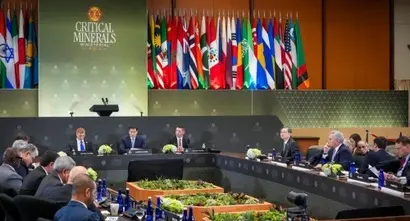
[비즈한국] U.S. President Donald Trump has formalized 'Project Vault,' a national stockpiling system, to secure a stable supply of critical minerals. He is also accelerating efforts to strengthen supply chain security by reorganizing related multilateral cooperation frameworks. Minister of Foreign Affairs Cho Hyun attended the Ministerial Meeting on Critical Minerals held in Washington, D.C., where he held back-to-back meetings with U.S. heads of energy and trade to discuss measures for supply chain stability.
The U.S. administration announced on February 2 (local time) the launch of Project Vault, a $12 billion strategic stockpiling plan for critical minerals. This project operates as a public-private partnership model, combining $10 billion in direct loans from the Export-Import Bank of the United States (EXIM) with approximately $2 billion in private capital. This marks the largest single loan approval in the 92-year history of the EXIM Bank.
The primary purpose of Project Vault is to reduce resource dependence on specific countries like China and to protect U.S. private manufacturers from supply chain shocks. Unlike existing defense-related stockpiles, it is characterized by a demand-driven structure where major original technology manufacturers—such as GM, Google, Stellantis, and Boeing—participate to identify necessary minerals and request their stockpiling. Through this, the U.S. administration aims to act as a 'market stabilizer' to stabilize critical mineral market prices and mitigate private investment risks.
These actions by the U.S. administration signal a shift in the critical minerals market from a conventional spot-trading focus to a policy-based, stable supply system. Project Vault is expected to provide stable demand signals to participating companies and serve as a hedge against downward price risks. Furthermore, U.S. Secretary of the Interior Doug Burgum announced that he would sign up to 11 bilateral agreements on critical minerals this week, accelerating the drive to secure critical mineral resources.
Meanwhile, at the Ministerial Meeting on Critical Minerals held in Washington, D.C., on February 4, the existing Minerals Security Partnership (MSP) was expanded and relaunched as the 'Forum on Resource Geostrategic Engagement (FORGE).' The meeting saw the participation of 56 countries across the entire supply chain, including G7 nations. Key members of the administration, including Vice President J.D. Vance, Secretary of State Marco Rubio, and Secretary of Energy Chris Wright, attended in large numbers, demonstrating their policy commitment.
South Korea will serve as the chair of FORGE until this coming June, taking on a leading role in the international supply chain restructuring process. Welcoming the launch of FORGE, Minister Cho Hyun presented future development directions for the forum, including: strengthening diplomatic coordination and cooperation among member states; promoting communication among stakeholders across the full critical mineral lifecycle; and reinforcing its role as a platform to facilitate cooperation in critical mineral recycling. The South Korean government plans to use this to actively promote the stability and diversification of global critical mineral supply chains.