

[비즈한국] Samsung Electronics005930 is on the verge of seeing the birth of a 'majority union'—a union with more than half of the company's total workforce as members—for the first time since its founding. This comes six years after Samsung Electronics Chairman Lee Jae-yong declared the abandonment of a 'no-union management' policy in 2020. In particular, as this year's wage and collective bargaining negotiations have faced difficulties due to an inability to narrow the gap regarding performance bonus calculation methods and wage increase rates, the possibility of a labor dispute has begun to be discussed. It is assessed that the labor-management relationship at Samsung Electronics, which has continued with individual negotiations under a multiple-union system, has reached a critical turning point.

Performance Bonus Clash Continues in 8th Main Negotiation… Possibility of Labor Dispute Mentioned for the First Time
It is said that conflict over the wage structure, including the performance bonus system, played a decisive role in the emergence of Samsung Electronics' first 'majority union'. The 2026 wage and collective bargaining negotiations between Samsung Electronics' labor and management, which began last December, failed to reach an agreement even in the 8th main negotiation held on the 3rd. The company proposed an average total increase of 5.1%, including a 3.0% base-up, considering company-wide management conditions such as the deteriorating performance of the Device Experience (DX) division. However, the union countered by demanding a minimum of 7.0% for the base-up, citing the low proportion of fixed pay. In particular, negotiations are at a standstill as differences over the performance bonus calculation method remain unresolved.
According to the meeting minutes, the union demanded, "The performance bonus criteria should be simplified to '20% of operating profit' and the cap should be abolished." They argued that the EVA (Economic Value Added) standard is too complex and has low acceptance on the shop floor. On the other hand, the company maintains that immediate application is difficult given the performance gaps between business units and the existing performance bonus system. While not considering the current 50% annual salary cap inherently unreasonable, the company explained that it could review alternatives that could produce similar effects, such as performance compensation exceeding the cap.
The performance bonus system is a core issue. Dissatisfaction with lower performance bonuses compared to competitors, despite the semiconductor boom, has accumulated, becoming the background for the Samsung Electronics Super-Corporate Union to become a majority union. Previously, among the five labor unions at Samsung Electronics, three unions—the Samsung Group Super-Corporate Labor Union Samsung Electronics Branch, the National Samsung Electronics Labor Union (NSEU), and the Samsung Electronics Companion Union—formed a joint bargaining team to participate in wage negotiations.

On this day, the union revealed for the first time that it would not rule out a labor dispute if negotiations break down. The union stated, "We are preparing for a transition to a joint struggle headquarters system in preparation for the case where the company's proposals in intensive negotiations do not meet the members' expectations, and we are even considering a labor dispute." Regarding this, the company showed a cautious attitude, saying, "We will inform you after an internal review regarding whether to proceed with intensive negotiations."
Majority Union on the Verge... Verification Process Initiated
It has been confirmed that practical work for forming a majority union has already begun. According to the Super-Corporate Union, labor and management met privately on the 4th and agreed to initiate procedures to formalize the status of a majority union. Both sides agreed to proceed with calculating and verifying the number of union members to confirm the status of employee representative through the Gyeonggi branch of the Ministry of Employment and Labor. Choi Seung-ho, head of the Samsung Electronics branch of the Super-Corporate Union, stated, "We have decided to submit a joint labor-management inquiry to the Gyeonggi branch of the Ministry of Employment and Labor next Monday regarding the status of the employee representative for the majority labor union."
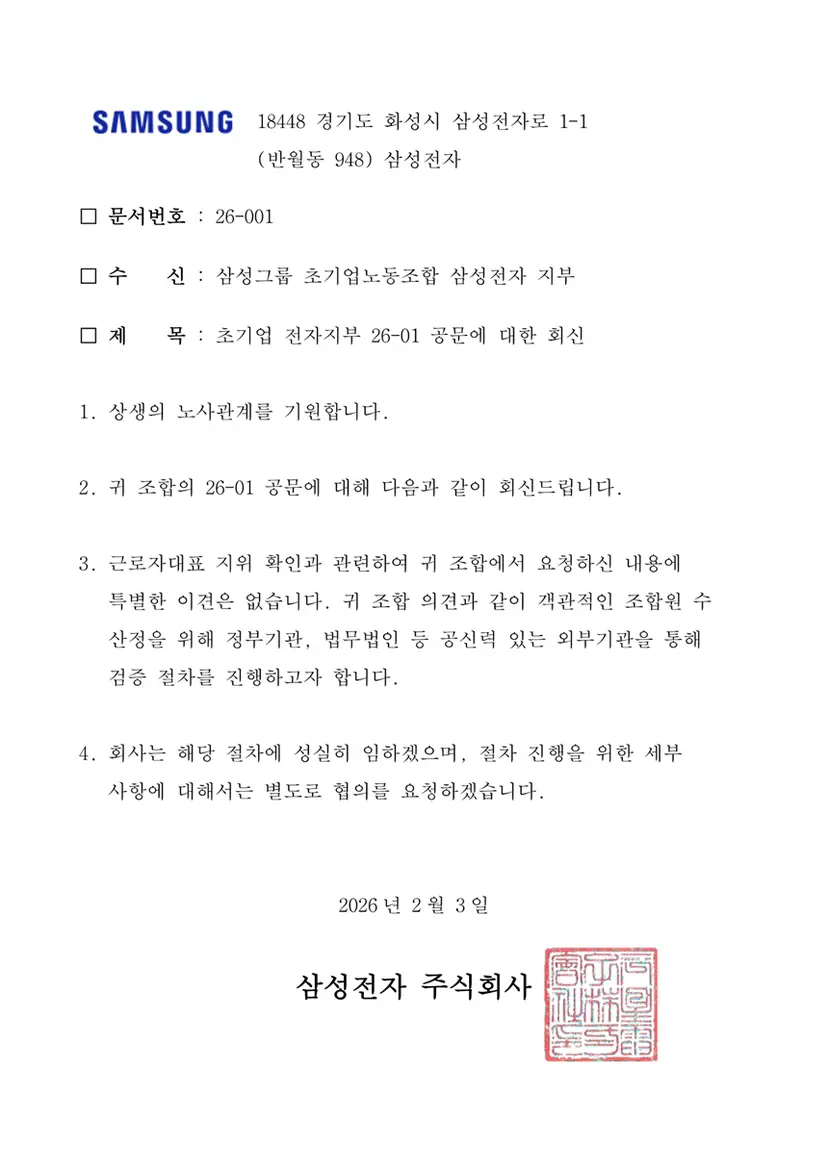
Previously, the Super-Corporate Union sent an official document to the company on the 30th of last month, requesting the 'initiation of the procedure for calculating the number of union members to confirm the status of employee representative.' The company replied, "We will faithfully engage in the procedure, and we will discuss the details separately." The union claims that as of the 30th of last month, the number of union members was approximately 64,000, exceeding the 62,500 estimated to be the majority of the total workforce. This is an increase of nearly 14,000 in less than a month from 50,853 at the end of last year.
The reason behind the weight of the union's voice is evaluated to be its rapidly increased organizational power. Most of the members of the Super-Corporate Union are understood to be employees in the Semiconductor (DS) division and the Device Experience (DX) division, which includes smartphones and home appliances. Once the verification process by the Ministry of Labor, including checks for duplicate members, is completed, Samsung Electronics will face the era of a single majority union for the first time in history.
However, whether a majority union is exactly established may depend on future verification procedures. Third-party verification methods, such as through national agencies or law firms, will be conducted to ensure fairness and objectivity. It is expected that the process of calculating the number of union members may involve resolving duplicate memberships, and such verification work is expected to take a certain period of time.
The launch of a single majority union is considered a variable that will change the overall landscape of labor-management negotiations at Samsung Electronics. Until now, due to the absence of a majority union, individual negotiations were held by multiple unions, but if a majority union is established, the representative bargaining union will exercise collective bargaining rights alone. The company must respond to bargaining demands, and the consent of the majority union will be required for major labor issues, such as changes to employment rules.
In particular, changes to the performance bonus system, which is cited as the background for the rapid increase in union membership, are drawing attention. Samsung Electronics' performance bonuses are capped at 50% of an individual's annual salary and are calculated based on 20% of EVA, not operating profit. On the other hand, its competitor, SK Hynix000660, paid 10% of operating profit as performance bonuses through labor-management agreements last year. The union's view is that "not only are the calculation criteria for performance bonuses low, but the basis for EVA calculation is also not transparent."
Samsung Electronics is in a situation where labor-management tension is rising simultaneously during a phase of performance improvement amidst a booming semiconductor market. It is assessed as a turning point where management stability and labor-management risk management capabilities are being tested together during a growth phase. The Super-Corporate Union, which has set wage increases and expanded benefits as core tasks, emphasizes that a predictable compensation system is the foundation for long-term R&D competitiveness.
However, some raise concerns that even after the launch of a single majority union, a uniform compensation system could lead to conflicts of interest between business units, given the large performance gap between the semiconductor and set businesses.
It is also pointed out that higher compensation expectations based on the boom period could act as a burden on company management in the mid-to-long term. As the labor-management relationship at Samsung Electronics enters a new phase, attention is focused on how the future negotiation results will affect the overall management strategy and personnel and compensation systems.
A Samsung Electronics official stated, "Regarding the status of the employee representative, the company has been replying in accordance with established procedures and schedules," and "We plan to continue to communicate and negotiate with the union as much as possible regarding wage negotiations."