

[비즈한국] With its IPO just one month away, K-Bank held a press conference on the 5th to outline its mid-to-long-term strategy. K-Bank has been conducting demand forecasting since the 4th to finalize its offering price. Having significantly lowered its valuation to ensure a successful listing, the bank aims to conclude the process smoothly. K-Bank also revealed plans to utilize the secured funds for stablecoin issuance, strengthening its platform business based on 'Banking as a Service (BaaS),' and expanding its corporate loan portfolio to 50%.
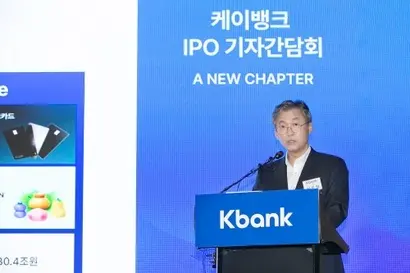
K-Bank held an IPO press conference ahead of its scheduled KOSPI listing on March 5. K-Bank will conduct demand forecasting from February 4 to 10, with the offering price to be finalized on the 12th. The subscription dates are scheduled for February 20 and 23, and subscriptions can be made through NH Investment & Securities, Samsung Securities, and Shinhan Securities. The number of shares offered is 60 million, with a target price range of 8,300 KRW to 9,500 KRW, aiming for an expected market capitalization of 3.3673 trillion KRW to 3.8541 trillion KRW.
At the press conference on the 5th, K-Bank CEO Choi Woo-hyung stated, "This January marked our 10th anniversary since incorporation. In 2025, we improved our growth, asset quality, and fundamental profitability." He added, "We will drive financial innovation from banking business to digital assets. We will differentiate ourselves from existing banks through tech-based, efficient organizational management."
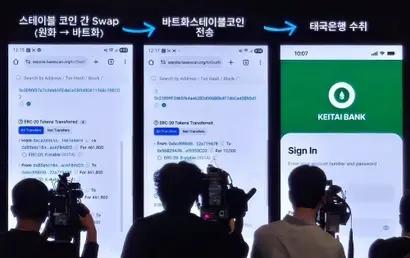
K-Bank explained its mid-to-long-term growth strategy utilizing the capital from the listing, including: penetrating the individual business owner and Small and Medium Enterprise (SME) market, expanding platform business, and new ventures related to digital assets. Of particular note is the plan for stablecoin issuance and payment services. During the event, K-Bank showcased a video demonstrating the use of a stablecoin within its app to convert Korean Won to Thai Baht and remit it to a Thai bank account.
CEO Choi Woo-hyung explained, "We are the first in the industry to practically prepare for stablecoins. Stablecoin-based overseas remittances allow for real-time deposits and receipts with nearly zero fees. In terms of cost and speed, it is incomparable to existing foreign exchange transactions."
K-Bank plans to utilize BC Card's payment infrastructure domestically after issuing the coin, and to build a stablecoin-based foreign exchange remittance and payment network by partnering with overseas banks and digital asset firms in the global market. Its recent signing of Memorandums of Understanding (MOU) with Thailand and the United Arab Emirates (UAE) to build infrastructure for stablecoin-based overseas remittances and payments is part of this initiative.
CEO Choi explained, "We are approaching stablecoins in three areas: issuance, domestic remittance/payment, and overseas remittance/payment. Although legislation is still pending, we are proactively building infrastructure, proving technology, and forming partnerships with overseas firms. We plan to issue a stablecoin. However, the issuance must align with the legislative process. We will either participate in a banking consortium to issue it, or proceed in accordance with regulations."
Furthermore, the bank expects to benefit if it enters the digital asset market in earnest. CEO Choi said, "We are supporting non-face-to-face accounts to prepare for the expansion of corporate investment. We currently provide real-name accounts for 189 corporations, including government agencies and research institutes. This is at the highest level in the country."
Regarding its real-name account partnership with the virtual asset exchange Upbit, which was extended until October this year, he replied, "We are maintaining a solid partnership. It is a win-win situation," while adding, "With the strengthening of our banking business, our deposit and loan base is now robust, so unlike in the past, Upbit's deposits do not have a major influence."
The bank is also entering the individual business owner and SME market in earnest. The goal is to gradually expand the portfolio from household loans to corporate loans, reaching a 5-to-5 ratio between household and SME loans by 2030. To achieve this, the bank is upgrading its Credit Scoring System (CSS) and strengthening its SME-specific product lineup. In 2024, K-Bank launched the industry's first non-face-to-face real estate mortgage loan for individual business owners, and is preparing a fully non-face-to-face loan product for SMEs with a target launch in early 2027.
When it was pointed out that asset quality could deteriorate due to the expansion of SME loans, CEO Choi explained, "We have significantly lowered delinquency rates compared to the past and will continue to stabilize them. We will manage risks strongly through credit policies, evaluation models, and the use of alternative data."
K-Bank is also strengthening its platform business foundation through an 'open ecosystem' by partnering with various platforms. The plan is to collaborate with large platforms to increase traffic and expand its customer base. K-Bank expressed its ambition to be the first bank to monetize its platform business through BaaS partnerships.
Specifically, in the first half of this year, it plans to launch a service where Musinsa members can issue K-Bank accounts and check cards within the app. It is also developing a service where Naver Pay individual business customers can receive credit loans based on joint screening by K-Bank and Naver Pay. The Musinsa collaboration has been designated as an Innovative Financial Service, and the joint loan screening with Naver Pay has been submitted for designation.
Confidence was also shown regarding the listing. When asked about the prospects, K-Bank CFO Lee Joon-hyung replied, "The price band for the IPO was set at a level lower than the corporate value, and the discount rate has risen to 20-30%. The market also views this as an appropriate level, so we expect good results." Regarding shareholder return policies after the listing, CEO Choi Woo-hyung stated, "We plan to focus on growth for the time being. Our Return on Equity (ROE) is approaching double digits, and once it exceeds 15%, we will implement active shareholder return policies."