

[비즈한국] SPC Group’s safety management declaration is being put to the test. A fire occurred at the SPC Samlip005610 Sihwa plant just six months after President Lee Jae-myung personally visited the site to strongly criticize the management's lack of safety awareness. With confirmation that basic automatic fire extinguishing equipment, such as sprinklers, was absent in the factory where the fire broke out, critics are pointing out that SPC's safety innovation plan needs to be re-examined.
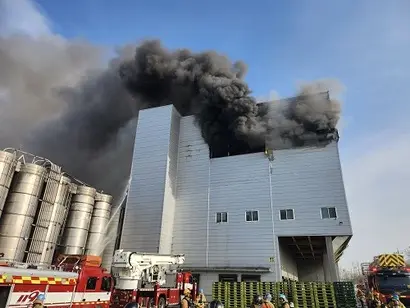
SPC Samlip Sihwa Plant, Fire Accident Occurs This Time
On the 3rd, a fire broke out at the SPC Samlip Sihwa plant located in Siheung-si, Gyeonggi-do. According to the Gyeonggi Fire and Disaster Headquarters and others, the fire started at approximately 2:59 PM that day on the 3rd floor of the 4-story Building R (production building) where bread is produced.
A total of 544 employees were working at the Sihwa plant, and it is reported that 12 workers were on the 3rd floor where the fire broke out. Out of the 12 workers on the 3rd floor, 10 evacuated on their own, and 2 were rescued by firefighters after retreating to the 4th floor and the rooftop, respectively. It was confirmed that 3 people sustained minor injuries due to smoke inhalation. Fire authorities stated that there was no possibility of further casualties.
About 130 firefighters and some 50 pieces of equipment, including pump trucks, were deployed to the site, and the fire was completely extinguished around 10:49 PM, 8 hours after it broke out.
Due to this fire, the operation of the Sihwa plant has been completely halted. As the Sihwa plant, which focused on the production of bread and hamburger buns, has come to a standstill, concerns are growing in the industry that supply disruptions for bread are inevitable, especially for major fast-food companies. In fact, some convenience stores, such as CU and GS25, have already stopped the sale of bread products that were produced at the Sihwa plant.
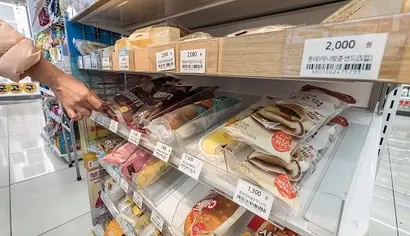
SPC Samlip stated, "Immediately after the fire, we halted plant operations with safety as our top priority, and we are simultaneously operating an alternative production system to minimize disruptions in product supply." They added, "We plan to proceed with alternative production and supply of major products like bread and hamburger buns by utilizing major hub production facilities such as those in Seongnam and Daegu, as well as external partners."
They continued, "We are actively cooperating with site cleanup and safety inspections by relevant authorities, and we will do our best to ensure that production and supply are fully normalized as soon as possible once they are completed."
Safety Management Emphasized After President's Rebuke... But the Site Remains a 'Safety Blind Spot'
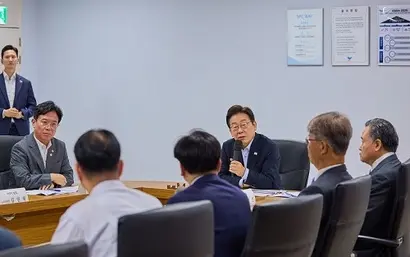
The fire at the SPC Samlip Sihwa plant is drawing attention again because it is the very site that President Lee Jae-myung visited to reprimand the company over safety issues. President Lee visited the Sihwa plant last July to hold an on-site meeting regarding major industrial accidents and delivered a warning message regarding the repeated industrial accidents occurring at SPC subsidiaries.
In May of last year, a worker died at the SPC Samlip Sihwa plant after being caught in machinery while working on a production line. In August 2023, a worker in their 50s died after being caught in a dough machine at the Seongnam Shani plant, and in October 2022, a female worker died after being caught in a sauce mixer at the SPC subsidiary Pyeongtaek SPL plant, marking a series of major industrial accidents.
At the time, President Lee pointed out to management, "The fact that the same type of accident occurs in the same place in the same way is clearly a problem with the system." Following the President's high-intensity pressure, SPC Group immediately released a safety management implementation plan centered on large-scale investment and structural innovation.
SPC Group announced that it would invest a total of 100 billion won into the safety sector over the next three years to completely replace aging facilities and significantly improve safety infrastructure, such as by introducing AI-based risk detection sensors on all production lines. Furthermore, they promised a shift to a 3-shift or 4-shift system to resolve long-hour labor and emphasized that they would strengthen the functions of the Safety Management Committee centered on external experts.
However, with the fire occurring at the Sihwa plant just about 6 months after such promises were made, criticism is being raised that the safety management promoted by SPC may have been merely a superficial measure. Critics argue that despite pledging large-scale safety investments and institutional improvements after the President's visit, loopholes in on-site safety management have still been exposed.
In particular, the controversy is growing as it has been revealed that Building R, identified as the starting point of the fire, was not equipped with sprinklers for initial suppression. Fire authorities stated that the results of the first joint inspection showed that the building where the fire occurred was equipped only with fire hydrant facilities, without any sprinklers.
While the building is not required by current law to be equipped with sprinklers, the fact that it lacked even basic automatic fire extinguishing equipment capable of automatic fire detection or initial suppression is casting doubt on the sincerity of SPC, which had promised to strengthen safety.
Fire authorities and the police plan to determine the exact cause of the fire through a second joint inspection on the 5th, with the participation of the National Forensic Service.