

[비즈한국] It is hard to deny that the Russia-Ukraine war has been the backdrop for the remarkable growth of South Korea's defense industry, often referred to as 'K-Defense,' over the past few years. As a vast number of weapons have been consumed in the largest conventional war since the collapse of the Cold War, few countries have possessed the superior production capacity to meet delivery timelines.
However, Singapore is a 'hidden defense powerhouse' that has achieved growth just as impressive as Korea's over the past few years. Although Singapore is a city-state smaller than Seoul with a population of about 6 million, it is a formidable defense exporter, and its conventional weapon exports have surged significantly in recent years. This is thanks to the exceptional capabilities of ST Engineering, Singapore's largest defense contractor.
Unlike what one might expect from a small city-state, ST Engineering's business portfolio is incredibly diverse. In the commercial aviation sector, it is a powerhouse in MRO (Maintenance, Repair, and Overhaul), boasting the top order volume in Asia, and it also handles business related to urban security facilities.
However, ST Engineering's core competitiveness lies in its defense division. Despite the country's small size, it produces a wide range of weapon systems. In particular, its prowess in ammunition production has led to significant success in European exports. Its main export items are 155mm artillery shells used for self-propelled and field artillery, and 40mm grenades for infantry support.
Beyond just shells and bullets, their achievements in other areas are substantial. Having spent decades dedicated to developing its own firearms, it produces not only the SAR21 assault rifle adopted by the Singapore Armed Forces but also several other firearms, such as the Ultimax machine gun, which have been consistently sold for decades. It is no exaggeration to say that Singapore is ahead of Korea in terms of recognition within the firearms industry.
Furthermore, ST Engineering also manufactures sophisticated, large-scale weapons. Its Marine division independently builds all surface ships for the Singapore Navy. The Formidable-class frigate, developed in collaboration with France, boasts excellent air defense capabilities, and the next-generation Victory-class frigate currently under construction reaches a displacement of 8,000 tons and incorporates advanced concepts such as the operation of various unmanned surface vessels.
The area where ST Engineering stands out the most is in Land Systems. The Bronco armored vehicle, equipped with both mine protection and amphibious capabilities, is an excellent vehicle currently in use in the UK, Germany, Thailand, and Ukraine. It was deployed in combat during the War on Terror and saved many British soldiers, earning its reputation for reliability.
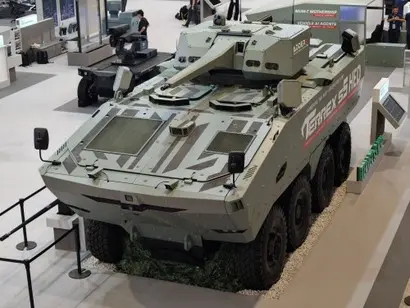
However, even ST Engineering has not been able to break through the 'impenetrable fortress' of the North American market. The Terrex wheeled armored vehicle made it to the final round for the US Marine Corps' ACV project but lost to the UK's BAE Systems. Seemingly frustrated by this loss, ST Engineering unveiled the 's5HED,' the latest upgraded version of the Terrex, at the Singapore Airshow that began on February 3, and has been aggressively promoting it.
The most notable feature of the Terrex s5HED is its hybrid propulsion system. It can operate using only batteries and motors during low-speed maneuvers, enabling ultra-quiet movement that is difficult for enemies to detect, and its fuel efficiency is improved for long-distance operations, significantly enhancing its operational capability. This is a technology that Korea is still developing and has not yet mass-produced.
The firepower of the ADDER remote-controlled weapon station (RCWS) mounted on the Terrex is also excellent. The ADDER turret is equipped with a 30mm autocannon and a 7.62mm machine gun. By combining its new 4 drone detection radars with the ADDER turret, the Terrex s5HED has the capability to intercept enemy suicide drone attacks using its autocannon.
It appears that ST Engineering is seeking extensive cooperation with the South Korean defense industry. During the Singapore Airshow held from February 3 to 7, CHUA Jin Kiat, Assistant Senior Vice President of ST Engineering's International Marketing, told me in an interview that ST Engineering is already collaborating with several small but strong Korean companies and plans to further expand the scope of cooperation.
My investigation reveals that Korean-made components are already being integrated into key ST Engineering products in several areas, such as counter-drone systems and armored vehicle parts. It appears that the collaboration within Korea will expand beyond simple parts subcontracting to include AI, drones, and Manned-Unmanned Teaming (MUM-T). This includes both 'soft-kill' (drone jammers) and 'hard-kill' (interceptor drones) methods to stop drone attacks, which have become critical since the war in Ukraine.
It is also noteworthy that ST Engineering and the Korean defense industry share many of the same partners. For example, Hanwha Aerospace012450 is currently developing THeMIS-K, a Korean version of the Lithuanian unmanned ground platform 'THeMIS,' and ST Engineering is also cooperating with Lithuania in a similar way, leaving open the possibility of a three-way partnership.
A strong rival can also be a strong ally. Despite its small territory and limited resources, the small but strong nation of Singapore maintains its competitiveness through a specialized defense industry and, like Korea, is a notable defense powerhouse achieving great results through its delivery competitiveness. This is why extensive cooperation between the Singaporean and Korean defense industries is necessary.