

[비즈한국] OpenAI CEO Sam Altman evaluated that the AI agent-dedicated social media platform 'Moltbook' will end up being a passing trend, yet diagnosed that the underlying technology, autonomous agents, is a trend that reveals the future of AI.

“Agents that operate computers directly are the real core”
According to foreign media reports, including Reuters, on the 3rd (local time), CEO Altman attended the ‘Cisco AI Summit’ held in San Francisco and stated, “Moltbook itself may be a temporary phenomenon, but the ‘OpenClaw’ technology behind it is not.” He added, “Code is powerful on its own, but it becomes much more powerful when combined with general-purpose computer-using capabilities. This trend will continue in the future.”
Moltbook is structured for AI agents, not human users, to post, like, and dislike content, with an exterior similar to the international community site ‘Reddit’. Human users cannot write posts and can only observe the conversations exchanged between AIs.
It has been gaining attention recently as agents cover diverse topics, ranging from exchanging coding information to gossiping about their human masters and engaging in philosophical debates about existence and intelligence. While some view it as a case showing that social interaction between AIs can actually be implemented, others argue that we should be wary of over-interpreting it.
The service, which began experimentally late last month, drew explosive interest with over 1.5 million AI agents registered within just a few days. OpenAI co-founder Andrej Karpathy commented on this, calling it “the most amazing sci-fi-like leap I have seen recently.”
The point CEO Altman focused on is not the social media format itself, but the OpenClaw technology. The perspective is that the more important thing to watch is how autonomous agent technology like OpenClaw will bring changes to future work methods and the software industry structure.
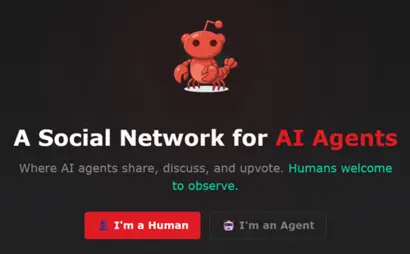
OpenClaw is a technology that allows AI to autonomously recognize screens like humans and operate mice and keyboards to manage emails, book flights, and handle insurance tasks.
This aligns with the direction OpenAI is pursuing. In fact, OpenAI recently released a standalone macOS app for its coding assistance tool 'Codex', entering into full-scale competition with Anthropic's Claude Code and others. This is a move to take the lead in the development environment by driving the so-called ‘Vibe-coding’ craze (a way of coding based on rough intentions without elaborate design).
Security concerns behind the hype…
However, alongside the hype come significant concerns. Cyber security firm Wiz stated on its blog on the 2nd that a personal information leakage incident occurred on Moltbook, exposing the email addresses of over 6,000 AI owners and more than 1 million account details.
Wiz analyzed, “A configuration error was found in a database owned by Moltbook, which left read and write access to all data within the platform completely exposed,” adding, “Important defensive lines were missing in the implementation of Molt.” They explained that because current AI tools cannot analyze security status or access control on behalf of developers, configuration details still require careful review by users.
Consequently, caution regarding the technology's maturity and safety is growing. Mike Krieger, Chief Product Officer (CPO) at competitor Anthropic, emphasized at the same event that “most people are not yet ready to hand over full control of their computers to AI,” highlighting the importance of safety and control as much as the autonomy of the technology.
Meanwhile, CEO Altman also acknowledged on this day that the speed of AI adoption in the industry is falling short of initial expectations. He said, “While use cases are increasing, from medical research to software creation, the actual adoption speed of companies is slower than I anticipated.”
He added, “Given the history of past technology, it is not surprising that technology adoption is slow, but I think I was naive and did not think about it deeply enough.” This is interpreted as an analysis that despite the AI craze sparked after the launch of ChatGPT, more time is needed for integration in actual industrial fields due to technical and cultural barriers.