

[비즈한국] Is human personality hereditary? Or does it change based on the environment? A similar problem exists for the fate of galaxies.
Galaxies are constantly colliding and interacting with their neighboring galaxies. As such, the close environmental factors a galaxy experiences after its birth have a significant impact on its fate. In contrast, it might seem that environmental factors on a more massive, cosmic scale would not have a direct effect on the later life of a galaxy. But that is not the case! In fact, cosmic conditions that far exceed the scale of individual galaxies might have already determined their destiny!
I call this effect the 'cosmic glocal effect,' meaning that the global-scale cosmic environment ultimately influences the fate of galaxies at the local scale. How is that possible? I am introducing my latest research findings after a long time.
I am more interested in 'couple galaxies' that interact with adjacent galaxies rather than isolated galaxies. Interactions between galaxies also give rise to diverse changes in their appearance. A prime example is 'warping,' where the galactic disk is distorted. This phenomenon is particularly evident in galaxies where the galactic disk appears almost perfectly edge-on. However, creating and maintaining a warp in a galactic disk is difficult with just a single violent encounter with another galaxy. Such a momentary fling cannot explain the warped structures of actual galaxies that stably maintain their shape over hundreds of millions of years.
Therefore, astronomers have sought the reason in the dark matter halo surrounding the galaxy. Dark matter in the halo is not simply gathered in a neat, round, ball-like shape. It is gathered in a shape resembling a rugby ball, slightly elongated along one axis. However, the axis of the dark matter halo does not necessarily align with the axis of the galactic disk inside it. They are slightly misaligned and tilted. A violent collision with a neighboring galaxy is also one of the major factors that can tilt the central axis of this dark matter halo.
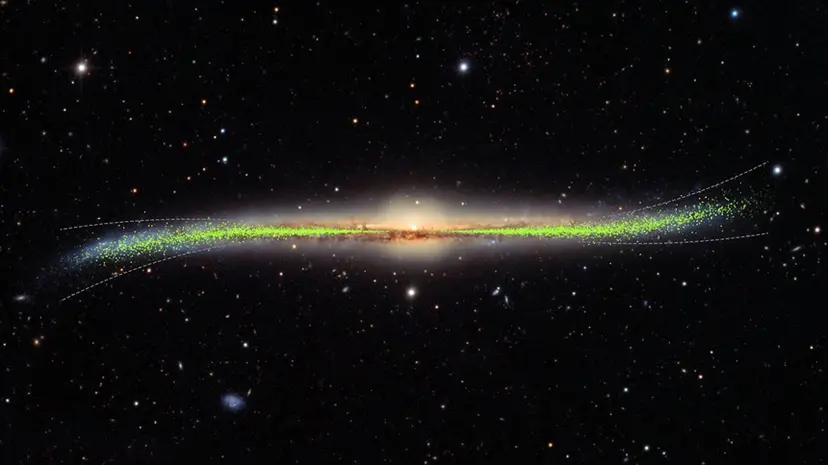
Fitting for its massive scale, the dark matter halo exerts a continuous gravitational influence on the galactic disk within it for a long period of time. Thanks to this, once a galactic disk is warped, it does not quickly return to its original flat appearance, but can maintain its warped structure for a long time. In fact, our Milky Way disk also shows a distinct S-shape, like a Pringle, and one of the reasons it can maintain such a long-warped structure is presumed to be that the dark matter halo surrounding our galaxy is slightly tilted relative to the galactic axis, causing the Milky Way disk axis to undergo periodic precessional motion within it.
This is a very plausible hypothesis, but there is a problem. The dark matter halo surrounding each galaxy is difficult to identify through standard optical observations. Because dark matter does not emit light, it is completely invisible no matter how much you try to photograph a galaxy. Instead, there is an indirect method to infer the scale, shape, and axial direction (in which direction it is elongated) of the dark matter halo: by identifying the gravitational potential created by the dark matter halo. For this clue, we use the spatial distribution of satellite galaxies orbiting each galaxy.
In this study, I selected galaxies that show clear warped structures in their disks. Warps are largely classified into two types based on their shape: S-shaped warps, where both ends are bent in opposite directions, and U-shaped warps, which look like a bowl as they bend in the same direction. I then identified all the light satellite galaxies captured around the warped galaxies and determined how they are distributed in the surroundings.
As a result, compared to galaxies with flat disks and no warps, galaxies with warps showed a clearly elongated, non-circular distribution of satellite galaxies. This means that galaxies with warps live inside dark matter halos shaped like distorted rugby balls. This serves as strong evidence for the hypothesis that the gravitational potential of a tilted dark matter halo is the secret behind long-lasting galactic warps.
Comparing how far each galaxy is from the filaments of the cosmic web, and the direction in which the nearest filament flows, reveals even more interesting facts. The axial direction of the dark matter halo surrounding a galaxy is not randomly distributed. After all, individual galaxies are the result of material flowing along and gathering from the filaments of the cosmic web.
However, what is interesting is that the way the dark matter halo aligns with the filament shows a clear difference depending on the shape of the warp. In the case of galaxies showing an S-shaped warp, the dark matter halo aligns almost parallel to the adjacent filament. In other words, galaxies formed within a dark matter halo that is aligned along the flow of the filament exhibit an S-shaped warp. On the other hand, the axes of the dark matter halos of galaxies with U-shaped warps align almost perpendicular to the adjacent filament. In places where the dark matter halo is formed perpendicular to the flow of the filament, away from its path, galaxies create much more unstable U-shaped warps.
This discovery is quite intriguing because it has long been thought that the shape of the warp would be determined by minor differences in interactions with neighboring galaxies, such as the direction and intensity of their approach. However, while most galaxy collision simulations easily reproduce stable S-warps, they have struggled to reproduce U-warps, and even when they did, they could not maintain them for a long time. Therefore, the existence of U-warps, which are frequently found in the actual universe, had not been perfectly explained.
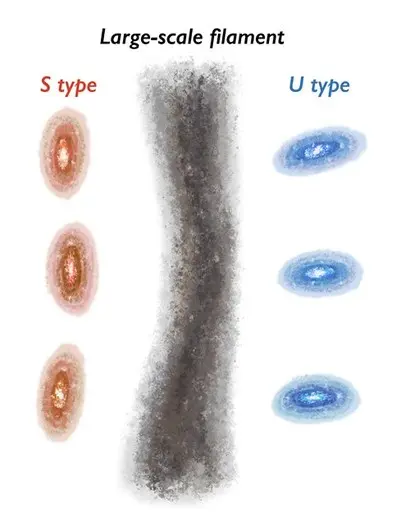
However, this study suggests the possibility that the shape of a warp is not just a trivial issue decided at the moment of a collision with a neighboring galaxy—an acquired trait—but rather an innate destiny. Depending on the shape of the dark matter halo in which a galaxy was born relative to the adjacent filament, its shape may have already been determined. This provides an important clue to the so-called 'glocal' effect of the universe that I have suspected.
When filaments of the cosmic web form, gas and dark matter flow rapidly along them. In the process, the alignment of the surrounding dark matter halo is determined, and as an individual galaxy is born within it, the galaxy's fate is ultimately decided. By mediating through the important intermediate step of the dark matter halo, the effects occurring on the scale of the cosmic web at the Mpc (megaparsec) level eventually influence the fate of individual galaxies living within it at the kpc (kiloparsec) level!
However, as this was discovered under the limited condition of warped disk galaxies, systematic additional verification is needed for a more diverse and broader range of galaxies in the future. I plan to carefully analyze whether the cosmic glocal effect truly works across various aspects, including the morphological, chemical, and dynamical evolution of galaxies, and whether the fate of individual galaxies is truly governed by the filaments of the cosmic web formed long ago.
Reference
https://iopscience.iop.org/article/10.3847/1538-4357/ae0e13
Who is the author Ji Woong-bae? He loves cats and the universe. After watching 'Galaxy Express 999' as a child, he developed a dream of making the beauty of the universe known. He is currently an assistant professor in the Division of Interdisciplinary Studies at Sejong University, participating in various science communication activities such as lectures and writing. He has authored books such as 'Everyday a Piece of the Universe', 'Scientists in the Starry Universe', 'Things You Can Know Though You Can't Go', and 'Strange Questions That Come to Mind When Looking at the Universe', and has translated books including 'The Hitchhiker's Guide to the Real Universe', 'How I Killed Pluto', 'Quantum Life', and 'Cosmigraphics'.