

[비즈한국] With the amendment to the Trade Union Act, commonly known as the 'Yellow Envelope Act,' set to take effect this coming March, Korea Aerospace Industries (KAI)047810 has embarked on establishing an enterprise-wide labor risk management system. Given the heightened labor tensions, including the company filing damages lawsuits against former and current employees, this move is interpreted as a strategy to refine its response to industrial action disputes and proactively mitigate risks within its existing subcontracting structure.

Comprehensive Review of 'Employer Status' for Prime and Subcontractors
According to industry sources on the 3rd, KAI plans to hire a specialized firm next month to overhaul its procedures for assessing liability and responding to labor disputes. On the 29th of last month, KAI issued a bid notice titled 'Consulting Service for Response to the Yellow Envelope Act.' The goal is to proactively assess legal risks and establish a practical response system before the amendments to Articles 2 and 3 of the Trade Union and Labor Relations Adjustment Act (Trade Union Act) go into effect in March. The consulting project is expected to last for about a month until mid-April.
The primary focus appears to be determining whether the company is legally recognized as an 'employer' of internal and external subcontracted workers and creating improvements for its operational command and control structure. This includes auditing the current status of all contracts—such as internal subcontracting, dispatching, and outsourcing—as well as diagnosing the legal nature and practical control of each contract. The proposal also explicitly lists 'illegal dispatch risk assessment' as one of the required tasks.
Due to the nature of the aerospace industry, which relies heavily on subcontracting, the shift in criteria for determining employer status is bound to have a significant impact. It is common for personnel from multiple partner companies to work together on a single process. Through this consulting, KAI plans to fully review the legal adequacy of its processes for selecting, evaluating, and terminating contracts with partner firms.
The Yellow Envelope Act limits a company's ability to claim excessive damages for legitimate industrial action by trade unions and broadens the scope of 'employers' in labor relations. Once the law takes effect, if a prime contractor substantially and concretely controls or decides the working conditions of subcontracted workers, it may be recognized as an employer under the Trade Union Act, potentially expanding the range of entities held accountable as employers.
An official from the KAI labor union stated, "As of now, we see this as an internal review in preparation for the enforcement of the law," adding, "We do not interpret this as a measure specifically targeting individual ongoing labor-management issues."
Internal Conflict Persists… Building a Dispute Response System
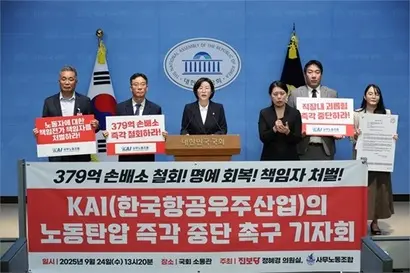
This project is drawing attention as it overlaps with ongoing internal conflicts within KAI. The company has been embroiled in legal battles against partner firms and some former and current employees, holding them accountable for the discontinuation of the 'Smart Platform' project, a major digital transformation initiative. The Smart Platform project was pursued under former CEO Ahn Hyun-ho, appointed during the Moon Jae-in administration, but was scrapped under former CEO Kang Goo-young during the Yoon Suk-yeol administration.
KAI is claiming the return of unjust gains worth 37.9 billion won against partner firms that demanded unpaid fees. The case is currently in the appellate stage after both sides' claims were dismissed in the first trial last September.
Labor-management relations are also strained due to these lawsuits. The company is conducting civil proceedings to hold some employees liable for damages, citing their management and supervision responsibilities during the project. According to the union, while the certified mail sent by the company during this process mentioned damages worth 37.9 billion won, the claim filed with the court was reduced to 500 million won.

Given the sensitivity of these issues, building a system for responding to industrial actions and proving damages will be a key focus. The plan is to go beyond mere legal analysis and create a concrete manual to objectively prove losses in future disputes.
This includes tasks such as establishing criteria to calculate losses incurred when production stops due to strikes and organizing procedures to secure evidence that demonstrates whose actions caused those losses. Additionally, professional advisory services regarding the scope of exercising facility management rights during strikes and the legal boundaries for deploying replacement workers will be provided in parallel.
Guidelines for responding to collective bargaining demands from subcontracting unions will also be revised in light of the potential expansion of the employer definition. Detailed response strategies, including procedures for unifying bargaining channels and methods for conducting negotiations, will be established. The goal is to minimize management uncertainty by preparing response manuals for various potential conflict scenarios.
This consulting, which encompasses collective bargaining, response to industrial actions, and systems for proving damages, is largely a preemptive measure to prepare for the changing structure of disputes following the enforcement of the revised Trade Union Act. It is viewed as an effort to systematize internal standards, especially given that the changes in the definition of employers and the criteria for assessing damages can significantly affect corporate labor response strategies.
However, KAI maintains that the issue should not be over-interpreted. A KAI official explained, "Receiving advice from a professional firm is for analyzing the impact of the law and conducting internal checks," adding that it is "a routine preparatory procedure."