

[비즈한국] February 2026, the compass of the Seoul real estate market is pointing west. The fact that Gangseo-gu, Seoul, ranked first in weekly price increases in the weekly apartment trends report released by KB Real Estate is more than just a statistical figure. As the heat of the rise led by the three Gangnam districts (Gangnam, Seocho, Songpa) and 'Mayongseong (Mapo, Yongsan, Seongdong)' began to cool down, the momentum has shifted to Gangseo-gu, the gateway to southwestern Seoul.
Many ask, "Why Gangseo-gu, and why now?" And, "Should I jump on this trend even now?" To answer these questions, we must precisely dissect the three major tectonic shifts currently taking place in Gangseo-gu: ① Gap Filling, ② Evolution into a self-sufficient city (Magok Paradox), and ③ The materialization of massive development projects.
Why Gangseo-gu now? The 'End of Undervaluation'
The rise of Gangseo-gu is no coincidence. Capital always flows from high places to low places, but specifically to places with 'value.' Over the past year, prices in Seoul's premium neighborhoods have broken past previous highs and soared. Banpo solidified the era of 100 million won per pyeong, and new apartments in Mapo have settled into the '2 billion won club.' In this process, market participants inevitably fall into 'relative deprivation' and scramble to find alternatives.
The first trigger for Gangseo-gu's rise to the top is 'price attractiveness' and the 'balloon effect' of loan regulations. Currently, the government's loan regulations (such as the Level 2 Stress DSR) make it difficult to access high-priced apartments exceeding 1.5 billion won. However, the flagship complexes of Gangseo-gu, particularly in Gayang-dong, Yeomchang-dong, and parts of Magok, are still positioned between 900 million and 1.4 billion won. This means the perception has spread that this is effectively the last remaining 'high-value area for the price' where one can live close to work while utilizing mortgage loans. In short, it is reaping the greatest benefits of the 'gap filling' market.
Magok District: Beyond a Bedroom Community to 'Korea's Silicon Valley'
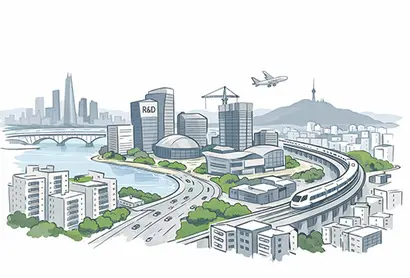
The strongest fundamental for the rise of Gangseo-gu is undoubtedly the Magok District. Once treated as an outlying bedroom community of Seoul, Gangseo-gu has been upgraded to Seoul's 'fourth business district' with the completion of the Magok District development.
Led by LG Science Park, major corporate R&D centers for companies such as Kolon002020, Lotte, and E-Land have either completed their move-in or are in the process of doing so. What is important is that business and commercial support facilities such as the 'Magok MICE Complex (Le West)' and 'One Grove' have now begun full-scale operations. This increases the income level of Gangseo-gu residents and creates a solid back-end demand from high-income professionals. The immutable law of real estate—"As seen in Pangyo, house prices in places with jobs do not fall"—is being proven in Gangseo-gu. Magok is no longer just a residential area; it is the economic heart of western Seoul.
The Gayang-dong CJ Site: A 'Transformation' Rivaling Gangnam's COEX
The hidden contributor to the number one ranking is the visible progress in the development of the CJ factory site in Gayang-dong. This project, a long-cherished wish of Gangseo-gu residents, has significantly improved its business feasibility through recent changes in construction permits. The direction has been set to reduce the proportion of knowledge industry centers and instead create large-scale high-end residential complexes and complex shopping malls (such as Starfield Village).
In the real estate market, the groundbreaking of large complex shopping malls and landmarks is the most powerful catalyst for re-evaluating the value of nearby existing apartments. Just as COEX in Samseong-dong supports the value of Gangnam, the development of the CJ site in Gayang-dong is a 'game changer' that will elevate the status of the entire Gangseo-gu area along the Line 9 route. As this positive news comes into view, Riverside complexes in Gayang-dong that have reached the age for reconstruction are becoming targets for buyers.
Will this trend continue?
In conclusion, it is highly likely that Gangseo-gu's upward trend will not end as a one-off event. The reasons are as follows:
First, the ripple effect of the supply shortage. The volume of new apartments in Seoul will plummet over the next two to three years. Particularly, as subscriptions in the Gangnam area have become like 'lottery' tickets, Gangseo-gu, with its relatively new (Magok M Valley) and semi-new apartments, will become a sanctuary and settlement area for actual residents.
Second, a transportation revolution. In addition to the 'golden line' of Subway Line 9, the Western Metropolitan Railway (Daejang-Hongdae Line) will begin construction at the end of 2025, erasing transportation blind spots around Gangseo-gu Office Station and Gayang Station. Expansion of the transportation network directly correlates to a rise in land value.
Third, support from jeonse prices. Currently, the jeonse price ratio in Gangseo-gu is slowly rising. This is evidence that there is solid support from actual demand, showing a typical early-stage pattern of an upward market where rising jeonse prices push up sale prices.
Therefore, it is projected that Gangseo-gu's upward trend will show a steady upward staircase pattern until it catches up to the market prices of Mapo-gu and Seongdong-gu to a certain extent (70-80%).
Should I engage in chase-buying now?
While there is a saying that "it is never too late," chasing the market at this point requires 'cool-headed selection.' Blind buying is prohibited, as polarization will intensify even within Gangseo-gu.
Gangseo-gu's number one ranking is not just a list of numbers. It is a signal indicating that Seoul's urban structure is shifting from the dual axis of 'Downtown-Gangnam' to a multi-core structure that includes 'Magok'.
The market is telling us now: If you cannot buy in Gangnam, look for places that hold as many jobs as Gangnam, border the Han River, and have improving transportation networks. Gangseo-gu is at the center of that intersection. While reckless 'leveraging to the max' (yeong-kkeul) should be avoided, for non-homeowners looking to secure one home for actual residence or one-home owners looking to trade up to a higher-tier area, Gangseo-gu remains a land of opportunity. The wind has already begun to blow from the west. Whether you raise your sails or stay in the harbor is your choice.
Kim Hak-ryeol, the head of the Smart Tube Real Estate Research Institute, known by the pen name 'Pashong,' served as the team leader of the Real Estate Research Division at Gallup Korea. He operates and hosts the Naver blog 'Pashong's World Exploration' and the YouTube channel 'Stu TV.' His books include 'Rewriting Korea Real Estate User Guide (2025),' 'The Power of Gyeonggi Real Estate (2024),' 'Seoul Real Estate Absolute Principles (2023),' 'The Future of Incheon Real Estate (2022),' 'Kim Hak-ryeol's Real Estate Investment Absolute Principles (2022),' 'Future Map of Korea Real Estate (2021),' and 'From Now On, Only Places That Will Rise, Rise (2020).'