

[비즈한국] Medical AI company Lunit328130 is facing fierce criticism from the market after conducting a large-scale paid-in capital increase, reversing its previous pledge that it had no plans for further fundraising. Market confidence remains low due to the management's retracted statements and low subscription participation rates.
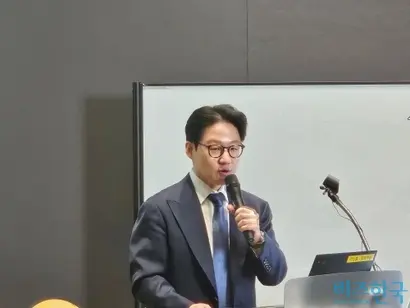
Seo Beom-seok, CEO of Lunit, held a press conference at 8:00 a.m. on the 2nd at Lunit Square in Gangnam-gu, Seoul, stating, "We judged that a paid-in capital increase was the optimal way to fundamentally improve Lunit's financial structure. Once this is done, the stock price will reflect the company's fundamentals." The conference was arranged to explain the background of the 250 billion KRW rights offering—followed by a general public offering for unsubscribed shares—announced on January 30, and to persuade shareholders.
Lunit has set the primary goal of resolving the 171.5 billion KRW convertible bond (CB) put option (early redemption claim) risk through this capital increase. Lunit had issued two series of CBs in May 2024 to acquire the global breast cancer screening platform company Volpara Health Technologies (now Lunit International). CEO Seo emphasized, "Feedback from institutional investors indicates that the stock price is being suppressed by the put option risk, so resolving this is extremely important."
Currently, Lunit's finances are in the red. As of the end of the third quarter last year, its current assets were only 65.6 billion KRW, leaving it with no capacity to respond to the CB put option exercise on its own. It has no choice but to raise external capital. The first CB put option exercise period begins on March 4, and the second on April 1. Lunit aims to induce some put options through negotiations with bondholders, with the goal of repaying or acquiring 50% of the total volume.
However, this appears difficult. As of 10:50 a.m. that day, Lunit's stock was trading at 38,700 KRW, down 1,500 KRW (3.73%) from the previous day. This is significantly lower than the 52,846 KRW exercise price of the 1st series CB and the 47,819 KRW exercise price of the 2nd series. Consequently, the prevailing market view is that bondholders will likely exercise their put options to recover their principal rather than converting them into stock.
Lunit originally pushed for a third-party paid-in capital increase of 80 to 90 billion KRW, but emphasized that a rights offering was inevitable as that would not be enough to fully resolve the put option risk. However, shareholder reactions are cold. This is because in December 2024, a Lunit executive faced controversy for a "deceptive sell-off" by selling stocks at 4.99993 billion KRW—just 70,000 KRW short of the 5 billion KRW threshold for mandatory advance disclosure of insider trading—and because the company is now turning to shareholders despite repeatedly stating last year that there would be no capital increase.
The management's announcement that they would only participate in a portion of this capital increase is also expected to be controversial. Park Hyun-sung, CFO and Managing Director of Lunit, explained that in the rights offering conducted in November 2023, management had taken out large loans to participate, making additional participation difficult. "We currently have 30 billion KRW in loans with an annual interest rate of 15%," said CFO Park. "We will subscribe to about 15% of the allocated amount through the sale of subscription rights." This could be interpreted as using shareholder funds to resolve the company's financial crisis.
Furthermore, concerns are being raised about a potential future management crisis as the stakes of major shareholders and related parties could be diluted. As of the end of September last year, the stake of Lunit's major shareholder and related parties was 17.58%. It is predicted that if they only subscribe to 15% of their allotted shares, their stake will drop to 14.4%.
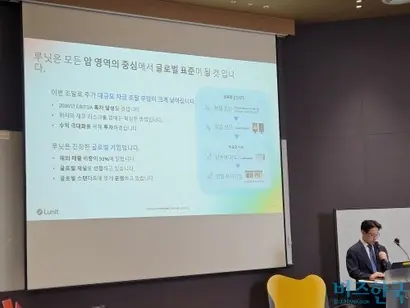
There are also concerns that as the stock price falls due to the capital increase, the total amount raised may fall short of the original 250 billion KRW goal. Critics point out that since stock prices often fall further between the announcement of a capital increase plan and the finalization of the issuance price, there could be setbacks in securing funds to resolve the put option risk. In response, CFO Park explained, "Resolving a significant portion of the put option risk is meaningful in itself. As there are institutions that have expressed interest in investing, we can supplement this by pursuing a third-party capital increase in the future."