

[비즈한국] The Seoul Metropolitan Government is at odds with the central government, displaying conflicting attitudes toward development projects adjacent to World Heritage sites. While the city has argued that the redevelopment of Sewoon District 4 near Jongmyo Shrine does not require a mandatory assessment, it is now emphasizing that the Taereung CC development project—for which a housing supply plan was recently announced—must undergo a World Heritage Impact Assessment (WHIA) as required by law. The differing interpretations surrounding the two project conditions are spiraling into a dispute between central and local governments.
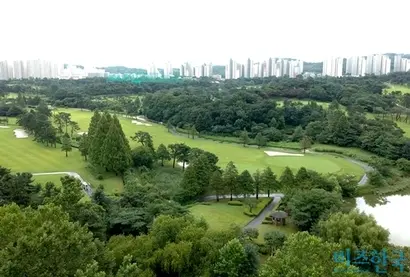
Last month, the government announced its 1.29 supply measures, stating it would provide 6,800 housing units on the Taereung CC site in Nowon-gu, Seoul. Taereung CC is a military golf course adjacent to the Taereung and Gangneung Royal Tombs, which are World Heritage sites. Development was initially pushed under the August 4 Real Estate Measures during the Moon Jae-in administration but was aborted due to resident opposition and other factors. The Ministry of Land, Infrastructure and Transport plans to complete the World Heritage Impact Assessment in cooperation with the Korea Heritage Service, collect resident feedback, and break ground by 2030. The housing in the area is being conceived as low-to-mid-rise to ensure harmony with the World Heritage sites.
In response, the Seoul Metropolitan Government has insisted on the necessity of a World Heritage Impact Assessment for Taereung CC. On the 30th of last month, the city stated, "A comparison of the Taereung CC project site with the Historical and Cultural Environment Conservation Area (within 100m of the heritage boundary) as defined by the Cultural Heritage Protection Act for the Joseon Royal Tombs of Taereung and Gangneung indicates that approximately 13% of the project site overlaps." The city pointed out that "according to the 'Special Act on the Preservation, Management, and Utilization of World Heritage,' any development project that includes or borders a World Heritage zone, even partially, requires a World Heritage Impact Assessment regardless of the proportion of the area."
Seoul City's stance on the World Heritage Impact Assessment contrasts with its position on Sewoon District 4. Previously, the UNESCO World Heritage Centre issued official letters in March and November of last year requesting a World Heritage Impact Assessment for the redevelopment project site in front of Jongmyo Shrine (Sewoon District 4). The Korea Heritage Service conveyed these contents to the Seoul Metropolitan Government and urged the implementation of the measures. After remaining silent for a while, the city essentially refused on the 28th of last month, proposing the formation of a four-party consultative body—including the government, local government, residents, and experts—to discuss whether to accept the impact assessment.
Seoul City has long opposed the World Heritage Impact Assessment for Sewoon District 4, claiming it lacks legal basis. According to the World Heritage Act, projects involving the installation or expansion of structures or facilities that may negatively affect the outstanding universal value of a World Heritage site within a World Heritage zone must undergo such an assessment. Even for projects outside the zone, the Administrator of the Korea Heritage Service can request an assessment if it is certain that the project will have a significant impact on the value of the World Heritage site. However, the area around Jongmyo was not designated as a World Heritage zone even after Jongmyo was named a World Heritage site in 1995.
Following the city's opposition, the Korea Heritage Service designated the area around Jongmyo as a World Heritage zone last December. To effectively maintain the outstanding universal value of the World Heritage site, 194,090 square meters around it were designated as a World Heritage zone. Although Sewoon District 4 was not included in the Jongmyo World Heritage zone, the Korea Heritage Service established a basis to request impact assessments for projects inside and outside the zone. Subsequently, the agency has been working on amending the enforcement decree to specify the target projects and evaluation criteria for these assessments.
On the 31st of last month, President Lee Jae-myung posted an article on social media criticizing the Seoul Metropolitan Government regarding the Taereung CC development, stating, "What is the difference? The same issue, but the opposite stance." He asked, "Are high-rise developments in front of Jongmyo allowed, but housing supply next to Taereung is not?" On the 1st, Seoul Mayor Oh Se-hoon retorted on social media, "The Korea Heritage Service opposes the development of the Sewoon District, which is far away from the conservation area, but does not oppose the Taereung CC project, which is clearly within the scope of the World Heritage site's influence."
The Korea Heritage Service argued that the standards applied to both the Sewoon District 4 and Taereung CC projects are identical. On the 1st, Huh Min, head of the Korea Heritage Service, stated on social media, "The standards for Jongmyo and Taereung are the same. Both the high-rise redevelopment in front of Jongmyo and the housing supply next to Taereung must go through the 'World Heritage Impact Assessment' procedure recommended by UNESCO to derive a reasonable adjustment plan." He added, "The difference lies in the attitude toward accepting the obligation to implement the assessment; the Ministry of Land, Infrastructure and Transport clearly stated it would prioritize the World Heritage Impact Assessment when announcing the Taereung CC development project."
Meanwhile, in an interview with Bizhankook last November, a UNESCO spokesperson warned, "UNESCO emphasizes that all future development projects near Jongmyo must undergo a rigorous World Heritage Impact Assessment to evaluate potential effects on the features that serve as the basis for Jongmyo's World Heritage inscription. If the assessment indicates that these core features are at potential risk, the World Heritage Committee may consider inscribing the property on the 'List of World Heritage in Danger'."