

[비즈한국] South Korea’s real gross domestic product (GDP) growth rate hit 1.0% last year, barely crossing the 1% threshold. Given the headwinds of the 'three highs'—high interest rates, high inflation, and high exchange rates—coupled with the added burden of tariff threats from U.S. President Donald Trump, it was a respectable performance, all things considered.
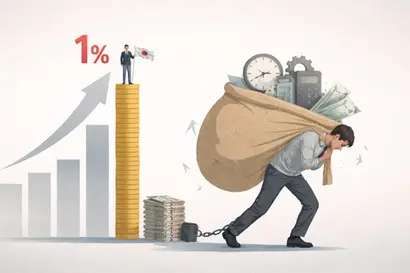
However, despite the Korean economy maintaining a 1% growth rate, the public is not feeling the benefits. This is because, for five consecutive years, the real wage growth of workers—adjusted for inflation—has failed to reach even half of the economic growth rate, or has even turned negative. There is growing concern that if this trend of 'growth without wage increases' persists, the polarization issue currently plaguing Korean society will deepen further.
On December 11 of last year, President Lee Jae-myung pointed out during a report by the Ministry of Employment and Labor, "So-called 'free labor,' where employees are not compensated for the actual hours worked under the guise of an inclusive wage system, is rampant in the field." He added, "This is becoming a tool for legal labor exploitation, especially for young people who lack information and have weak bargaining power."
At the '2026 Small and Medium Business New Year's Greeting and Meeting' on January 14 this year, President Lee further stated, "Paying for what you work is the beginning of fairness," and warned, "The practice of companies making blanket contracts without accurately measuring the workload must disappear." He emphasized, "Paying fair wages for work done is the starting point of the 'fairness' our administration aspires to." This was a critique of the fact that the wages returned to workers are insufficient compared to the results companies achieve through labor input.
In fact, looking at South Korea's real economic growth and real wage growth rates over the past five years, a pattern has emerged where wage growth consistently fails to reach even half of the economic growth rate. In 2021, the Korean economy showed a high growth rate of 4.6%, largely as a base effect from 2020 (-0.7%), when the real economic growth rate was negative due to the aftermath of COVID-19.
However, the real wage growth rate was only 2.0%, not even half of the economic growth rate. The average monthly real wage for all workers, which was 3.527 million won in 2020, only increased by 72,000 won to 3.599 million won in 2021.
In 2022, when the real economic growth rate fell to 2.7%, the real wage growth rate actually retreated. The average monthly real wage for all workers in 2022 was 3.592 million won, a decrease of 7,000 won (0.2%) compared to 2021.
This decline in real wages continued in 2023. While the real economic growth rate for 2023 was 1.6%, the average monthly real wage for all workers fell by 38,000 won (1.1%) from the previous year to 3.554 million won. Although the economy grew for three consecutive years following the pandemic, workers' paychecks effectively became thinner.
In 2024, the economy grew and wages increased, but the improvement was barely perceptible. The real economic growth rate in 2024 was 2.0%, an improvement over 2023. However, the real wage growth rate for workers was only 0.5%, a quarter of the economic growth rate. Consequently, while the average monthly real wage rose by 19,000 won from 2023 to 3.573 million won, it remained 26,000 won lower than the 3.599 million won recorded in 2021. This means that despite economic growth, wages have shrunk.
This pattern of wage growth trailing behind economic growth repeated itself last year. During the first three quarters (January-September) of last year, the real economic growth rate was 0.8%, but the average monthly real wage for all workers was 3.587 million won, an increase of only 0.5% (18,000 won) compared to the same period the previous year (3.569 million won). Considering that the overall economic growth rate for last year was 1.0%, it is estimated that even if wages increased in the fourth quarter, they were likely still lower than the growth rate. We are witnessing 'growth without wage increases.'
While wages for workers remain stagnant, labor productivity is rising. The labor productivity index growth rate recorded 6.2% in 2021, followed by 2.1% in 2022, 2.9% in 2023, and 4.8% in 2024. While wages are essentially standing still, the labor intensity imposed on workers is actually increasing.