

[비즈한국] Entrepreneurs who have built companies in Europe know this: the concept of Europe as a 'single market' is somewhat removed from reality. While the EU is supposedly one entity, a closer look reveals that the challenges aren't just about different languages or unique consumer tastes. One must address every individual requirement in the public sphere—from varying policies to different regulations—and even then, one often faces the nightmare of being caught in the vicious cycle of European bureaucracy. Only then do you painfully realize that Europe is not a single, unified EU, but a combination of nations divided by 27 borders.
It is not difficult to hear 'battle' stories among European entrepreneurs regarding how difficult administrative processes were in which country, or in which country they paid the most taxes. After enduring slow administrative processes to establish a legal entity in Germany—considered the largest economy and market in Europe—you hit another policy wall when trying to penetrate the French market. If tax issues arise, you might contemplate moving the headquarters to Luxembourg, only to wonder if London, an English-speaking region, would be the better answer for other global markets. It is not just money that is wasted in this process; the most fatal losses are 'time' and 'speed.' The common observation that 'scaling up is difficult' in Europe compared to the U.S. market has, in essence, meant that 'the walls of borders are too high.'
Cheers from the European Startup Ecosystem at the Davos Forum
To bridge this gap, EU Commission President Ursula von der Leyen officially announced 'EU Inc.' at the Davos Forum on January 20, 2026.
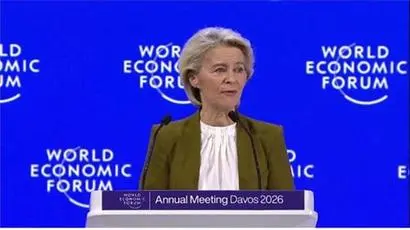
This is the so-called '28th regime.' It grants a 'common EU corporate personality' that companies can choose, without affecting the existing legal systems of the 27 member states. The '28th regime' concept was officially proposed in the 'Future of the Single Market' report released by former Italian Prime Minister Enrico Letta in April 2024.
The key is not to abolish the complex corporate laws of the existing 27 member states. Instead, it involves adding an additional, separate corporate framework that is commonly applicable across the entire EU. Entrepreneurs can choose whether to establish a domestic entity—a GmbH in Germany or an SAS in France—or a common EU entity, 'EU Inc.'
The main provisions are groundbreaking. First, it is possible to establish a company with as little as 1 Euro in capital, aiming to lower the threshold and remove barriers to entry. Second, the goal is to enable incorporation within 48 hours. The plan is to allow 100% online registration within two days, omitting complex notarization procedures. Third, it adopts standard articles of association based on a standardized governance and operational rule set recognized equally across all 27 EU nations. Finally, it standardizes the tax systems and rights structures for stock options, which currently vary by country, allowing companies to recruit talent across Europe with a single contract.
The Fruits of a Grassroots Petition
EU Inc. is not a product of ivory-tower bureaucrats. It is the result of a massive petition that began in 2024, when entrepreneurs wearing the blue 'EU Inc.' caps—symbolic of the European startup scene—flooded LinkedIn.
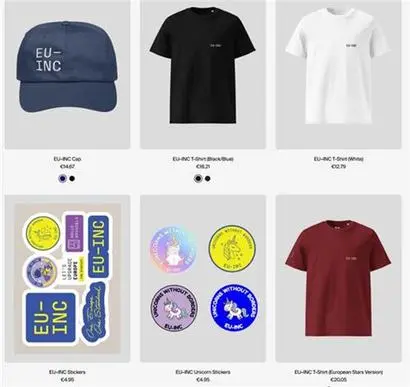
More than 13,000 innovators joined this petition, including leaders of Europe's representative unicorns, such as Hanno Renner of Personio (Germany), Jarek Kutylowski of DeepL, and Anton Osika of Lovable, currently one of Europe's hottest startups. To the outcry from the field asking, "The U.S. has Delaware, why does Europe have to start over 27 times?", the EU responded with 'systemic reform.'
What Will Change with EU Inc.?
For startups, 48 hours does not simply mean faster paperwork; it means having the time to immediately execute expansion strategies. Until now, expansion within Europe took longer than 'launching the first product.' Because corporate forms, company laws, and labor laws differed by country, one had to start from scratch even after validating the business in one country.
Once EU Inc. is introduced, the paradigm of the question will shift. Entrepreneurs will no longer waste time agonizing over "which country's laws are more favorable." Instead, they can focus on "which market to target first." The era where the geography of incorporation blocked the geography of strategy is coming to an end.
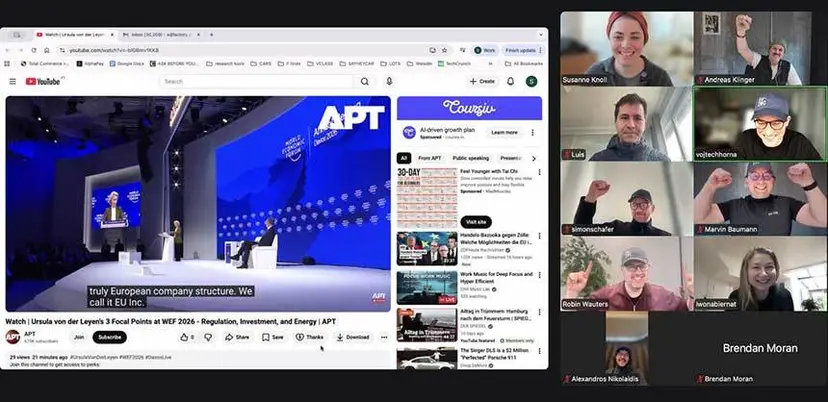
There is another reason why the European startup scene is so enthusiastic: the unification of the 'language of investment.' Until now, European VCs cited 'location of incorporation' as a major risk during investment reviews. Discussions such as the "closed nature of a German entity" or the "complexity of a French entity" delayed deal closings. However, once the common framework of EU Inc. settles, investors can focus on the essential questions: product, market, and execution capability. In particular, once stock option regulations are standardized, recruiting talent across borders will become much easier. It is a powerful weapon for Europe to regain the speed of capital and talent in response to Silicon Valley in the U.S.
Korean Startups Also Shifting from 'Individual Attacks' to 'Integrated Targeting'
This is also welcome news for Korean startups dreaming of entering the European market. The first step is no longer deciding "which country's corporate entity is more favorable." The key is "whether to adopt an expansive structure covering the entire EU from the start."
This change is both an opportunity and a challenge. As the complex administrative barriers of 27 countries shrink into one, entry strategies will become simpler, and it will become an era where one is evaluated based on ability after properly navigating regulations.
The EU Inc. bill is expected to be finalized within the first quarter of 2026. Therefore, companies looking to enter Europe need to think specifically about how to respond to this change. If you plan to operate in two or more European countries simultaneously, have the intention to raise global capital from European VCs, or intend to actively utilize stock options for key local talent, EU Inc. is news you must pay close attention to. Europe is currently building a massive 'digital single playground' by reflecting the voices of entrepreneurs. It is time for our companies to stop seeing Europe as a subject of 'individual attacks' and start redrawing strategies by viewing it as 'one giant market.'
The author, Lee Eun-seo, studied law in Korea and theater in Berlin. Based in Berlin, a city of art and a hub for European startups, she leads 123factory, connecting the startup ecosystems of Korea and Germany while growing along with the city.