

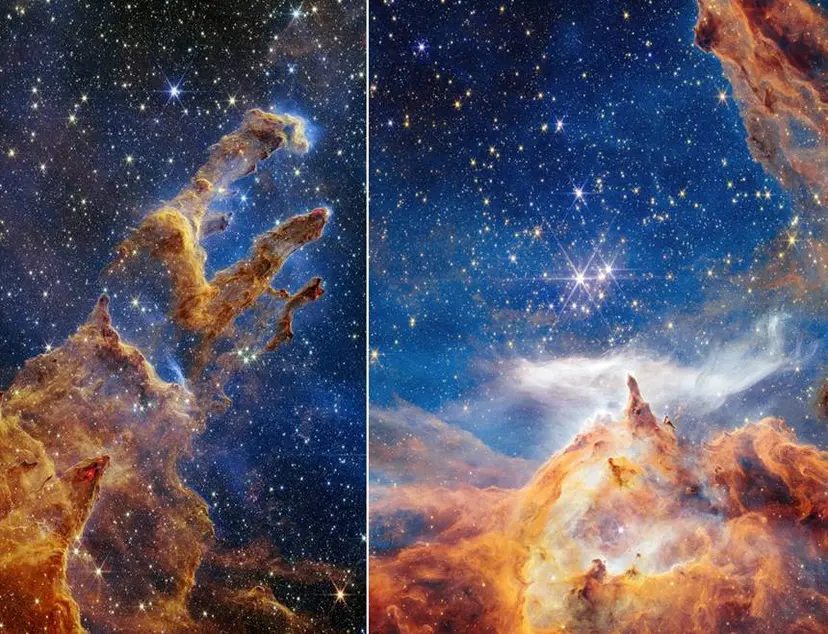
[비즈한국] On the reporter's computer desktop, there is a photo of the Pismis 24 star cluster taken by the James Webb Space Telescope (JWST). The dreamy landscape, which looks as if clouds and mist are wrapping around mountain peaks under a dark blue night sky, actually captures the incredible scene where countless stars are born. Located in the heart of the Prawn Nebula in the direction of the constellation Scorpius, about 5,500 light-years from Earth, Pismis 24 is one of the places closest to humanity where stars are actively being born. Thanks to the JWST, humanity can now track the secrets of star formation and stellar evolution taking place there.
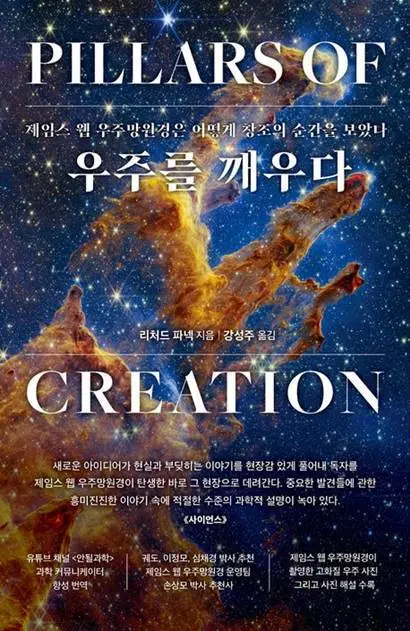
The recently published 'Awakening the Universe' tells the thrilling story of the tumultuous birth and incredible achievements of the James Webb Space Telescope, a 'game changer' in astronomy. The 'James Webb Space Telescope' is considered one of the greatest scientific achievements humanity has produced since 2020. While its 'predecessor,' the Hubble Space Telescope, expanded the horizons of astronomy for over 30 years by observing the deep field, various galaxies, and supernovae, the James Webb has expanded those horizons to an entirely new dimension.
The JWST is an infrared telescope with a larger mirror than Hubble, which views in the visible and ultraviolet ranges, allowing it to see further into the universe (into the more distant past). The universe is expanding at an accelerating rate, and the farther away a celestial body is, the faster it moves away from us. Due to the Doppler effect, the light from these celestial bodies undergoes redshift and shifts into the infrared range. Therefore, to see the farthest, oldest parts of the universe, an infrared telescope is essential. The James Webb Space Telescope was born under the ambitious goal of finding the 'first light' and uncovering the origins of the universe.
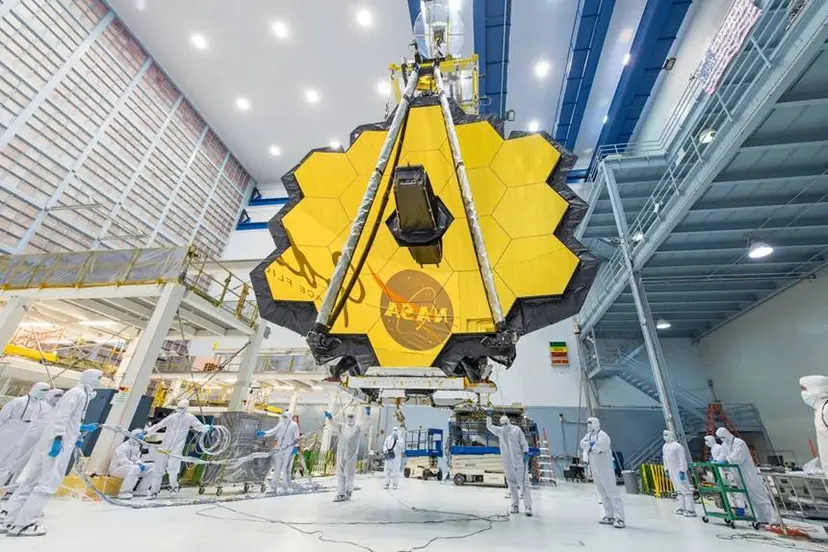
Of course, achieving such a goal was not easy. The JWST can be called a colossal dream that thousands of people have dedicated themselves to for 30 years. The process of turning that dream into reality was closer to a 'nightmare.' The initial budget was $1 billion, but it gradually ballooned to $10 billion (14 trillion won) in the end. The scheduled launch date was also pushed back from 2007 to 2014, then to 2018, and again to 2021. Ultimately, the day the JWST flew into space was the morning of Christmas, with only 6 days left in 2021.
Building the telescope was also a series of impossible challenges. The incredible idea was realized of dividing the massive 6.5-meter mirror into 18 hexagonal segments because it could not fit into a rocket, and then unfolding and aligning them in space. Additionally, to eliminate the telescope's own heat, which must operate at cryogenic temperatures, a tennis-court-sized, five-layered sunshield was built and deployed in space.
The process was fraught with political pressure, budget cuts, and technical failures. Even the COVID-19 pandemic intervened... The fact that the JWST finally flew into space after overcoming all these adversities is proof of what humanity is capable of achieving.
On the morning of December 25, 2021, millions of people around the world watched the launch of the JWST. The rocket launch was a success. However, 344 steps remained. If even one failed, the massive project would go down the drain. Starting with the first solar panel deployment, the biggest hurdle was the deployment of the sunshield. 107 release devices, 90 cables, and 400 pulleys had to work perfectly. It took a full week to unfold the sunshield. A few days later, the primary and secondary mirrors also unfolded, creating a perfect honeycomb shape. The JWST had finally opened its eyes!
Finally, on January 24, the JWST arrived at its destination, the Lagrange L2 point. Located 1.5 million kilometers from Earth, this is where the gravity of the Sun and Earth are in equilibrium. This allows it to maintain its orbit with minimal fuel and take pictures from behind the Earth, almost completely shielded from the bright ultraviolet influence of the Sun and Earth.
Two months later, NASA released the first test image taken by the JWST. It was a photo of a single, ordinary star called 2MASS J17554042+6551277, but its sharpness was close to the theoretical limit. What was particularly surprising was the background. Countless galaxies were embedded around the star like jewels. During the test phase, the JWST had already sent back results that rivaled the deep field images taken by Hubble.
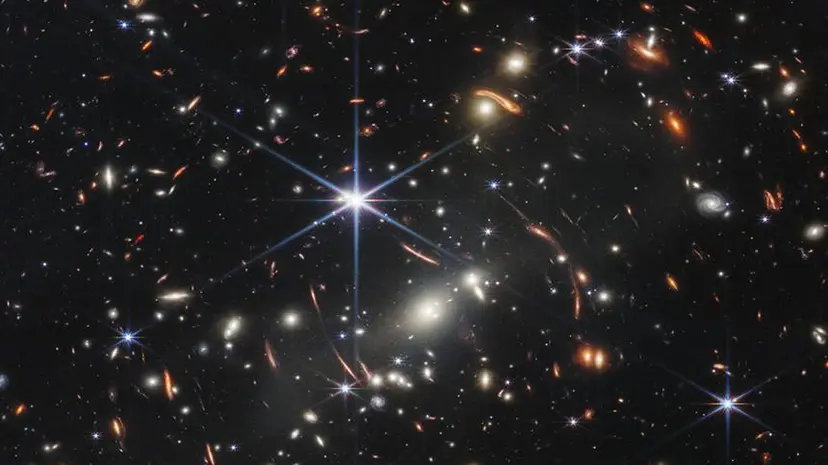
Then, on July 12, the first deep field image of the SMACS 0723 galaxy cluster taken by the JWST was released. Even more distant, darker, and older galaxies that even Hubble could not see were vividly revealed. A patch of sky only the size of a grain of sand contained thousands of galaxies from the early universe 13 billion years ago.
With larger and clearer eyes, the JWST is rewriting the history of astronomy. Now, astronomers around the world are analyzing the JWST's observational data to uncover the secrets of the universe.
'Awakening the Universe' tells the story of the crises and moments of challenge for the JWST as vividly as a documentary. At the heart of those moments are 'people.' Riccardo Giacconi, director of the Space Telescope Science Institute, who proposed the development of a successor telescope before Hubble was even launched; Alan Dressler, a researcher at the Carnegie Institution for Science in Washington, who persuaded NASA to make it an actual project; Mike Menzel, who designed the sunshield; Lee Feinberg and the engineers who tested the massive primary mirror after segmenting it into 18 pieces to ensure it functioned properly; NASA's Heidi Hammel, who showed the rings of Neptune captured by the JWST to her cat; and countless astronomers who analyze JWST data to approach the origins of the universe.
Author Richard Panek connects the stories of all these people to tell an exciting tale of how humanity's 'new eye' was built and what it saw. Additionally, the translation and commentary by astronomer and YouTuber 'Hangseong' Kang Sung-ju make it easy and fun to read, even for those unfamiliar with astronomy. The book also includes color photographs of the main images captured by the JWST. The Pillars of Creation, the Cosmic Cliffs, Stephan's Quintet, the Cosmic Hourglass, and the rings of Jupiter and Neptune are just some of the unbelievably sharp and beautiful images of galaxies and the solar system that are a treat for the eyes.
Oh, and unlike other space telescopes named after famous scientists like Kepler, Hubble, and Chandra, the James Webb was named after James Edwin Webb, the second administrator of NASA. Webb led NASA during its golden age of the space race, including the Apollo missions.