

[비즈한국] The government will supply 60,000 housing units by 2030, focusing on prime locations in the Seoul Metropolitan Area. Approximately 30,000 units are expected to come from Seoul alone, with over 10,000 units from the Yongsan area, the heart of Seoul. The government emphasized that since these projects were identified through cooperation between ministries and local governments, the supply is highly executable. However, the Seoul Metropolitan Government, which oversees half of the supply volume, has pushed back against the government-led supply plan, calling instead for the vitalization of private redevelopment projects.
Koo Yun-cheol, Deputy Prime Minister and Minister of Finance and Economy, announced the 'Measures to Expand and Expedite Urban Housing Supply' at the Government Complex Seoul on the 29th. This is a follow-up to last year's September 7 housing supply measures, which aimed to supply over 1.35 million units in the capital region by 2030. The core of this supply plan is to provide 60,000 units by 2030—32,000 in Seoul, 28,000 in Gyeonggi, and about 130 in Incheon—by utilizing idle land in highly accessible city centers. Excluding the previously announced volume for Yongsan (6,000 units for the International Business District and 1,400 for Camp Kim), this adds up to about 52,300 units.
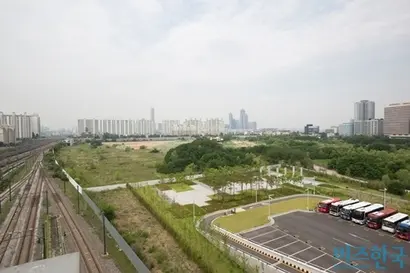
The area with the largest supply volume is Yongsan-gu, Seoul. The government plans to supply 13,501 units by utilizing sites near subway stations in the city center, such as Yongsan and Namyeong. This includes 10,000 units in the Yongsan International Business District, 2,500 at the Camp Kim site, 480 at the Yongsan reservoir, 324 in the Yongsan Urban Regeneration Innovation Zone, 150 at the Seobinggo Station 501 Intelligence Unit, and 47 at the Yongsan Post Office. Notably, the government increased the planned volume for the Yongsan International Business District and the Camp Kim site by 4,000 and 1,100 units, respectively, from their original 6,000 and 1,400. Through increases in floor area ratios and green space efficiency, they plan to begin construction in 2028 and 2029, respectively.
The Taereung Country Club (CC) development project in Nowon-gu, Seoul, which had long been stalled, will also move forward in earnest. The government plans to utilize the site of the military golf course to supply 6,800 units in the future. Low-to-mid-rise housing will be provided to avoid obstructing the view of the Joseon Royal Tombs, which are World Heritage sites. The area had previously been slated for development under the August 4 Real Estate Measures during the Moon Jae-in administration but was scrapped following resident backlash. The government plans to work with the Korea Heritage Service to quickly complete the World Heritage Impact Assessment and aim for construction to begin by 2030.
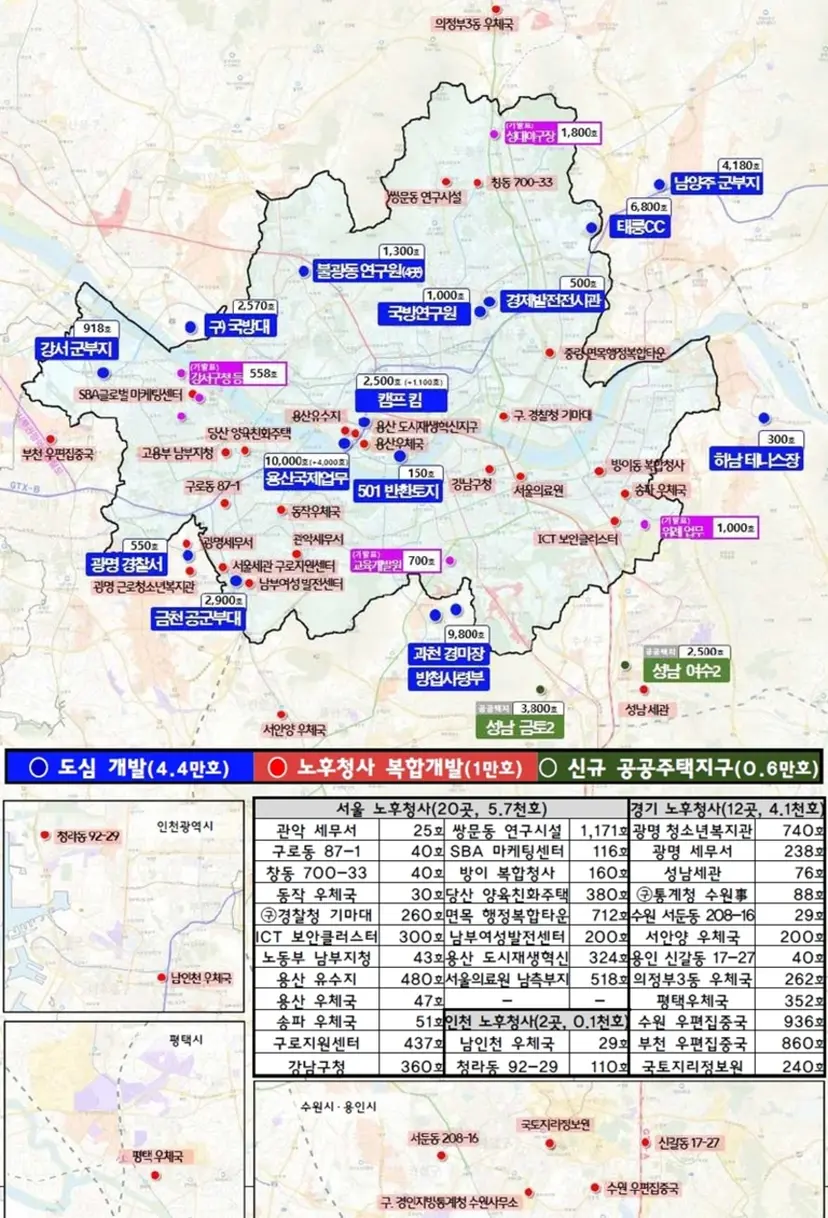
Large-scale supply is also expected in Gwacheon and Seongnam in the southern part of Gyeonggi Province. The government plans to develop the Gwacheon Horse Racing Park (LetsRun Park) and the site of the Defense Security Command together to supply a total of 9,800 units. The area will be developed into a cutting-edge business city that brings jobs and housing together, including an Artificial Intelligence (AI) techno-valley. Additionally, a new public housing district will be created near the Pangyo Techno Valley and Seongnam City Hall in Seongnam, Gyeonggi, with an additional 6,300 units to be supplied. This area will be developed into a high-tech, eco-friendly residential complex that integrates with the surrounding urban space.
Other public sites in urban centers slated for over 1,000 units include military sites in Namyangju, Gyeonggi (4,180 units); the Doksan Air Force base in Geumcheon-gu, Seoul (2,900 units); the Korea National Defense University site in Goyang, Gyeonggi (2,570 units); the Defense Research Institute and Korea Economic Development Exhibition Hall site in Dongdaemun-gu, Seoul (1,500 units); and the site of the Korea Institute of Public Administration, Korea Industry & Technology Institute, Korean Institute for Gender Equality Promotion and Education, and the Korean Women's Development Institute in Eunpyeong-gu, Seoul (1,300 units).
Dilapidated public government buildings in the city center will also be actively utilized for housing supply. The government stated it would develop housing, public offices, and social infrastructure as a mixed-use complex to provide residential space for young people and others. Target sites include the southern side of the Seoul Medical Center in Gangnam-gu, Seoul (518 units); the National Police Agency mounted police unit site in Seongsu-dong, Seongdong-gu, Seoul (260 units); educational research facilities in Ssangmun-dong, Dobong-gu, Seoul (1,171 units); and the Mail Processing Center in Suwon, Gyeonggi (936 units). The Ministry of Land, Infrastructure and Transport plans to continue identifying new project sites with relevant ministries and aims to enact special laws to accelerate the projects within the year.
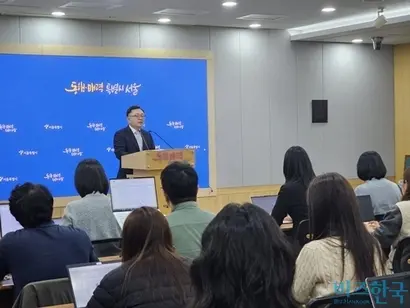
Minister of Land, Infrastructure and Transport Kim Yun-deok stated, "Through the September 7 measures, the government announced a goal to begin construction on over 1.35 million units in the capital region over 5 years. Since then, we have been implementing the supply plan without a hitch, including legislative and systemic improvements and pushing for construction to start on 110,000 units this year." He added, "We will continue to announce housing supply plans as additional volume is secured to build a more robust, long-term foundation for housing supply." In particular, the government emphasized that these projects are "highly executable because they were identified through cooperation between ministries and local governments."
The Seoul Metropolitan Government immediately protested the January 29 housing supply measures, pointing out that the government is too focused on public-led supply rather than private redevelopment projects. In a briefing on the 29th, Kim Sung-bo, Vice Mayor for Administrative Affairs of Seoul, emphasized, "Over 90% of Seoul's housing supply has been sustained by private momentum. In particular, apartments preferred by citizens are mainly supplied through redevelopment projects, accounting for 64% of last year's apartment supply. However, the housing supply pipeline was severed in the 2010s due to the cancellation of redevelopment zones and a halt in new designations. Activating private redevelopment projects is the fastest path forward."
Seoul City also pointed out issues with the supply volumes contained in the measures, specifically the Yongsan International Business District (increased to 10,000 units) and the Taereung CC site (6,800 units). Vice Mayor Kim noted, "(Seoul City) had argued for a maximum of 8,000 units for the Yongsan International Business District. This was to maintain the function of the international business district by managing the residential ratio in the area at an appropriate level (within 40%) and creating a high-quality residential environment." He added, "The supply effect of the Taereung CC site is minimal compared to the size of the greenbelt being released, making it difficult to achieve real effectiveness."