

[비즈한국] With Samsung Electronics005930 and SK Hynix000660 both recording record-high performance driven by the AI investment boom, the two companies have entered a full-scale competitive phase for leadership in the 6th-generation High Bandwidth Memory (HBM) 'HBM4' this year. In their respective earnings calls held sequentially on the morning of the 29th, SK Hynix expressed confidence in cementing its lead through superior quality, while Samsung Electronics signaled a fierce pursuit by setting a concrete schedule for 'shipments in February.'
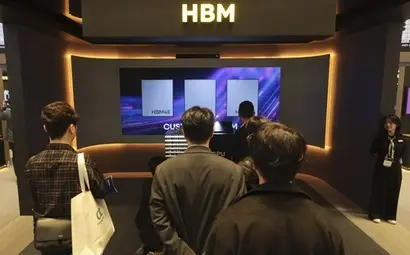
'Cementing the Lead' via Quality Advantage vs. 'Turning the Tables' via February Mass Production
After rewriting their all-time revenue records last year, both companies expressed their determination to secure profitability through high-value-added products like HBM and maintain an insurmountable technical lead, forecasting that supply-demand imbalances in the memory market will persist this year.
SK Hynix held an earnings conference call at 9:00 AM that day, stating, "Although we are currently maximizing production, it is difficult to meet 100% of HBM customer demand, so the entry of some competitors is expected," but added, "We believe our market leadership and dominant position as a supplier based on performance, mass-producibility, and quality will continue."
With memory semiconductor demand skyrocketing due to expanding AI infrastructure investments, memory chip demand is expected to overwhelm supply again this year. Currently, SK Hynix maintains its market-leading position by supplying its flagship product, HBM3E (5th generation), to major big-tech clients including Nvidia. Kim Ki-tae, Vice President of HBM Sales & Marketing at SK Hynix, said, "For HBM4, we are also aiming for an overwhelming market share, just as we did with HBM3 (4th generation) and HBM3E."
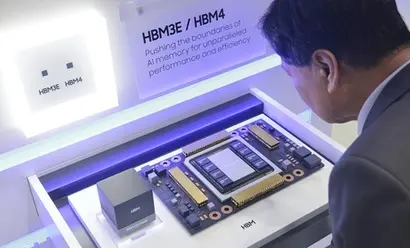
Samsung Electronics stated in its subsequent earnings conference call, "This year, HBM revenue is expected to improve significantly, more than tripling compared to last year," and "Major clients are already requesting early discussions regarding supply volumes for 2027 and beyond."
Regarding its HBM technical competitiveness, the company made it clear that it has entered the mass production phase for HBM4. They explained that they set performance targets exceeding customer requirements from the initial development stage of HBM4, supplied samples last year without the need for redesign, and have now entered the final stage of customer qualification.
Kim Jae-june, Vice President of the Memory Strategy & Marketing Office at Samsung Electronics, revealed, "We are receiving feedback from customers that we have secured differentiated performance competitiveness," adding, "HBM4 has already been put into normal mass production. Following requests from major clients, we are scheduled to ship HBM4 products, including our top-tier 11.7Gbps model, starting in February."
They also emphasized that they are pursuing the development of next-generation products in parallel. They stated that they plan to first sample standard HBM4E (7th generation) products mid-this year, and for custom HBM products based on 4-core dies, they intend to proceed with initial wafer inputs for each project according to customer schedules in the second half of the year.
Samsung's 'Return of Supercycle' vs. SK's 'New History of Operating Profit'
Both companies achieved their best-ever performance last year, led by HBM. Both far exceeded the consensus estimates of securities firms. Samsung Electronics surpassed 20 trillion won in quarterly operating profit in the fourth quarter of last year for the first time in the history of domestic companies, while SK Hynix achieved record-highs in both annual revenue and operating profit since its founding.
In the fourth quarter of last year, Samsung Electronics' semiconductor (DS) business recorded over 44 trillion won in quarterly revenue and 16 trillion won in operating profit, breaking its annual record for maximum revenue. Revenue increased by 23.82% compared to the same period the previous year, and operating profit surged 209.17% over the same timeframe. Both are quarterly records for revenue and operating profit.
On an annual basis, the company recorded 333.6059 trillion won in revenue and 43.6011 trillion won in operating profit, up 10.9% and 33.2% from the previous year, respectively. The annual revenue is the highest on record, following 2018 (58.89 trillion won), 2017 (53.65 trillion won), and 2021 (51.63 trillion won). The fourth-quarter operating profit of the DS division accounted for 82% of the company's total operating profit for that quarter, driving the performance. Strong performance, centered on the semiconductor business, is expected to continue in the first quarter of this year amid robust memory demand.
SK Hynix announced on the 28th that it recorded 32.8266 trillion won in revenue and 19.1695 trillion won in operating profit for the fourth quarter. It set a record for the highest quarterly revenue in its history and rewrote its own best performance metrics. Its operating profit margin reached an impressive 58%.
Accordingly, the annual revenue for last year on a consolidated basis was 97.1466 trillion won, with an operating profit of 47.2063 trillion won. Notably, the operating profit surpassed that of Samsung Electronics for last year. Revenue increased by 46.8% and operating profit by 101.2% compared to the previous year.
Questions regarding HBM4 and the state of the memory semiconductor industry were the first topics raised during the companies' earnings calls, proving the high level of market interest. In the midst of intensified competition, both companies highlighted their technological advantages while concurrently presenting concrete plans to expand supply capacity to meet skyrocketing demand.
Song Hyun-jong, President of SK Hynix, stated, "In a situation where supply delays versus surging AI memory demand have led to supply-demand imbalances and price spikes, we will prioritize building trust by meeting customer needs over short-term gains," and added, "We will expand new capacity at M15X to maximize productivity despite space constraints and accelerate the transition to advanced nodes to actively respond to surging demand."
Samsung Electronics also reaffirmed its determination to break through head-on with bold investments. Kim Jae-june, Vice President of the Memory Strategy & Marketing Office, emphasized, "In line with the strong AI demand, we plan to increase our 2026 capital expenditures significantly compared to the previous year," and "We will maintain a preemptive investment strategy of injecting facilities at the right time by utilizing previously secured Fab and cleanroom spaces." He added, "We also plan to continuously strengthen our advanced process development capabilities by continuing investments in the next-generation semiconductor R&D complex (NRDK)."