

[비즈한국] The Defense Acquisition Program Administration (DAPA) unveiled the specific design and project schedule for the next-generation Ocean Surveillance Ship (AGX-III), which had previously been shrouded in mystery, at a briefing in Changwon on January 26. Once this ship, which will lead a 'quantum jump' in the Navy's intelligence-gathering capabilities, is deployed, it is expected to dramatically enhance comprehensive surveillance and reconnaissance capabilities—not only for maritime environment data but also for tracking North Korean missiles and collecting signals intelligence (SIGINT). In particular, this competition is drawing significant attention from the defense industry, as it is expected to be a fierce two-way race between HD Hyundai Heavy Industries329180, which carries risks from security-related penalty points, and Hanwha Ocean042660, which is seeking a comeback.
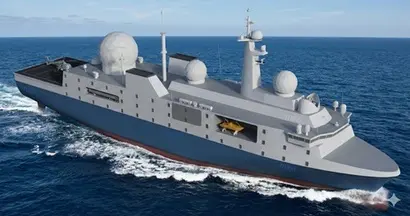
Ocean Surveillance Ships (AGX, Auxiliary General Ocean Surveillance), previously known as Acoustic Ocean Surveillance ships, focused primarily on underwater terrain surveying and long-range submarine detection using large sonars. However, in modern warfare, the status of these ships has been elevated to 'sea-based intelligence organizations' that integrate the collection of battlefield data, including optical imagery, communications interception, and radar signal analysis, beyond just acoustic intelligence (ACINT) collection.
Currently, the Republic of Korea Navy operates two ocean surveillance ships: the 'Sinsegi (AGS-12)' and the 'Singiwon (AGS-13).' These are classified (secret) assets operated under strict security, and public information about them is extremely limited. The first ship, Sinsegi, utilizes a SWATH (Small Waterplane Area Twin Hull) design to maintain stability even in rough seas and operates a Surveillance Towed Array Sensor System (SURTASS) capable of detecting submarine noise from hundreds of kilometers away, along with various signals intelligence collection equipment. The follow-on ship, Singiwon, is known to be equipped with a significantly upgraded indigenous towed sonar system, known as 'Baekryong.'
The next-generation Ocean Surveillance Ship (AGX-III) currently under construction is expected to feature 'game-changer' level performance that exceeds the operational concepts of previous vessels. While its hull shape resembles that of a standard merchant ship, making it appear ordinary on the outside, its interior is a 'wolf in sheep's clothing' packed with cutting-edge sensors and analysis equipment.
The most notable change is the large-scale adoption of unmanned assets. It will carry S-300 class ship-board unmanned aerial vehicles (UAVs), which have significantly improved flight endurance and payload capacity compared to the existing S-100 Camcopter, thereby expanding aerial surveillance capabilities. Additionally, dedicated Launch and Recovery Systems (LARS) for unmanned surface vehicles (USV) and unmanned underwater vehicles (UUV) will be added to the stern and sides of the ship. This means that unmanned assets can covertly infiltrate and collect information in hazardous waters or deep seas where the mother ship cannot easily approach, suggesting a dramatic increase in operational radius and survivability.
Furthermore, the AGX-III will be equipped with high-performance optical and radio measurement equipment capable of tracking ballistic missile trajectories. This will not only allow it to perform telemetry missions during our military's missile test launches but also contribute to acquiring precise information from the initial launch stages during North Korea's increasingly sophisticated missile provocations.
While ocean surveillance ships lack flashy armaments, they are core strategic assets that wield the most lethal weapon in modern naval warfare: 'information.' The value of the AGX-III shines even brighter, especially as North Korea is ramping up efforts to develop Submarine-Launched Ballistic Missile (SLBM) carrying submarines such as the 'Hero Kim Kun Ok.'
The next-generation ultra-low frequency towed sonar (ULTASS-III) and multifunctional signal analysis system to be installed on the AGX-III will be able to pre-emptively detect and track minute communication signals and submarine propulsion noise generated near North Korean submarine bases. In other words, it will act as the 'eyes and ears' that monitor the movements of North Korean strategic nuclear submarines (SSBNs) even before they set sail, and guide our Navy's strike assets in case of a contingency.
According to DAPA, the AGX-III project is a large-scale endeavor that will invest a total of 1.9719 trillion KRW from this year through 2035 to build two ships. An initial budget of 10.75 billion KRW has been allocated for this year, and the plan is to conduct proposal evaluations in May, select a basic design contractor by June, and sign the main contract.
Currently, the most likely candidate is HD Hyundai Heavy Industries, which successfully completed the conceptual design of the AGX-III. Having performed the conceptual design gives it the advantage of best understanding the military's Required Operational Capability (ROC). However, the key variable remains whether the security penalty points associated with the Korean Next-Generation Destroyer (KDDX) project will affect this bid as well. On the other hand, Hanwha Ocean is focusing its technological prowess in the special-purpose vessel sector with the goal of rebuilding its status as a surface ship powerhouse, making this order competition likely to be a fiercer technological and strategic battle than ever before.