

[비즈한국] The way we fight the war against cancer has changed. Domestic bio-companies Oscotec039200 and Hyundai ADM Bio have set out to target the root causes of 'resistance,' a survival strategy of cancer cells, rather than striking the cells directly. This represents a paradigm shift: by blocking cancer cells' evasion routes or breaking down their physical barriers, they aim to overcome the limitations of existing treatments. However, there are still significant hurdles to clear, such as complex resistance mechanisms and the economic burden of combination therapies.

Recently, Oscotec and Hyundai ADM Bio have been focusing on overcoming drug resistance, which is considered a major limitation of current anticancer drugs. Rather than developing stronger drugs, they are challenging themselves to improve the efficacy of existing treatments by starving cancer cells or dismantling their surrounding barriers.
Oscotec: Blocking Cancer Cell Exit Strategies, but the 'Hidden Passages' Remain a Problem
In cancer treatment, if a primary drug fails, doctors use secondary or tertiary treatments that are often more toxic. In the process, the cancer becomes more malignant, and the duration of effective treatment shortens. While previous anticancer research focused on switching to drugs with different mechanisms once resistance developed, Oscotec is focusing on the 'polyploidy' strategy, where cancer cells replicate their genome, increase in size, and enter a state of hibernation when they encounter an anticancer drug.
The core of Oscotec's 'anti-resistance anticancer drug' is to block the very process of subsequent resistance formation by inhibiting polyploidy. By addressing the root cause of resistance and suppressing recurrence, the company expects to extend patient survival by sustaining the efficacy of the anticancer drugs used in combination.
Yoon Tae-young, CEO of Oscotec, stated at an investor day event held at the Federation of Korean Industries (FKI) building in Yeouido, Seoul, on the 7th, "It is no exaggeration to say that developing anticancer drugs is a battle against resistance. It is simply a matter of how long the effect lasts and how much we can delay recurrence; in most terminal cancers, resistance and recurrence occur regardless of the treatment used. Our research direction will be to identify the primary factors that cause resistance in specific cancers."
Oscotec currently holds four anti-resistance anticancer drug candidates. In May and November of last year, the company received approval for Phase 1 clinical trial plans for 'OCT-598' in the United States and South Korea, respectively, and has begun administering it to patients.
However, there are limitations. Because resistance arises through various pathways, it is scientifically difficult to eliminate the possibility of resistance entirely. Concerns have also been raised that since cancer cells are adept at finding new paths when main routes are blocked, this could stimulate the development of other mutations. CEO Yoon also explained, "This does not mean we are capturing the entire mechanism of resistance all at once."

Hyundai ADM Bio: Breaking Down Barriers Around Cancer Cells to Secure 'Drug Pathways'
Hyundai ADM Bio's approach goes one step further. The company focuses on the fact that during treatment, cancer cells stimulate surrounding cancer-associated fibroblasts (CAFs) to excessively create rigid extracellular matrix (ECM) barriers. The argument is that this is a case of 'pseudo-resistance'—a physical barrier preventing drug access—rather than the drug itself being ineffective.
Hyundai ADM Bio is promoting 'Penitrium,' which increases the bioavailability of 'niclosamide,' a compound used as an anthelmintic for the past 60 years. Penitrium disrupts the link where overactive cells create the ECM through 'metabolic decoupling,' which reduces the energy activity of mitochondria, the powerhouses of cells. Hyundai ADM Bio explains that normal cells have energy reserves and will not suffer critical damage even if metabolic activity is temporarily suppressed.
Hyundai ADM Bio plans to utilize Penitrium for the development of treatments for both cancer and autoimmune diseases. Last March, the Ministry of Food and Drug Safety approved the company's Phase 1 clinical trial plan for Penitrium in prostate cancer patients. In December of the same year, they also received approval for Phase 1 clinical trials for breast and lung cancer patients and plan to explore its potential for treating a wider range of solid tumors in the future. They are also in the final stages of entering clinical trials for rheumatoid arthritis.
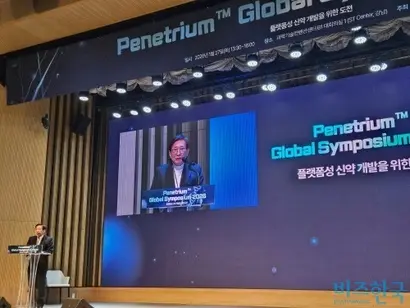
Jin Keun-woo, CEO of Hyundai ADM, stated at the '2026 Penitrium Global Symposium' held at the Science and Technology Convention Center in Gangnam, Seoul, on the 27th, "If clinical trials confirm the proportion of 'pseudo-resistant' patients among those resistant to treatment, we could change the map for all cancers, not just prostate cancer. While previous efforts focused on treating rheumatoid arthritis through immune suppression, we are exploring possibilities through non-immune suppressive methods."
Cho Won-dong, Chairman of Hyundai ADM Bio, revealed, "We will soon apply for a U.S. FDA clinical trial for prostate cancer. Regarding rheumatoid arthritis, we have already signed an agency contract with an overseas CRO (Contract Research Organization) and plan to apply for clinical trials in both South Korea and the United States simultaneously." However, some concerns remain that breaking down these barriers might inadvertently promote cancer metastasis, and overcoming such concerns is another task ahead.
The Paradox of 'Combination Therapy': High Costs and Toxicity Control are Key
Although the two companies use different approaches, they are both based on the recent trend of combination therapy rather than targeting cancer cells directly. This structure inevitably raises concerns regarding costs and toxicity.
Oscotec is conducting clinical trials combining the targeted anticancer drug Docetaxel with OCT-598, while Hyundai ADM Bio is using the immune checkpoint inhibitor Keytruda in combination with Penitrium. Docetaxel is known as a highly toxic anticancer drug, and Keytruda costs approximately 2.1 million won per vial (non-reimbursed). If the combination therapy does not receive insurance coverage, the economic burden on cancer patients will inevitably increase.