

[비즈한국] One of the great unsolved mysteries: Are black holes truly eternal? Stephen Hawking demonstrated the possibility that even black holes could slowly evaporate by emitting particles. This is Hawking radiation. It is the concept that just as a star with heat emits light, black holes can release energy in the exact form of blackbody radiation.
Hawking radiation depends on the curvature of the event horizon around a black hole. Heavy black holes have enormous event horizons, resulting in less curvature of spacetime. Conversely, small black holes have tiny event horizons and much more severe curvature. Therefore, Hawking radiation proceeds very slowly when a black hole is massive, but as it evaporates and becomes lighter, it accelerates uncontrollably. If a black hole were to become as light as an asteroid, it would have to spew out a staggering amount of blinding light over a very long period.
Recently, there was an event that excited astronomers. It was a massive event that raised the question: had we finally captured the legendary Hawking radiation? Can Hawking's final dream be proven through observation?
Astronomers believe that numerous primordial black holes were born throughout the universe immediately after the Big Bang. The early universe was filled with primordial black holes at high densities. These collided rapidly to grow in size, likely becoming the seeds of the supermassive black holes found at the centers of galaxies today. If, as we expect, there were many light primordial black holes in the early universe, shouldn't we be able to catch the blinding flashes they emit when looking into the distant, early universe?
Although they have all vanished by now, the high-energy particles emitted by these primordial black holes, which surely existed once, must still be drifting through space. Some astronomers hope that the detectors on the Voyager probes, which have already left the influence of the solar wind and entered interstellar space, will capture traces of these primordial black holes. Unfortunately, however, Voyager's batteries will soon shut down completely. Relying only on Voyager's faint signals to find traces of primordial black holes is therefore difficult.
However, on February 13, 2023, a surprising signal was detected by the KM3NeT neutrino detector installed deep in the Mediterranean Sea. KM3NeT detected the traces of Cherenkov radiation spread by high-energy neutrinos as they swept rapidly through the water, using thousands of optical sensors. KM3NeT, which is being installed on the seabed off the coasts of France and Greece, is still only partially constructed. Once completed, it will fill a massive volume of 1 cubic kilometer of seabed space with detectors. It can be seen as an underwater version of Super-Kamiokande.
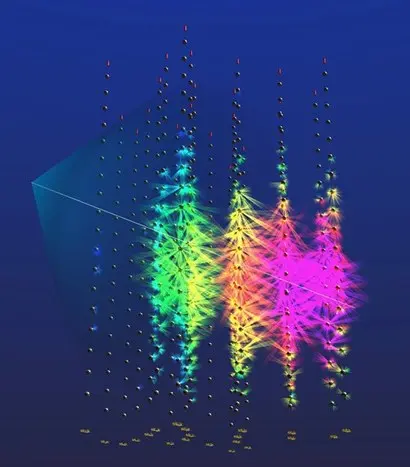
The neutrino captured by the detector carried an incredible energy of 220 PeV (peta-electron volts)! To put this into perspective, the most powerful particle energy achievable by the most potent particle accelerator on Earth today is not even 1/10,000th of this neutrino's energy. A particle of immense energy that humans could never replicate arrived from deep space! Astronomers were even hopeful that this might be the trail left by an ultra-early primordial black hole that was born less than a second after the Big Bang.
Based on the trail left by the detected neutrino, researchers inferred how heavy the black hole would have to be and how far it must have traveled if it were indeed the culprit. The result led to the conclusion that it must have been a primordial black hole with the mass of a single mountain, evaporating at a distance of only 1.2 billion km! That is only as far as Saturn. In other words, it suggests that a tiny primordial black hole—no bigger than a mountain, let alone an asteroid—that had survived from one second after the Big Bang until now, somehow ended up in our solar system by chance and recently suddenly vanished, emitting this high-energy particle. While thrilling, it is also suspicious.
In fact, it is not just primordial black holes that create high-energy neutrinos. Other powerful explosive phenomena, such as gamma-ray bursts or supernova explosions, can also emit neutrinos. If the neutrino was truly left behind by a disappearing primordial black hole, a similar level of gamma rays should have been detected consistently for several hours before the black hole vanished, not just at the final moment. To prove it was a real primordial black hole, high-energy gamma rays would have to have been detected from the same direction starting just before the neutrino detection.
There are already many hunters waiting for neutrinos and gamma rays all over the Earth. In this study, astronomers compared the observation results with IceCube, another underwater neutrino detector installed under the Antarctic ice, LHAASO (Large High Altitude Air Shower Observatory), which waits for high-energy cosmic ray particles in the high-altitude region near the Tibetan Plateau, and HAWC (High Altitude Water Cherenkov Observatory), located at the foot of the Sierra Negra volcano in Mexico at an altitude of 4,100 meters.
However, no traces of other neutrinos or gamma rays were caught anywhere. If the particle detected by KM3NeT was truly a high-energy neutrino from a primordial black hole, LHAASO should have captured hundreds of millions of gamma rays in the 7 to 14 hours before the black hole vanished. IceCube should also have detected at least 100 neutrinos in the final moment of the black hole's disappearance. Unfortunately, HAWC was not observing during that period. Ultimately, the identity of the culprit that sent the incredibly powerful ultra-high-energy neutrino to KM3NeT remains unknown. It is sad, but it seems it was not a primordial black hole that happened to enter the solar system.
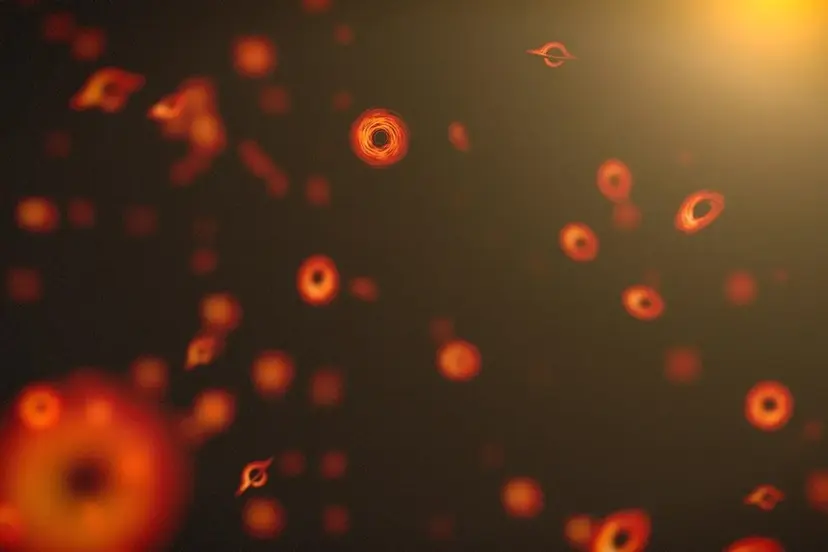
Some astronomers even suspect that primordial black holes might be the dark matter filling the universe, given that they existed since shortly after the Big Bang and are not easy to find through conventional optical observations. Others are trying to connect another mystery continuously detected at the edge of the universe, the early universe, through James Webb observations—the 'little red dots'—to primordial black holes. However, nothing yet perfectly matches what we expect from a real primordial black hole.
One thing is certain: according to our estimated models of cosmic evolution, the universe must have gone through a period where it produced a massive amount of primordial black holes. By now, they have either grown into supermassive black holes at the centers of galaxies, or the smaller ones that failed to merge have already quickly evaporated and vanished. If that were the case, high-energy particles left behind by the extinction of primordial black holes must be drifting aimlessly through space somewhere in the universe.
Although this recent controversy failed to definitively locate and verify a primordial black hole, it offers some comfort through a significant new possibility. We are now looking at the universe not only with classic high-energy electromagnetic waves like gamma rays and X-rays, but also with a new eye: neutrinos. We are also opening an era of multi-messenger observation, mapping where these signals originate. Just as we eventually captured gravitational waves—something we had once resigned ourselves to never observing—I hope that with the persistent efforts of astronomers, the day will soon come when the tail of another legendary entity, the primordial black hole, is finally caught. I hope for the day when the unfulfilled dream of the late Hawking comes true.
Reference
https://ui.adsabs.harvard.edu/abs/2025arXiv250524666A/abstract
About the author: Ji Ung-bae loves cats and the universe. After watching 'Galaxy Express 999' as a child, he dreamed of sharing the beauty of the universe. He is currently an assistant professor in the College of Liberal Studies at Sejong University, engaging in various science communication activities such as lectures and writing. He has authored books such as 'A Piece of the Universe Every Day,' 'Scientists of the Starry Universe,' 'I Know It Even If I Can't Go,' and 'Strange Questions That Come to Mind When Looking at the Universe,' and translated books including 'The Hitchhiker's Guide to the Real Universe,' 'How I Killed Pluto,' 'Quantum Life,' and 'Cosmigraphics.'