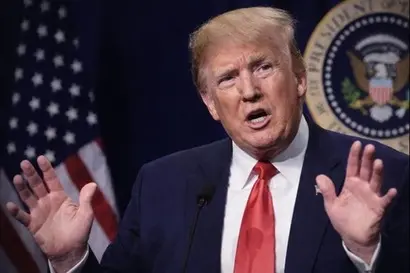
[비즈한국] Tensions are rapidly spreading across the South Korean economy as U.S. President Donald Trump mentioned plans to hike reciprocal tariffs on South Korean automobiles, pharmaceuticals, and timber back to 25%. While he cited "legislative delays" regarding the implementation of the Korea-U.S. trade agreement as the reason, market uncertainty is growing because these statements were made via social media rather than through official administrative procedures.
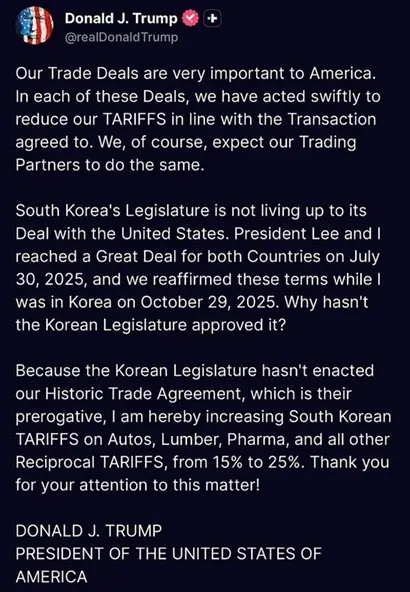
In a post on Truth Social on the 26th (local time), President Trump stated, "The U.S. lowered tariffs quickly in accordance with the trade agreement, but the Korean legislature failed to implement them," adding, "I am increasing all reciprocal tariffs on automobiles, timber, pharmaceuticals, etc., from 15% to 25%." He claimed that although he visited Korea last July and October to reaffirm the trade agreement with President Lee Jae-myung at the time, the Korean National Assembly has yet to finalize the related procedures.
More Likely a Pressure Tactic for Implementation Than a Deal Cancellation
Most analysts believe that this statement is closer to a political message intended to pressure implementation rather than a "cancellation" of the Korea-U.S. trade agreement. However, the market reacted immediately once automobiles were specifically mentioned as a target for the tariff hike. On the 27th, shares of Hyundai Motor005380 and Kia000270 fell by around 4% in early trading, and major parts manufacturers like Hyundai Mobis012330 also saw a simultaneous decline. This reflects concerns that if the tariffs become reality, a decline in price competitiveness and profitability would be inevitable given the high reliance of the automotive industry on exports to the U.S.
The possibility of a tariff hike also affected exchange rates and investment sentiment. The KRW/USD exchange rate showed volatile movement, crossing the 1,450 won mark shortly after opening. The market is wary that if tariffs are actually imposed, it could lead to concerns over slowing exports alongside pressure for foreign capital outflows. In particular, because the automotive industry has a wide reach including steel, logistics, and parts, analysts say this could dampen sentiment across the entire manufacturing sector, beyond just a single industry.
The Korean government is maintaining a cautious stance. The Presidential Office stated, "We have not received any notice from the U.S. side through official diplomatic or trade channels" and has begun to verify the facts. It is reported that an emergency inspection meeting was held, led by the Ministry of Trade, Industry and Energy, and that they are considering the possibility of discussions with the U.S. Department of Commerce and the Office of the United States Trade Representative (USTR). Inside and outside the government, analysts suggest that response strategies may vary depending on whether President Trump's remarks actually lead to tariff implementation or remain a bargaining chip to urge legislative and investment implementation.
Trump's Social Media Politics Grow Uncertainty; How Far Will the Ripple Effect Reach?
President Trump's erratic tariff policy is difficult to avoid criticism, as it creates structural uncertainty in the global market. The method of touting the signing of a trade agreement and tariff cuts as a direct achievement, only to then mention tariff hikes again due to legislative procedures or political judgment, undermines predictability. Since tariffs are a policy tool directly linked to corporate investment plans and supply chain strategies—rather than just diplomatic rhetoric or bargaining messages—critics point out that using social media to proactively shake the market lowers the credibility of U.S. policy.