

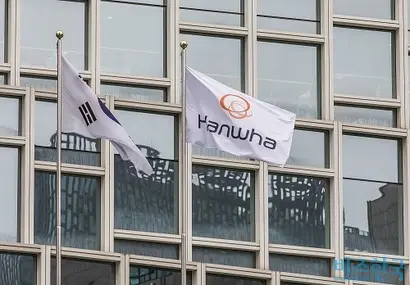
[비즈한국] Hanwha000880 Group has announced a plan for a physical split-off. Once completed, Vice Chairman Kim Dong-kwan (43) is expected to lead Hanwha Corporation, while his younger brother, Kim Dong-seon (37), Vice President of Hanwha Galleria452260, will lead a newly established entity called Hanwha Machinery & Services Holding. Key subsidiaries of Hanwha Corporation include Hanwha Aerospace012450 and Hanwha Solutions009830. While Hanwha Aerospace is enjoying high growth in both stock price and performance, the situation at Hanwha Solutions is not as bright, largely due to the downturn in the petrochemical industry. The securities industry estimates that Hanwha Solutions recorded a deficit last year.

Hanwha Group announced its split-off plan on the 14th. The main point is to incorporate affiliates in the tech and life sectors as subsidiaries after establishing the new entity, Hanwha Machinery & Services Holding. Hanwha Group's tech affiliates include Hanwha Vision, Hanwha Momentum, Hanwha Semitech, and Hanwha Robotics, while life affiliates include Hanwha Galleria, Hanwha Hotels & Resorts, and Ourhome. Business related to these sectors has been managed by Vice President Kim Dong-seon.
Defense, shipbuilding, marine, energy, and financial affiliates will remain as subsidiaries of Hanwha Corporation. Once the split is complete, Vice Chairman Kim Dong-kwan is expected to manage Hanwha Corporation, and Vice President Kim Dong-seon will manage Hanwha Machinery & Services Holding. Both are essentially stepping onto a management trial.
Hanwha Aerospace and Hanwha Solutions are considered the core subsidiaries of the Hanwha Corporation that Vice Chairman Kim Dong-kwan will lead. Hanwha Life Insurance088350 is also a subsidiary of Hanwha Corporation, but it is led by his younger brother, Hanwha Life President Kim Dong-won (41), rather than Vice Chairman Kim Dong-kwan. Another key affiliate, Hanwha Ocean, is controlled by Hanwha affiliates such as Hanwha Aerospace, which serves as the largest shareholder.
Both Hanwha Solutions and Hanwha Aerospace have seen their performance rise recently. According to quarterly reports, Hanwha Aerospace’s revenue grew 184.98% from 6.4151 trillion won in the first three quarters of 2024 to 18.2817 trillion won in the same period of 2025, while operating profit increased 174.17% from 832.2 billion won to 2.2817 trillion won. The outlook is also positive. Lee Han-gyeol, an analyst at Kiwoom Securities, stated regarding Hanwha Aerospace, "Given the order pipeline currently under discussion in Europe and the Middle East, we expect order intake this year to increase significantly compared to last year."
Hanwha Solutions' revenue also grew 23.55% from 7.7511 trillion won in the first three quarters of 2024 to 9.5761 trillion won in the same period of 2025. Additionally, while it recorded an operating loss of 407.2 billion won in the first three quarters of 2024, it recorded an operating profit of 125 billion won in the first three quarters of 2025.
However, the current sentiment is reportedly negative. Although Hanwha Solutions recorded a surplus in the first three quarters of 2025, it posted an operating loss of 7.4 billion won in the third quarter alone. While the full-year 2025 performance has not yet been announced, the securities industry estimates that Hanwha Solutions also recorded a deficit in the fourth quarter. The 2025 consensus for Hanwha Solutions (average of forecasts released by securities firms over the last 3 months) is an operating loss of 14.6 billion won.
Hanwha Solutions’ business divisions are largely divided into Chemicals, Advanced Materials, and New & Renewable Energy. Among these, the Chemicals division is negatively impacting overall performance, having recorded an operating loss of 149 billion won in the first three quarters of last year. This division produces basic petrochemical products such as PVC (polyvinyl chloride), LDPE (low-density polyethylene), LLDPE (linear low-density polyethylene), and CA (chlorine and caustic soda). Because the petrochemical industry is currently in a general downturn, Hanwha Solutions' performance is also struggling.
The New & Renewable Energy division performed relatively well with an operating profit of 300.3 billion won in the first three quarters of last year. However, a closer look reveals that while it earned over 100 billion won in operating profit in both the first and second quarters, the third-quarter operating profit was only 7.9 billion won. This was due to variables such as the delayed operation of the Hanwha Qcells Cartersville plant in Georgia, USA. Going forward, the U.S. government's supply chain restriction policies are expected to serve as a significant variable for the Cartersville plant's operations.
Meanwhile, Hanwha Solutions' financial health is also deteriorating. The debt-to-equity ratio has increased from 167% at the end of 2023, to 183% at the end of 2024, and 189% at the end of the third quarter of 2025. The net borrowing ratio has also risen from 78% at the end of 2023, to 98% at the end of 2024, and 112% at the end of the third quarter of 2025. While it is difficult to call this a dangerous level, financial deterioration is not welcome news. As debt increases, the interest burden grows accordingly.
These concerns are also reflected in the stock price. While the KOSPI index recently surpassed 5,000, Hanwha Solutions' stock price has failed to gain significant momentum. It exceeded 40,000 won at one point last May, but closed at 29,000 won on the 26th. This contrasts with Hanwha Aerospace, which hit a 52-week high of 1,398,000 won during trading on January 20th.
Yoo Jun-wi, a senior researcher at Korea Investors Service, analyzed in a report last December, "Despite the increase in electricity demand in the U.S., the (Hanwha Solutions) New & Renewable Energy cell and module division's short-term performance is expected to fall short of initial expectations due to utility and equipment defects at the U.S. Cartersville plant causing delays in normal operations. Given the Trump administration's unfriendly stance toward new and renewable energy, it is necessary to continue monitoring future policy changes."
Kim Seo-yeon, a senior researcher at NICE Credit Rating, also evaluated, "As of the end of September last year, Hanwha Solutions' net debt was 12.5 trillion won, an excessively high level compared to its profit-generating capability. With remaining debt levels exceeding 10 trillion won and high uncertainty surrounding profit-generation forecasts, improvement in debt repayment capacity based on operating cash flow is expected to be limited in the short term."
There are also positive outlooks. Baek Young-chan, an analyst at Sangsangin Securities, stated, "(The Cartersville plant) is expected to be capable of normal operation in the second half of 2026 through facility repairs. Looking at the U.S.'s active anti-China solar policies, it is clear that many opportunities will arise for non-Chinese solar companies in the long term." Business circles are focused on whether Vice Chairman Kim Dong-kwan will succeed in improving Hanwha Solutions' performance despite various concerns.