

[비즈한국] As the Korea Fair Trade Commission (KFTC) initiates sanctions against major paper companies for alleged price-fixing in paper for textbooks and books, it has been confirmed that Hansol Paper213500 and KleanNara004540 have simultaneously raised their white cardboard prices by 10%. With similar price adjustments following on the heels of the KFTC's investigation, industry insiders are pointing out that “the timing is extremely suspicious.”
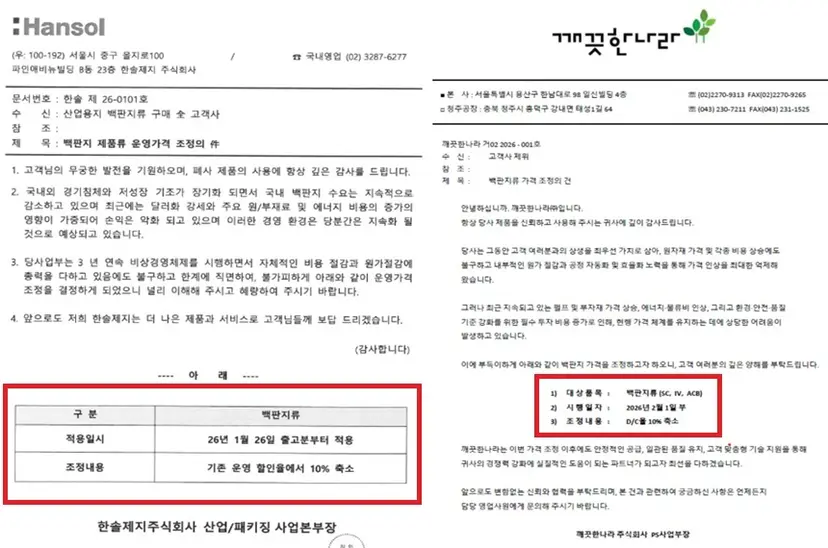
According to Bizhankook's reporting, Hansol Paper sent official notices to its clients stating it would reduce existing discount rates on white cardboard products by 10% starting from shipments on January 26, while KleanNara followed suit starting February 1. While formally described as an “operational price adjustment” or “reduction in discount rates,” it effectively has the same impact as a rise in supply prices.
Formally a discount reduction, effectively a price hike
In an official letter titled “Adjustment of Operational Prices for White Cardboard Products,” Hansol Paper cited the domestic and international economic downturn, a strong dollar, and rising costs of raw materials and energy as reasons for reducing its existing operational discount rate by 10%. The change applies to shipments starting January 26.
KleanNara also delivered similar news to its clients. In a letter titled “Adjustment of White Cardboard Prices,” it cited rising raw material costs and the burden of investment in enhancing energy, environmental, safety, and quality standards, announcing a 10% reduction in discount rates. The effective date is February 1.
Both companies explained the moves as “measures taken due to unavoidable changes in the business environment.” However, the industry is viewing this with skepticism, noting that both companies implemented the same 10% price hike via the same method—reducing discount rates—within just a few days of each other.
This latest price adjustment comes immediately after the KFTC issued investigation reports regarding alleged price-fixing in printing paper by six major paper companies, including Hansol Paper, Moorim Paper009200, Moorim SP001810, Moorim P&P, Hankuk Paper002300, and Hongwon Paper. The KFTC is reviewing sanctions against these companies for allegedly colluding on prices and price-hike rates between 2021 and 2024. The Commission plans to hold a plenary session as early as the first half of this year to determine the level of sanctions.
The KFTC investigation revealed circumstances where companies had aligned the timing and magnitude of price hikes, even varying the timing of their official notices to avoid suspicion of collusion. Given this, the fact that the white cardboard market is seeing similar, sequential price adjustments has led to reactions that “it feels like a repeat of the past printing paper collusion case.”
Of course, there is no evidence yet to conclude that the white cardboard price adjustments themselves are the subject of a KFTC investigation or illegal. Each company may adjust prices individually due to rising costs, and changing discount policies is a matter of corporate management judgment.
However, an industry official pointed out, “At a time when the KFTC has announced it will focus on cracking down on collusion in the education and publishing paper market, the fact that major companies have chosen the indirect method of ‘reducing discount rates’ at almost the same time and by the same margin is enough to raise questions in terms of market monitoring.”
Regarding this, a Hansol Paper representative stated, “We made our own decisions based on internal and external business environments, and it has nothing to do with other companies.”
White cardboard: The 'terminal of packaging,' impacting overall inflation
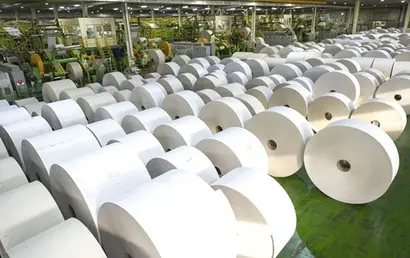
Hansol Paper and KleanNara hold 47% and 20% market shares (as of 2023), respectively, occupying the top two spots in the white cardboard industry. While not sold directly to consumers, white cardboard is a key intermediary material used in packaging for most consumer goods, including food, household items, pharmaceuticals, cosmetics, and home appliances. For this reason, fluctuations in the price of white cardboard affect the cost structure of manufacturing and distribution as a whole. This is why the industry views white cardboard as a 'hidden transmission route for inflation.'
The impact of price hikes appears first in mass-market consumer goods. Since snacks, ramen, instant food, detergents, and hygiene products have low-margin structures, the accumulation of packaging unit cost increases forces manufacturers to choose between raising prices, reducing capacity, or cutting promotions. Even if packaging costs are not a huge percentage of the total, repeated cost increases inevitably lead to adjustments in consumer prices.
Small and medium-sized manufacturers bear a relatively larger burden. They have less bargaining power regarding raw material prices and find it difficult to absorb the increased cost of packaging into other expenses. Eventually, their price competitiveness weakens due to higher supply prices, potentially leading them to be pushed out of distribution channels. In the long term, this could lead to a reduction in product choices and stronger price rigidity.
Such changes have a characteristic of being reflected across overall living costs with a certain time lag, rather than being immediately reflected in the Consumer Price Index. While the short-term impact may be limited, the common view in the industry is that it accumulates as 'silent inflationary pressure' over time. In particular, with local elections approaching and paper demand rising—all while sensitivity to living costs is high—the white cardboard price hike is being analyzed as a significant burden for policy authorities.
An official from the printing industry said, “White cardboard has a structure where once the price goes up, it rarely comes back down. If price burdens from white cardboard are added on top of printing paper, consumers will eventually feel that prices have risen across the board.”