

[비즈한국] Although Hanwha000880 Group is using a corporate spin-off to boost the independent management of retail and leisure under Kim Dong-seon, Vice President of Hanwha Hotels & Resorts, the development of the Incheon Dream Park—a project personally managed by Vice President Kim—has been at a standstill for over a year. Despite his ambition to transform the equestrian venue, which holds the memories of a 2014 Asian Games gold medal, into a world-class theme park, the project appears to be drifting without even breaking ground.
Concept was 'Incheon's Lotte World', Reality is a Local Amusement Park?
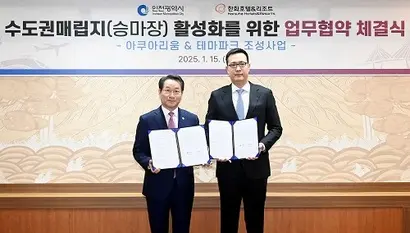
In January 2025, Incheon City and Hanwha Hotels & Resorts signed a Memorandum of Understanding (MOU) and began developing the area around the metropolitan landfill (Dream Park) in Seo-gu, Incheon. The plan was to transform the Dream Park equestrian venue, which had been drifting without a clear purpose since the 2014 Incheon Asian Games, into a world-class leisure complex.
The plan Hanwha presented at the time was effectively an 'Incheon version of Lotte World.' Hanwha Hotels & Resorts planned an indoor dome-type theme park equipped with an aquarium and amusement rides on the 170,000 square-meter Dream Park equestrian site, a space equivalent to 24 football fields, with an investment of 250 billion won. They expressed a strong will to build a landmark in the form of a massive dome, like Lotte World in Jamsil, that could be enjoyed regardless of the weather.
According to the original schedule, site preparation and design work should be in full swing by now, but more than a year after the MOU was signed, the project has yet to produce a finalized plan. As of now, the originally planned 2027 completion date is effectively impossible.
The reason for the slow progress lies in the necessity to secure public utility for the land usage. The Dream Park site is state-owned land, and for large-scale development projects using such land, the government strictly scrutinizes not only the private company's profitability but also its contribution to the local community and public value. However, the project was pointed out as 'lacking public utility' during the Ministry of Economy and Finance's preliminary review for private investment projects. The government emphasized that the project should not just build a theme park for admission revenue, but sufficiently incorporate facilities that give back to local residents and serve as public infrastructure.
Consequently, it is reported that Hanwha is completely revising its plan, moving toward excluding the 'dome-style indoor theme park' that was the core of the initial proposal. It is now highly likely that the project will be changed into an ecological park centered around a Ferris wheel or outdoor experiential facilities, with fewer indoor amusement facilities focused on profitability. A Hanwha Hotels & Resorts official stated, "The plan has changed from an all-indoor dome center to a hybrid indoor-outdoor form, though we are maintaining the originally planned aquarium."
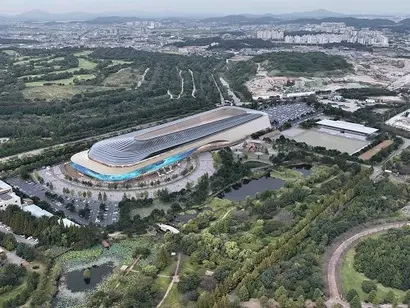
With the exclusion of the large-scale indoor dome, considered the project's core facility, observers speculate that the total project cost will be cut in half, dropping from the initial 250 billion won to approximately 110 billion won. In the local community, which had anticipated an 'Incheon Lotte World,' there are growing concerns that the project may end up as a 'half-baked amusement park.'
Hanwha explained that they are currently completely revising the project plan and are in preliminary discussions with the licensing authorities. A Hanwha Hotels & Resorts official explained, "Detailed discussions regarding the project method with the Sudokwon Landfill Site Management Corporation (SLC) have been delayed. We are currently in the stage of receiving preliminary reviews through the Incheon Public Investment Center after submitting a revised proposal before the formal submission."
The key remains the remaining procedures. Even after the preliminary review concludes, there are many hurdles to cross, including the KDI (Korea Development Institute) private investment eligibility review and the third-party bidding process. The aforementioned official added, "We are implementing the mandatory procedures for private investment projects, such as the KDI review and third-party bidding, and we expect construction to begin in the second half of 2028 or the first half of 2029."
Will Kim Dong-seon Prove His Management Capability?
As the project struggles to gain momentum, some observers suggest that the burden surrounding the Dream Park development could fall squarely on Vice President Kim Dong-seon. Analysis suggests that Kim's personal connections and involvement played a significant role in Hanwha Hotels & Resorts pushing this project.
The Dream Park equestrian center is a symbolic place for Vice President Kim, where he won a gold medal in the team dressage event at the 2014 Incheon Asian Games. Kim personally attended the January 2025 business agreement signing ceremony for the revitalization of the metropolitan landfill, stating, "It is very meaningful to be able to build a new landmark at the site of the Asian Games, which drew the attention of the entire nation in 2014. I will create a completely new leisure space so that this place can once again receive the nation's spotlight."
However, as the Dream Park development drifts without even crossing the threshold of government administrative guidelines, critics point out that the gap between the business vision Kim promised and reality is becoming apparent.
This project is considered one of the representative initiatives led by Vice President Kim, who has recently begun walking an independent path by taking charge of the group's retail and leisure divisions. Hanwha Group is currently pursuing the establishment of a new holding company, Hanwha Machinery & Services Holdings, through a recent corporate spin-off, while realigning its affiliates around Kim's retail and leisure divisions.
The business world interprets this spin-off as the launch of Vice President Kim's independent management system. Consequently, observers note that the success or failure of the Dream Park development could become a benchmark for evaluating Kim's management capabilities. However, apart from his commitment to the project, there is also a view that rising financial burdens could become a constraint for future progress.
Hanwha Hotels & Resorts has recently been aggressively expanding its footprint by acquiring Ourhome and Anto (Paraspara Seoul). In May 2025, it purchased Ourhome for 869.5 billion won, and in August, it acquired Anto for approximately 30 billion won, including a 29.5 billion won capital increase, on the condition of assuming 390 billion won in debt. With the financial burden growing due to successive large-scale M&As, the debt ratio of Hanwha Hotels & Resorts, which was 193.3% at the end of 2024, rose to 208.3% as of the third quarter of last year. Market analysts suggest that such financial pressure could act as another limiting factor in the process of carrying out large-scale development projects in the future.
Regarding this, Hanwha Hotels & Resorts stated that there would be no major setbacks in securing funds for the Dream Park project. A company official explained, "Since we are following the procedures for a private investment theme park project, we believe there will be no problems with securing funds by the second half of 2028 or the first half of 2029, when construction is expected to begin."