

[비즈한국] There is always a place in the Seoul real estate market that rises first. Core areas—the three districts of Gangnam, Yongsan, and the so-called 'Ma-Yong-Seong' (Mapo, Yongsan, Seongdong)—open the curtains of a bull market, and the remaining regions follow suit. This pattern has become so familiar that when people talk about Seoul's housing prices, they immediately picture the 'top-tier' markets. However, the market never stays in one scene for long. After the top tier heats up, there comes a moment when a place that has been quiet for a while suddenly surges. And that, in itself, is the signal that the phase of the Seoul market has shifted.
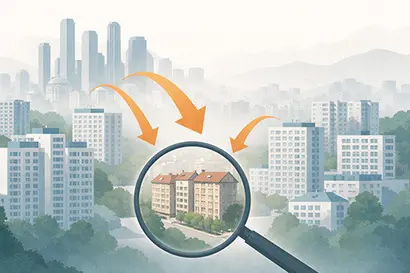
The rise in Gwanak-gu this week is exactly that signal. Gwanak-gu has been a 'place that rose less' or a 'place where even rising was limited' while the top-tier markets were surging. But why has it moved suddenly now? The sharp rise in Gwanak-gu cannot be explained by the single sentence, "I bought it because it was cheap." It overlaps with the capital structure of the Seoul market, the collapse of the jeonse (lump-sum deposit) market, the unintended fallout of regulations, and the revaluation of transportation and living spheres. Most importantly, this is not a 'coincidental price spike,' but a structural change where money is beginning to flow into 'transactable complexes.'
Why has Gwanak-gu 'remained quiet' until now?
Gwanak-gu holds a unique position in Seoul. It is close to Gangnam but is not Gangnam, and while it is connected to the city center, it does not fully enjoy the premiums of the city center. Above all, Gwanak-gu's housing market is not composed solely of apartments. There are many studio apartments, multi-household houses, and villas; demand from university students and office workers is mixed in; and the character of its living spheres is diverse. This means that even in a bull market, the 'way premiums are added' was limited.
There are three main reasons why Gwanak-gu was relatively quiet while top-tier regions were rising rapidly.
First, the product quality was not uniform. While top-tier areas were neatly arranged with 'newly built, semi-new, brand-name, and station-adjacent' properties, Gwanak had large deviations between complexes. Differences between hills and flat land, street noise versus interior unit conditions, and accessibility to stations and traffic flow dictated prices. In areas where 'livable lines' and 'lines to avoid' are extremely polarized even within the same neighborhood, the index is unlikely to jump at once, even in a bull market. The market always buys the 'safest products' first and the less convenient ones later. Gwanak was in a structure prone to being placed in that 'later' category.
Second, the 'psychological distance' from the top tier was far. Seoul moves not just by price, but by 'rank.' School districts, proximity to jobs, image, and the texture of demand act like a social hierarchy. While Gwanak has strong actual demand, it was not a section where the demand for trading up from superior areas would flock all at once. Especially when the market is unstable, people flock to places that are more certain. That is why Gwanak remained on the 'wait-and-see list' for a long time when top-tier areas were rising.
Third, the market often cooled down 'before the energy of the bull market could reach Gwanak.' Once the top-tier starts running, the warmth should descend to the mid-tier and lower-tier. However, interest rates, regulations, and psychological shocks frequently interrupted that flow. As a result, Gwanak missed the timing to 'heat up sufficiently' and remained in the shadow of a market where 'only the top tier rose.'
If so, the question changes. If Gwanak was quiet all this time, why is it moving now? That reason is crucial. Because Gwanak's current rise is not a 'delayed rise' but a 'rise in a shifted paradigm.'
The real reason Gwanak is rising: An era where money flows where it 'can'
The most powerful word in the Seoul market these days is 'can.' More important than the debate over whether it goes up or down is 'can you buy it?' In the past, people's desires moved first in a bull market. Now, however, the reality of loans, cash, and interest burdens moves before desire. In other words, the market sees transactions appearing first in places where you 'can afford to go,' not where you 'want to go.'
The first reason for the sharp rise in Gwanak-gu is that capital has begun to descend 'normally' from the top tier to the mid-tier. Once the top tier rises too high, transactions no longer happen actively. As prices rise, the pool of buyers thins, and one or two record-breaking high prices can no longer represent the market. Conversely, the mid-tier has a thick pool of buyers. This is because the price range enters a zone where they 'can buy.' Gwanak has re-emerged as a representative beneficiary of that 'affordable zone.'
The second reason is that the jeonse market is forcibly pushing up purchase demand. When the jeonse market is stable, people do not feel the need to make a major decision. However, when the jeonse market falters, choices narrow to two: wait while continuing to pay monthly rent, or move to a purchase within an affordable limit. Since Gwanak has a mix of university and office worker demand, jeonse demand is strong from the start, and the more unstable the jeonse market becomes, the faster the resolve to "just buy it" accumulates. This resolve is not represented by statistics, but by the stamps on contracts. Gwanak's rise this week means those stamps have increased.
The third reason is that mistrust in the villa and multi-household market has pushed the 'preference for apartments' to the extreme. In areas in Seoul with many multi-household houses and villas, people choose "apartments nonetheless." That structure is strong in Gwanak. When the market is unstable, apartments become safe assets, not just residences. Therefore, in Gwanak, when transactions increase, a tilt toward large-scale, brand-name, and verified complexes inevitably appears. This is why complexes like Gwanak Dream Town, Gwanak Prugio, and Gwanak Park Prugio have led the prices. It is not that all of Gwanak has risen, but that the complexes where transactions occur have pulled up the index.
The fourth reason is that expectations for transportation have pushed up the price ceiling based on 'future value' rather than 'current value.' Gwanak already has a powerful axis, the Line 2 subway. Add to that changes like the Sillim Line, and additional transportation plans act as 'expectations' in the market. Transportation doesn't just raise prices when it's completed. The market always reacts first at the moment when it 'seems very likely to happen.' The sharp rise in Gwanak-gu is the result of those expectations converging at once.
The final reason is that Seoul's bull market has now entered a phase of 'spreading by moving down one more level.' Bull markets are contagious. Only the speed and order of the contagion differ. The top tier runs first, and then the 'relatively less risen places' move. Gwanak's sharp rise shows that the market has entered a diffusion phase. What is important is that this spread is not scattered everywhere but is moving along 'preferred complexes for actual residence where transactions are possible.' This is why this rise should not be taken lightly.
The real message of Gwanak's sharp rise
The message of Gwanak-gu's rise is simple. The Seoul market is now moving from a 'market where only one side rises' to a 'spreading market.' And this spread is not moving blindly but following complexes preferred for actual living, price ranges where transactions are possible, and products with liquidity.
Therefore, our conclusion is this: Gwanak's rise may be the beginning, not the end. However, that beginning is not for all of Gwanak, but for the 'good' Gwanak. In other words, it is dangerous to be unconditionally excited while watching Gwanak rise, and it is also dangerous to unconditionally ignore it.
There is only one thing to do: decompose and analyze not just 'that Gwanak rose,' but 'which Gwanak rose.' That decomposition is survival, and that decomposition is profit.
Gwanak is currently showing the 'next scene' of the Seoul market. Whether to turn this scene into an opportunity or a nightmare depends solely on the buyer's attitude. Seoul is always expensive. However, what is more expensive is a 'house bought in a hurry.' What is needed now is not a decision, but an analysis. And Gwanak-gu's sharp rise is the test paper for that analysis.
Kim Hak-ryeol, director of the Smart Tube Real Estate Research Institute, known by the pen name 'Pashong,' served as a team leader at the Gallup Korea Real Estate Research Division. He operates and hosts the Naver blog 'Pashong's World Exploration' and the YouTube channel 'StuTV.' He is the author of several books, including 'The Republic of Korea Real Estate Manual (2025),' 'The Power of Gyeonggi-do Real Estate (2024),' 'Absolute Principles of Seoul Real Estate (2023),' 'The Future of Incheon Real Estate (2022),' 'Kim Hak-ryeol's Absolute Principles of Real Estate Investment (2022),' 'The Future Map of Republic of Korea Real Estate (2021),' and 'From Now On, Only Places That Will Rise, Rise (2020).'