

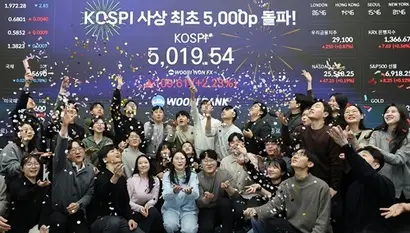
[비즈한국] After ushering in the era of the KOSPI 5000, the next challenge for the Lee Jae-myung administration is the exchange rate. With the won-dollar exchange rate soaring toward the high 1,400-won range, President Lee personally mentioned that it would "drop to around 1,400 won in a month or two," sparking diverse interpretations in the market regarding exchange rate trends and policy signals.
Since the President's remarks, actual market data shows cooling dollar-buying sentiment and a slowing rise in the exchange rate. The combination of a super-strong stock market, the National Pension Service's asset allocation issues, and the stabilization stance of foreign exchange authorities is lending weight to the "peak exchange rate" theory.

President's Unusual Currency Remarks: A Signal of Policy Intent
During his New Year's press conference on the 21st, President Lee addressed concerns that "the exchange rate could rise to 1,500 won" by stating, "According to foreign exchange authorities, it will drop to around 1,400 won in a month or two." It is highly unusual for a president to specify both an exchange rate level and a timeframe.
Normally, the government and the Bank of Korea do not publicly set target exchange rates or forecasts, even when introducing stabilization measures, because mentioning specific figures can send the wrong signals to the market. Nevertheless, the President's direct intervention is interpreted as an acknowledgment that the current foreign exchange market situation is a "managed risk" rather than mere volatility.
In fact, the statement was received as a strong message that foreign exchange authorities would not tolerate a rapid rise in the exchange rate, and it is credited with calming the "dollar hoarding" sentiment that had persisted for some time.
According to the financial sector, as of the 22nd, the balance of dollar deposits at the five major banks (KB Kookmin, Shinhan, Hana, Woori, and NH Nonghyup) stood at $63.2 billion, a decrease of approximately 3.8% from the end of last year. This marks a shift toward a decline after three consecutive months of growth.
In particular, corporate funds, which account for about 80% of total dollar deposits, have decreased rapidly. This is interpreted as a result of increased profit-taking dollar sales amid the perception that the exchange rate is nearing its peak. Indeed, the amount of dollars converted to won this month has significantly exceeded last year's average, and on the 21st, the day of the President's remarks, the daily conversion volume surged. Already, the foreign exchange market is noting that "the funds that were betting on an upward trend have begun to shift direction."
National Pension Service, a Variable for Both Stocks and Currency... Attention on January Fund Management Committee Meeting
Another key variable alongside the exchange rate is the National Pension Service (NPS). The NPS is unusually convening a Fund Management Committee in January to review its asset allocation strategy. This is the first time since 2021 that a meeting has been held before the closing of the annual financial statements.
The background to this is the super-strong domestic stock market. As of 2026, the target weight for domestic stocks in the NPS portfolio is 14.4%, with an upper limit of 19.4% considering the allowable range. However, due to the KOSPI surge, the proportion of domestic stocks has already significantly exceeded the target and is likely approaching the upper limit.
Under asset allocation principles, if this limit is exceeded, the fund may be forced to sell domestic stocks. This could not only increase stock market volatility but also impact the exchange rate. This is why the NPS's overseas investment ratio and currency hedging strategy are emerging as major variables in the foreign exchange market.
Previously, the Fund Management Committee noted the need to flexibly manage strategic currency hedging according to market conditions and is currently operating a relevant consultative body and task force. Global investment bank Goldman Sachs also mentioned in a recent report that the possibility of the NPS expanding its currency hedging could indicate that the won's weakness is entering its final stages.
Monetary and Fiscal Authorities Agree: "Current Exchange Rate is High"
The authorities' perception is largely the same. Deputy Prime Minister for Economy Koo Yun-cheol, regarding the high exchange rate, stated, "Good news may come from the National Pension Service," hinting at expectations for market stability. Regarding the "possibility of 1,400 won in a month or two," he said, "We will do our utmost."
Bank of Korea Governor Rhee Chang-yong also stated, "By any model, the current exchange rate level is high, and there is significant room for adjustment." However, he refrained from making specific comments regarding policy tools or target exchange rates.
Since the President's remarks, short-term trends have been changing, with the exchange rate rise slowing and dollar-buying heat cooling. Observers also suggest that external variables, such as the possibility of U.S. and Japanese foreign exchange market intervention and signs of a stronger yen, could act in favor of the won.
However, whether the exchange rate will truly stabilize at the low 1,400-won range depends on complex factors, including the global financial environment, U.S. monetary policy, and geopolitical variables. There remains a cautious view that the President's remarks are more of a signal indicating a direction rather than a promise guaranteeing a specific level.