

[비즈한국] Amid the global trend toward carbon neutrality, the production of solar panels and secondary batteries has increased explosively. Naturally, the recycling industry responsible for handling products that have reached the end of their lifespan is attracting attention as a future gold mine. Ironically, however, a phenomenon is occurring where recycling economic viability actually declines as manufacturing technology advances and product perfection improves. Technological innovation meant to protect the environment is, paradoxically, hindering resource circulation. Some point out that recycling should no longer be treated merely as a private for-profit business, but must be redesigned from the perspective of national strategic resource security and environmental policy.
Silver Content Drops by 80%, Solar Recycling's 'Cash Cow' Shrinks
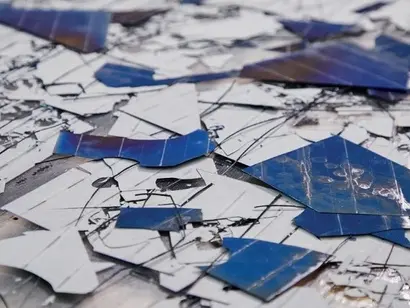
The biggest concern for the solar panel recycling industry is the rapid decrease in silver content within panels. In the past, solar panels used large amounts of silver as a key material to increase conductivity. Recycling companies generated revenue by collecting waste panels, separating aluminum frames and glass, and then extracting silver from the cells. In fact, while silver accounts for less than 0.1% of the total panel weight, it makes up a significant portion of recycling revenue, accounting for 40-50%.
However, the situation has changed drastically as manufacturers have advanced 'de-silvering' technology to cut costs. Solar panel manufacturers have been working to replace silver with cheaper metals like copper to reduce expenses. According to the International Energy Agency (IEA) report, 'End-of-Life Management of Solar Panels: Trends in PV Module Recycling,' the amount of silver used in recently produced panels has decreased by more than 80% compared to 2010. Once silver content falls below a certain level, a structural problem arises where the costs involved in the process (collection, transportation, precise separation) exceed the revenue generated from recycling. For recycling companies, their biggest 'revenue source' is disappearing.
Currently, the mainstream method for recycling waste solar panels is shifting from the 'shredding method'—where the entire panel is ground up without separating glass and backsheets after removing the aluminum frame—to the 'separation method,' which recovers resources with high purity by separating the glass. This is to ensure economic feasibility by recovering valuable metals like silver with high purity. Since this method incurs high recycling costs, profitability worsens when silver content decreases.
An official from the solar panel recycling industry stated, "Silver is currently the most significant source of recycling revenue after aluminum," adding, "We plan to maintain economic feasibility by increasing the volume of processing when panels with lower silver content arrive."
As NCM Fades and LFP Rises in the Battery Market, the Recycling Industry is 'Headached'
The secondary battery recycling market is in a similar situation. Previously, the recycling industry's primary target was NCM batteries, which contain nickel, cobalt, and manganese. Cobalt and nickel are rare and expensive, making them sufficiently economical to recycle. However, the landscape has changed as Lithium Iron Phosphate (LFP) batteries have emerged as the market mainstream due to the popularization of the electric vehicle (EV) market and intensified price competition.
While LFP batteries offer higher fire safety and lower costs compared to NCM batteries, they are the worst from a recycling perspective. Their main ingredients, iron and phosphate, are common materials available everywhere and have almost no resale value. In effect, the only resource worth extracting is lithium, and even that accounts for only 4-5% of the entire cathode material. Furthermore, LFP batteries have an 'olivine' structure with very stable chemical bonds, making the technical difficulty of breaking them down to extract lithium higher than that of NCM.
Although no domestic company has yet succeeded in the commercialization of LFP battery recycling, companies are jumping into the development of recycling technology as LFP batteries take the lead in the EV market. SungEel HiTech plans to build a 500t-scale pilot line in Gunsan this year. As battery recycling regulations are being introduced globally, they are planning a business model that processes entrusted LFP batteries. SK On096770 has published battery recycling technology in an international journal that recovers lithium using only water, carbon dioxide, and hydrogen peroxide.
A SungEel HiTech official said, "We agree with the necessity of LFP battery recycling, so we are preparing for technology development and commercialization," and added, "Government-level support is needed so that companies can jump into technology development, even if it is for the sake of the environment."
Government Support is Crucial to Prevent a Waste Crisis
The decline in recycling economic viability due to technological advancement has surpassed the threshold that can be overcome by the efforts of private companies alone. However, if waste panels and waste batteries are left neglected because they lack economic viability, it could result not just in environmental pollution, but in cutting off the supply chain for future energy industry raw materials.
The government is currently encouraging the recycling of solar panels and secondary batteries through the Extended Producer Responsibility (EPR) system. The EPR system is a policy that assigns a certain amount of recycling obligations to product producers, encouraging product recycling and imposing costs greater than the actual recycling cost on producers if they fail to comply. Through this, environmental costs are made to act as recycling economic drivers. For waste solar panels, EPR has been implemented since 2023. The Ministry of Climate, Environment, and Energy is also considering its introduction for EV batteries.
Experts suggest that for companies recycling LFP batteries or low-silver content panels that lack economic feasibility beyond regulations, the government should guarantee 'minimum profitability' through tax benefits or direct subsidies.
Eom Nam-il, a researcher at the National Institute of Environmental Research, said, "Since LFP batteries were introduced in earnest in Korea starting in 2021, they are expected to be scrapped in earnest in the 2030s," adding, "If the recycling market value is low and companies cannot approach it, government help such as subsidies is necessary."