

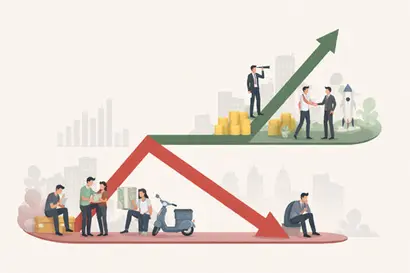
[비즈한국] In his New Year's press conference on the 21st, President Lee Jae-myung presented "Growth for All" as one of his strategies for economic development. This is aimed at preventing K-shaped growth, where the economy diverges—with one side rapidly improving while the other worsens. If K-shaped growth persists, it deepens polarization across industries, social classes, and regions.
The K-shaped growth in our society is trending toward worsening, a fact President Lee has emphasized several times already this year. Asset gaps are reaching extreme levels not only among salaried employees but also among self-employed business owners, and the asset gap between young people starting their careers and other age groups is widening by the day.
President Lee held his first official press conference—also serving as his New Year's press conference—since moving the presidential office to the Blue House under the theme, "A Great Transition Together, A Great Leap Enjoyed by All." President Lee proposed five measures to redraw the map of South Korea's growth.
Among these, he emphasized "Growth for All" as the second point to prevent the side effects of K-shaped growth. President Lee stressed, "We will overcome K-shaped growth, where one side grows rapidly while the other stagnates," adding that "The main players in solving this momentous task will be startups and venture companies that create new growth engines through constant innovation."
President Lee's commitment to overcoming K-shaped growth has been emphasized several times since the beginning of this year. Previously, during the National Report on Economic Growth Strategy on the 9th, he expressed concern, stating, "We are currently facing a major challenge known as K-shaped growth, which is different from the past," and adding that "The shadow of K-shaped growth is concentrated on the younger generation, who carry the future."
He subsequently ordered government officials to prepare countermeasures, saying, "We must do our best to ensure that the opportunities and fruits of economic growth can be shared by everyone, not just a select few."
Looking at current economic indicators, the polarization resulting from K-shaped growth is intensifying to the point where it is no surprise that the President has expressed concern multiple times. According to the National Data Agency, the average assets of the bottom 20% of households by income last year were 159.13 million won, while the average assets of the top 20% were 1.33651 billion won, a gap of a staggering 8.4 times. This is the highest level since the survey began in 2017.
In particular, the decline in the asset growth trend for the bottom 20% of households has had an impact. The average assets of the bottom 20% had been increasing annually starting from 130.78 million won in 2019, reaching 172.87 million won by 2023.
However, it decreased to 169.48 million won in 2024 and fell to the 150 million won range in 2025.
On the other hand, the average assets of the top 20% of households surpassed the 1 billion won mark in 2021 at 1.09952 billion won and have continued to increase. Although there was a slight pause in 2023 at 1.17458 billion won, the figure recovered to the 1.2 billion won range in 2024 at 1.2278 billion won, and surpassed the 1.3 billion won range last year.
As a result, the asset gap between the bottom 20% and the top 20% appeared to shrink from 7.2 times in 2022 to 6.8 times in 2023, but widened to a record high of 7.3 times in 2024, and broke the record again last year at 8.4 times.
This expansion of the asset gap is appearing among both salaried employees and the self-employed. Last year, the average assets of the top 20% of permanent employees were 1.24174 billion won, while those of the bottom 20% were 134.27 million won, a gap of 9.2 times. This is an even wider spread than the 8.6 times gap seen in 2024, which was the previous record high.
The situation is similar for the self-employed; last year, the average assets of the top 20% of self-employed individuals were 1.51759 billion won, while those of the bottom 20% were 238.77 million won, with the gap reaching a record 6.4 times.
The asset gap is also widening between the young generation, who are early in their careers and starting families, and other age groups. The average assets of households with a head under 39 years old were 314.98 million won last year, which is a record-high gap of 1.8 times compared to the average assets of all household heads at 566.78 million won.
The asset gap is even widening with households aged 60 and older, who are in their retirement years. Last year, the average assets of households with a head aged 60 or older were 600.95 million won, which is 1.9 times more than those of households aged 39 or younger.