

[비즈한국] Fully driverless robotaxis, operating without any safety drivers, have officially begun operations in the United States. This marks a transition for autonomous driving from mere demonstrations or experiments to a genuine transport service that carries passengers for a fare. In Korea, anticipation has grown following the formal launch of Tesla's Full Self-Driving (FSD) and positive remarks from Elon Musk regarding the Korean market. However, the introduction of autonomous driving for public transport, especially taxis, remains in its infancy. We examined when fully driverless robotaxis might become a reality in Korea.
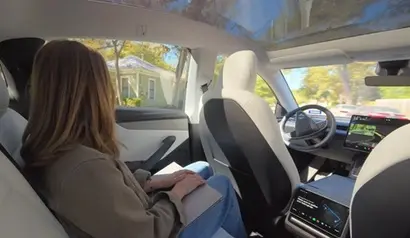
No Drivers, No Safety Monitors
Recently, in Austin, Texas, Tesla began operating some of its robotaxis without any safety personnel on board. The vehicles have neither a driver nor a safety monitor, and members of the public can hail them using an app and pay the fare. However, not all vehicles are currently operating driverlessly; the fleet is mixed, with some operating autonomously and others still requiring a safety monitor on board.
The vehicles are monitored in real-time by a control center. During the initial phase, chase vehicles and remote intervention systems are also in operation. Industry experts view this not as a declaration of full, unassisted autonomy, but as a phased expansion based on commercial service. Nevertheless, the significance is clear: autonomous vehicles with no humans on board are carrying ordinary citizens and generating revenue.
The reason fully driverless robotaxis are possible in the U.S. is that their legal and institutional framework differs from ours. The U.S. federal government does not fundamentally prohibit autonomous driving but instead provides guidelines centered on safety standards. Final operational approval is decided by state governments. In regions with flexible regulations, such as Texas, the concept of a 'driverless vehicle' is legally recognized, allowing vehicles without human occupants to provide paid transport if they meet specific requirements.
Liability in the event of an accident rests with the company operating the vehicle and the service, rather than an individual driver. By adopting a 'permit first, fix problems later' approach to commercializing autonomous driving, the U.S. was able to see fully driverless robotaxis emerge in specific regions first.
FSD Has Launched in Korea, but Robotaxis Are a 'Distant Future'
In Korea, Tesla's supervised FSD has recently been officially activated. Although the driver must watch the road and intervene at any time, it is seen as a significant signal of change, as it allows users to experience autonomous driving in actual urban environments. Additionally, Elon Musk's observation that Korea is a market that adopts new technologies rapidly has drawn attention.
However, experts generally agree that FSD and fully driverless robotaxis are at completely different stages. Korea's laws and systems are designed with the assumption of a human driver. There are no clear criteria for who should be held liable in an accident if a driverless vehicle provides paid transport, or how insurance should be handled. For this reason, most domestic autonomous driving pilot projects are predicated on having a safety monitor on board or using remote operation.
The urban environment is another variable. Seoul's traffic is high-density, with pedestrians, motorcycles, and illegally parked vehicles mixed together. This makes the application of autonomous driving more challenging than in cities like Austin. Therefore, the prevailing scenario in Korea involves a phased introduction, starting with limited conditions such as regulatory sandboxes (e.g., Pangyo, Sejong, Sangam), airport shuttles, and late-night low-speed zones.
However, consumer dissatisfaction with existing taxi services could be a variable. Late-night ride shortages or service inconsistencies could drive social demand for new mobility solutions. Furthermore, because driverless taxis are directly linked to the jobs of existing transport workers, there are still many hurdles to clear before reaching a social consensus.
The industry predicts that for the next few years, driverless technology will likely be introduced sequentially in limited sections and conditions. Ultimately, the timing of the introduction of fully driverless robotaxis will depend less on technical maturity and more on when the necessary systems and social consensus are established.