

[비즈한국] Jang Min-young, CEO of IBK Asset Management, has been appointed as the next CEO of IBK (Industrial Bank of Korea)024110. The CEO position at IBK had remained vacant for nearly a month following the retirement of former CEO Kim Sung-tae. Succeeding Kim, newly appointed CEO Jang Min-young faces numerous challenges, including resolving labor-management conflicts and promoting a transition toward productive finance. Due to a sit-in by the labor union blocking his entry, CEO Jang had to turn back on his first day of work on the 23rd.
The Financial Services Commission (FSC) announced on January 22 that it had recommended Jang Min-young, CEO of IBK Asset Management, as the new IBK CEO. The following day, on the 23rd, Jang Min-young took office as the new CEO of IBK. According to the Industrial Bank of Korea Act, the CEO is appointed by the President upon the recommendation of the FSC Chairman. Although former CEO Kim Sung-tae retired on January 2, the next CEO had not been decided, and the bank had been operating under an acting system led by Executive Vice President Kim Hyung-il. As Kim was considered a strong candidate for the next CEO, some viewed the FSC's recommendation of Jang as an unexpected move.
Newly appointed CEO Jang Min-young is an internal hire who has worked at IBK for over 30 years. He joined IBK in 1989 and served as Head of the Treasury Department in 2015, Head of the IBK Economic Research Institute in 2018, and Deputy CEO of the Risk Management Group in 2020. After stepping down as Deputy CEO, he moved to become Vice President of IBK Asset Management in May 2023 and was appointed CEO of IBK Asset Management in June 2024. With a two-year term as IBK Asset Management CEO, Jang returned to IBK before completing his tenure.
The FSC praised CEO Jang, stating, "He is a financial expert who has accumulated deep understanding of financial markets and expertise in risk management by serving in major positions at IBK. Based on this expertise, he is the right person to strengthen financial support for small and medium-sized enterprises (SMEs) and micro-business owners, and lead the grand transition to productive finance through policy finance."
The delay in selecting the next IBK CEO for nearly a month raised concerns in the market. Although the new year had begun, the unstable situation under an acting system persisted. With some executives nearing the end of their terms, annual organizational restructuring and regular personnel appointments were also delayed. Uncertainty in the field increased as it became difficult to establish business strategies under an acting management system.
It was also pointed out that a prolonged leadership vacancy could delay the transition to productive finance. During a report on the operations of financial public institutions under the FSC on the 13th, IBK announced the 'IBK-style Productive Finance 30-300 Project,' which aims to supply 300 trillion won in productive finance over the next five years until 2030. Specifically, the goal is to inject 250 trillion won into SMEs and micro-business owners, 20 trillion won into ventures, investments, and infrastructure, and 37.8 trillion won into supporting vulnerable groups and subsidiaries.
On that day, FSC Chairman Lee Bok-hyun mentioned to institutions including IBK, "We will examine whether the bank properly performs the role of a primer to redirect commercial funds toward cutting-edge industries, regional economies, and startups/ventures/SMEs that will become future growth engines." Acting CEO Kim Hyung-il, who attended the report, stated, "Productive finance is both the duty of IBK as a policy financial institution and what we do best. We will actively participate in the government's policy of a grand financial transition toward productive fields."
The new CEO must also resolve labor-management conflicts. IBK is at odds with the labor union over issues such as overtime pay and profit-sharing. The IBK Labor Union (the IBK Branch of the Korean Financial Industry Union) held a general strike resolution rally on December 29, 2025, and warned that it would launch a full-scale strike after the new CEO takes office if measures such as abolishing the total labor cost system were not prepared.
Immediately following the FSC's recommendation, the union protested, calling it the "appointment of a CEO with empty hands." In a statement on the 22nd, the union said, "Nominee Jang Min-young is a management-style candidate whose career is mostly limited to IBK; he is closer to a bureaucrat than a leader. We do not see the capability to persuade the President, stand up to the FSC, or influence the National Assembly. A state-run bank that places employees at the forefront of policy finance but does not compensate their labor has no tomorrow. All employees are disillusioned with the self-preservation and defeatism of the previous internal-hire CEO. For the sake of the organization, we cannot accept this appointment."
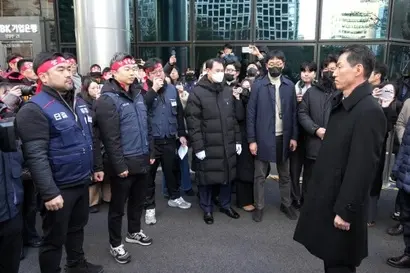
With such piled-up internal and external tasks, CEO Jang suffered the humiliation of being blocked on his very first day. The IBK labor union began a protest to prevent the CEO from entering the office on January 23. At 8:50 a.m. that day, CEO Jang arrived at the IBK headquarters in Eulji-ro, Seoul, but was blocked by the ranks of the union's protesters and eventually had to turn away.
The union previously held a 27-day protest in 2020 when Yoon Jong-won, former Senior Secretary to the President for Economic Affairs, was nominated as the next CEO during the Moon Jae-in administration. At the time, the union opposed the appointment on the grounds that he was an external figure with no experience working in financial institutions.
Union Chairman Ryu Jang-hee stated during the protest, "One cannot enter IBK with mere words of trying hard without alternatives to solve problems. We need a message regarding the 'securing of autonomy for IBK's budget and staffing' publicly directed by President Lee Jae-myung." The union also claimed on this day that as CEO Jang halted the regular personnel appointments originally scheduled for the 23rd, damages occurred, including wage losses due to delayed promotions and childcare/housing issues for those on leave or returning to work.
CEO Jang Min-young stated at the site, "I am aware that there were presidential instructions regarding IBK's issues and that the government is also working to resolve them. I also know the role the union played until the instructions were issued. Moving forward, labor and management will work together to solve these problems."