

[비즈한국] Prime Minister Kim Min-seok visited entertainment company HYBE352820 on the 21st, emphasizing the leap forward of K-pop. While the explanation is that it was part of an effort to foster the cultural content industry, some are pointing out that the visit was inappropriate. This is because HYBE's 'judicial risks,' including the ongoing investigation into Chairman Bang Si-hyuk, have not yet been resolved. Critics also argue that the government is merely relying on the halo effect of BTS without any concrete plans to foster the cultural industry.
“I Will Support You” Despite Unresolved Judicial Risks
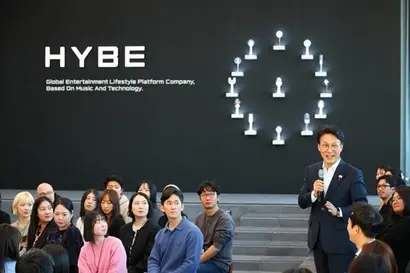
Prime Minister Kim Min-seok visited the HYBE headquarters in Yongsan-gu, Seoul, on January 21. This followed his visits to Nexon on the 15th and CJ ENM035760 on the 16th, with the stated purpose of confirming the global status of the K-content industry on-site. During the visit, Prime Minister Kim engaged in unconventional communication, such as having HYBE employees call him 'Min-seok-nim' during a town hall meeting. Prime Minister Kim praised the company, stating, "The root of the Korean Wave is liberal democracy," and added, "It is highly significant that BTS is performing their comeback stage at Gwanghwamun Square, which was once protected by light sticks."
The problem lies in the timing and the location. Currently, Chairman Bang Si-hyuk is under investigation for alleged violations of the Capital Markets Act (fraudulent unfair trading). He is suspected of gaining unfair profits through a private shareholders' agreement at the time of HYBE's listing. Recently, a personal data breach also occurred on 'Weverse,' the 50-million-strong fandom platform owned by HYBE's subsidiary.
As the second-in-command of the government, the Prime Minister effectively gave his endorsement to a company whose judicial risks remain unresolved. During the visit, Prime Minister Kim even stated, "I will support HYBE so that it can become a world-class cultural enterprise."
This contradicts the government's previous stance. President Lee Jae-myung has emphasized the advancement of capital markets for the 'KOSPI 5000 era.' Last June, he visited the Korea Exchange and stressed, "I will ensure that this marks the first day showing that anyone playing tricks in the stock market will face ruin." Regarding Coupang, which suffered a personal data breach, he even mentioned the possibility of a 'business suspension.'
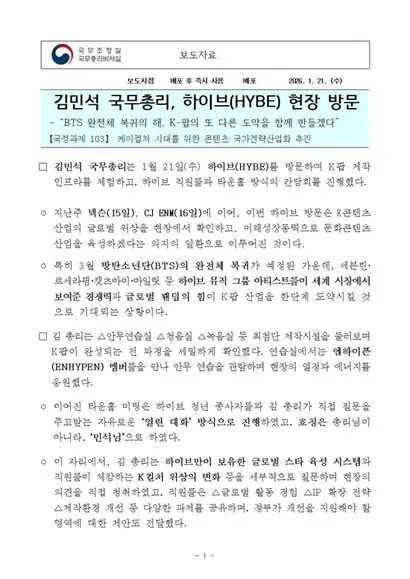
Questions are also being raised about the press release distributed by the Office for Government Policy Coordination, as it focused more on HYBE's influence than on government policy promotion. It listed HYBE-affiliated artists one by one and highlighted their 'state-of-the-art production facilities' and 'HYBE's proprietary global star training system.'
An official from the Office for Government Policy Coordination stated, "We visited because BTS is scheduled to return, including a commemorative event at Gwanghwamun, and because it is a central company of the Korean Wave to check the status of the K-pop industry. While we were concerned about judicial risks, it was a dimension of visiting a company that represents the Korean Wave. There was no interaction with Chairman Bang Si-hyuk." When asked what was meant by 'HYBE's proprietary global star training system,' they explained, "It was expressed that way because we visited HYBE; it did not mean that HYBE was differentiated."
"Should the Government Be 'Coattail Riding'?"
During his presidential campaign, Lee Jae-myung made the realization of a 'cultural powerhouse' a key pledge, promising to usher in a 300 trillion won K-culture market era and achieve 50 trillion won in cultural exports. According to his campaign platform, he specified expanding the national cultural budget and strengthening state support for the entire process of K-content creation. The goal of 'realizing a global Big 5 cultural powerhouse by strengthening K-content support' was even included as a top priority in his top 10 pledges.
This was reflected in the national policy agenda. National policy task No. 103, 'Promoting National Strategic Industrialization of Content for the K-Culture Era,' was explicitly mentioned in the press release of Prime Minister Kim's visit to HYBE.
The government has significantly increased related budgets. This year, the Ministry of Culture, Sports and Tourism (MCST) set a budget of 7.7 trillion won, an increase of about 10.3% compared to last year. Aiming to achieve the '300 trillion won' goal by fostering the content industry, the relevant budget was increased by about 26.5% to 1.6 trillion won.
However, critics pointed out that there is no concrete implementation plan for the '300 trillion won' pledge. A professor of Media and Communication at a university noted, "From the moment the 300 trillion won pledge was made, nobody knew where this number came from. Whether it refers to the scale of support or the scale of exports, no detailed plan could be found. In the end, they only presented a broad direction of fostering the industry without any substantial content."
Political circles have also pointed out the absence of an implementation plan for the 300 trillion won target. Furthermore, if related industries such as K-pop, K-drama, K-webtoon, K-game, K-food, and K-beauty are all combined, the revenue already exceeds 300 trillion won. At the comprehensive audit of the National Assembly's Culture, Sports and Tourism Committee last October, Representative Jung Yeon-wook (People Power Party) criticized, "The 'K-Culture 300 trillion won, 30 million foreign tourists' era touted by the Lee Jae-myung government is merely a slogan without substantial content." The criticism is that it lacks specific details and there is no change from the previous Yoon Suk-yeol administration's policies. At the time, MCST Minister Choi Hwi-young replied, "We will ensure that we inspect and revise the process during policy implementation."
Consequently, some point out that Prime Minister Kim Min-seok visited HYBE despite the controversy ultimately to use the BTS halo effect for policy promotion. Securities analysts predict that the 2026 BTS world tour alone will generate 1.3 trillion won in ticket sales and 450 billion won in merchandise sales.
Last October, the National Museum of Korea and the National Museum Foundation of Korea signed a Memorandum of Understanding (MOU) with HYBE regarding merchandise. About two months later, in a presidential briefing in December, MCST Minister Choi Hwi-young reported, "The National Museum of Korea will establish an expansion plan to allow for more comfortable viewing and eventually grow it into one of the world's top three museums."
Pop culture critic Kim Heon-sik pointed out, "It is hasty for the Prime Minister to visit a company where judicial risks have not been resolved. While it is right to support the achievements and activities of BTS, it is also important for the government not to 'ride on their coattails.' The government's role is to discover and foster idols and artists from small and medium-sized enterprises. In this respect, it is also inappropriate for the National Museum of Korea to conduct merchandise business, an area for small businesses, with HYBE. The government must recognize the current problems in K-pop, where the number of idols from small and medium-sized enterprises is decreasing and face-to-face performance culture is becoming scarce."