

[비즈한국] Workers at the Hyangnam Pharmaceutical Complex, the largest pharmaceutical production hub in Korea, have spoken out in unison to condemn the government's generic drug pricing policy. Tensions between the government and the pharmaceutical industry have reached a breaking point, with unions warning of collective action if the government pushes forward with its original plan.
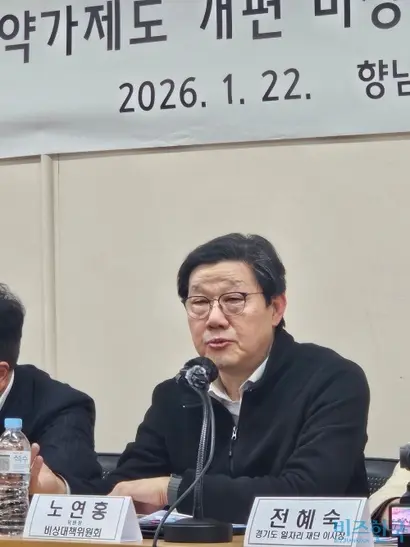
On the 22nd, a meeting of the 'Emergency Committee for Pharmaceutical Pricing System Reform for Industrial Development' was held at the Korea Pharmaceutical Cooperative conference room in the Hyangnam Pharmaceutical Complex, Hwaseong, Gyeonggi Province. The Hyangnam Pharmaceutical Complex houses 39 facilities from 36 companies, employing approximately 4,800 specialized personnel. The meeting was attended by Noh Yeon-hong, co-chairman of the Emergency Committee (Chairman of the Korea Pharmaceutical and Bio-Pharma Manufacturers Association), Cho Yong-jun, vice-chairman of the Emergency Committee (Chairman of the Korea Pharmaceutical Cooperative, Chairman of DongKoo Bio&Pharma 006620), Jeon Hye-sook, Chairperson of the Gyeonggi Job Foundation, and union leaders from over 30 companies. They argued that if the government's reform plan is implemented as proposed, the entire pharmaceutical industry would suffer, citing risks of employment instability, reduced R&D investment, and weakened production foundations.
Emergency Committee Chairman Noh expressed concern, stating, "If the reform plan is pushed through as originally intended, it is clear that industrial foundations will collapse, jobs will be lost, and the supply of essential medicines will become unstable." He added, "In particular, for the Hyangnam Pharmaceutical Complex, where small and medium-sized pharmaceutical companies are concentrated, the rapidly changing business environment could lead to job insecurity and a contraction of the local economy." The pharmaceutical industry projects that if the prices of approximately 21,000 listed drugs are lowered, losses could reach up to 3.6 trillion won annually. Given that the employment-inducing coefficient for the pharmaceutical industry is 4.11 persons per 1 billion won, it is predicted that 14,800 jobs could be lost in the industry alone. With an estimated 120,000 people working in the sector, this means more than 10% of the workforce could lose their jobs.
There are also concerns that lower drug prices will lead to a decrease in the production of domestic prescription drugs, further aggravating supply instability. There is significant anxiety that essential and life-saving medicines with low profitability will be hit the hardest. Even now, shortages of essential medicines such as antibiotics, labor induction drugs, and treatments for neonatal respiratory distress occur frequently. As of 2025, it is estimated that 106 out of 275 drugs in short supply, or 38.6%, are suffering from supply shortages due to worsening profitability.
Concerns have also been raised that the void left by domestic medicines will be filled by expensive imported drugs. Chairman Noh said, "If the production of essential and domestic prescription medicines is stifled, we will have no choice but to rely on high-priced imported alternatives."
Vice-Chairman Cho expressed concern that the management crisis for small and medium-sized pharmaceutical companies would worsen. With an average profit margin currently at only 4.8%, he argued that it would be impossible to survive if generic drug prices are cut further. Vice-Chairman Cho stated, "For small and medium-sized pharma companies, generic profits are the source of reinvestment for R&D on new drugs as well as maintaining GMP production facilities. If this cash cow is severed, factory operation itself will become uncertain, let alone innovation."
Some also voiced that the drug price cuts conflict with the government's own policy of stabilizing supply chains by domesticating active pharmaceutical ingredients (APIs). The self-sufficiency rate for chemical drug ingredients, including penicillin, which is not produced at all in Korea, remains in the single digits. Oh Sang-jun, chairman of the Gyeonggi Southern Region of the Chemical Industry Workers' Federation (FKTU) and labor union leader of Dongkwang Pharmaceutical 006320, raised his voice, saying, "Lowering drug prices forces us to seek cheaper raw materials, leaving us no choice but to import from China or India. This will lead to the production of low-quality drugs and could ultimately threaten public health as patients may need 4 to 5 days of prescriptions for conditions that should have been resolved in one or two days."
Laborers have also signaled that they will take collective action if the government forces the policy through. Lee Dong-in, secretary-general of the Pharmaceutical/Cosmetics Division of the Federation of Chemical Workers' Unions and labor union leader of Dongwha Pharm 000020, warned, "Since the government's plan is certain to collapse the pharmaceutical industry, we will take action to ensure the public understands the severity of the situation."
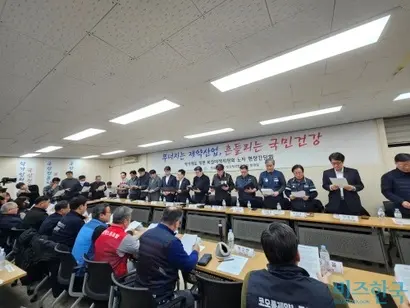
Chairman Noh expressed hope that the government would listen to the desperate voices of the pharmaceutical industry. He suggested, "The government has announced plans to finalize its drug pricing policy at the Health Insurance Policy Deliberation Committee scheduled for the end of next month and implement it starting in July. We propose halting the unilateral push for drug price cuts and discussing the matter in a social consultative body composed of pharmaceutical union leaders and the FKTU Chemical Federation's pharmaceutical and cosmetics branch leadership."
In November of last year, the government announced that it would lower the price ceiling for generic drugs from the current 53.55% of the original drug price to 40% in order to save on national health insurance finances. This includes plans to abolish the premium system that granted 59.5% of the original drug price to the first generic released for one year, and to reduce the number of generics under the same price cap from 20 to 10.