

[비즈한국] Once again, the world's attention is focused on the Swiss mountain village of Davos. However, the atmosphere at this year's World Economic Forum (WEF) is distinctly different from last year. Unlike last year, when AI innovation and global cooperation were at the forefront, this year's forum has transformed into an arena where geopolitical, security, and supply chain interests collide openly. While the official theme is the 'Spirit of Dialogue,' the actual messages exchanged in Davos were closer to the reshuffling of power rather than the restoration of dialogue. With U.S. President Donald Trump at the helm, Davos has ceased to be a venue for debating ideal norms and has become an 'economic battlefield' where each nation assesses its own interests.
The Greenland Controversy and AI Hegemony… A Snapshot of the Collapsed International Order
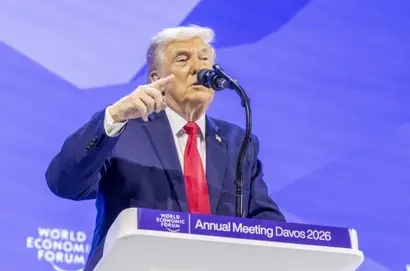
The most shocking scene at this forum was President Trump's declaration to resume negotiations for the acquisition of Greenland. He claimed that Greenland is essential to U.S. national security, and did not hesitate to make threatening remarks, stating, "I wouldn't use force, but if I did, it would be unstoppable."
In response, French President Emmanuel Macron appeared wearing sunglasses and strongly criticized the U.S.'s protectionism and logic of force, labeling it 'Brutalization.' President Macron countered that Europe would protect the multilateral order even if it meant resorting to measures such as selling U.S. Treasury bonds or employing coercive tools known as a 'trade bazooka' (Anti-Coercion Instrument, ACI). Canadian Prime Minister Mark Carney joined in. Prime Minister Carney asserted, "The rules-based international order that has protected us for decades is now over," and emphasized that "middle powers must arm themselves with 'value-based realism' for their own survival."
Chinese Vice Premier He Lifeng, while pointing out the meaninglessness of tariffs and trade wars, signaled a rebellion against the U.S.-led order by expressing China's will to grow its self-sufficiency as the world's 'market,' moving beyond being just the world's 'factory.'
The session that best illustrated the nature of this year's forum was 'AI Power Play, No Referees.' While discussions last year focused on ethical guidelines and cooperation in AI, the recognition that technology is synonymous with national security and weaponry has taken center stage this year.
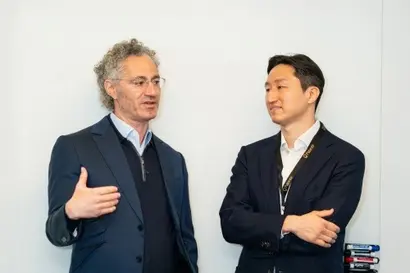
Palantir CEO Alex Karp, in a conversation with BlackRock CEO Larry Fink, emphasized the destructive impact AI has on defense, the economy, and social structures. CEO Karp highlighted that AI is not just a simple technological innovation, but a 'geopolitical weapon' that determines the survival of states and corporations, replacing everything from labor to immigration policies. He also warned that while the U.S. and China have succeeded in deploying AI on a large scale, Europe is facing severe structural problems.
The shift in the agenda was also evident in the climate crisis discourse. In his speech, President Trump vehemently criticized eco-friendly energy such as wind power, calling it a "Green New Scam," and declared energy self-reliance centered on oil, gas, and nuclear power. This shows that the carbon-neutral cooperation system, which was the mainstream at Davos until last year, is cracking before the barrier of 'energy security.'
South Korean Delegation Focuses on Supply Chain Construction and Practical Cooperation
Amidst this geopolitical fragmentation, South Korean participants showed a pragmatic approach. Yeo Han-koo, Minister for Trade at the Ministry of Trade, Industry and Energy, who attended as a government representative, said, "As a 'middle power' that the world is paying attention to, we will exert global leadership and contribute to the restoration of an international economic and trade order facing complex challenges." Minister Yeo met with officials from global companies such as Amazon Web Services (AWS) and Merck to propose investments in Korea, and is conducting behind-the-scenes negotiations with U.S. officials on key issues such as semiconductor tariffs.
Business leaders also devised survival strategies on their own battlefields. Chung Ki-sun, CEO of HD Hyundai, strengthened a partnership with Palantir for AI implementation in manufacturing sites, moving to secure a technological edge. Choi Yoon-beom, Chairman of Korea Zinc010130, participated as a speaker in the 'Strategic Partnerships in Critical Minerals' session and proposed the establishment of a stable resource supply chain. Chairman Choi also emphasized in a contributed article that a circular economy is the core of a clean energy supply chain and stated that he would solidify the company's position as a global supply chain hub through projects like the U.S. smelter project. Cho Hyun-sang, Vice Chairman of HS Hyosung487570, also participated in the 'Chemical Governors Meeting' to discuss medium- to long-term strategies for the chemical industry and ways to cooperate on global supply chains.