

[비즈한국] Between the filaments of the cosmic web, there exists a vast, empty space. This is a void. Within a space spanning hundreds of millions of light-years, galaxies are almost non-existent. A prime example is the Boötes Void. In a massive space 300 million light-years in diameter, there should typically be 2,000 to 3,000 galaxies, yet almost none are found there. Astronomer Gregory Aldering remarked that if we lived in the center of such a massive void, we might not even have known that other galaxies existed outside our own until the 1960s. For a galactic astronomer who studies the evolution of the universe through galaxies, that is a truly terrifying thought.
However, there is a very mysterious galaxy found in the middle of this desolate void: the dwarf galaxy NGC 6789, discovered in the Local Void. While it appears to be an unremarkable, small, and irregular dwarf galaxy, it harbors one of the most incredible mysteries that remains unsolved: stars are exploding into existence within this empty void where no one else is around.
In fact, the existence of NGC 6789 has been known since 1983. Located 12 million light-years from Earth, this galaxy is small but possesses a distinct blue tint. This signifies that very young stars are being born explosively within it. Such galaxies are called Blue Compact Dwarf (BCD) galaxies, named for their blue, dense, and compact nature.
Over the past 600 million years, this small galaxy has produced a massive number of stars, amounting to 4% of its total mass, or nearly 100 million times the mass of the Sun. This qualifies it as a starburst galaxy, a term for galaxies with explosive star formation. The problem is that for so many stars to form, a constant supply of new gas must be provided from the surroundings, yet this galaxy has nothing around it.
Usually, in spaces where galaxies are clustered together, large amounts of gas are funneled in when galaxies collide and interact. This allows galaxies that had been quietly aging without much star formation to undergo a period of rejuvenation, emitting bright blue light once again. When a galaxy collides with one of a similar size, or when a much smaller satellite galaxy plunges into it, the density of the gas held by the galaxy increases rapidly, efficiently creating new stars. In any case, for new stars to form continuously, conditions must be met where gas is compressed and kneaded at high densities within the galaxy. Typically, galactic interactions and collisions trigger such changes.
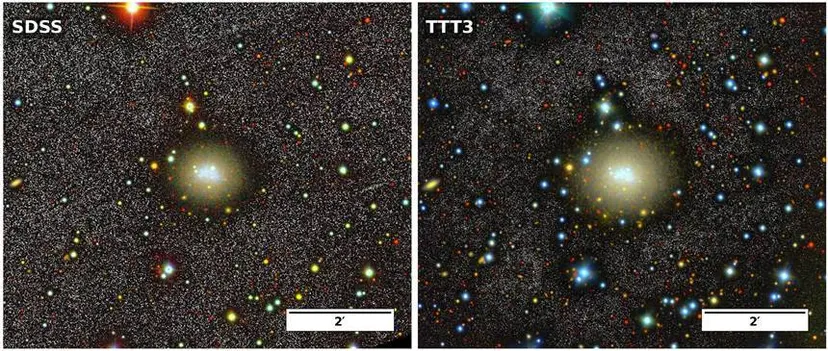
However, NGC 6789 shows no such signs. At least in previous observations, there were no indications of collisions. Thus, to look more deeply at the area around NGC 6789, astronomers used the 2-meter Twin Telescope (TTT), which looks like a pair of binoculars, to target it. While previous observations could only see the blurry center of NGC 6789, the deeper observations captured even the traces of starlight spread widely around it in great detail.
In this additional observation, NGC 6789 still showed no signs of collisions. Although it confirmed that the light extended further into the hazier regions of the galaxy's outskirts, the edges of the galaxy merely resembled a rounded dwarf elliptical galaxy. There were no traces of tidal tails—long lines of stars formed when a galaxy collides with or grazes another—nor any structures like stellar shells that would indicate recent gravitational interaction. This additional observation once again showed that NGC 6789 is a perfectly isolated galaxy that has not experienced any significant collisions recently.
If so, where is NGC 6789 receiving its fresh gas from? Perhaps NGC 6789 will serve as an opportunity to overturn our stereotypes about the cosmic web. What if the void is not completely empty? Even if there are no galaxies filled with brightly shining stars, what if it is filled with gas clouds and filaments that do not easily reveal themselves in standard optical observations? If NGC 6789 happened to be near a gas filament and is experiencing steady gas accretion from it, its unusually high star formation rate would be explained.
In fact, despite its continuous star formation, this galaxy shows a relatively low content of heavy metal elements in its chemical composition. This can be attributed to the constant influx of fresh, new gas from the outside. If new stars were born within the galaxy and supernovae were exploding, it would constantly be contaminated with metal elements; however, the steady influx of fresh gas from the outside can dilute these metals. This influx of cold, fresh gas into a galaxy along the surrounding cosmic web is called "cold gas accretion." This is presumed to be the primary cause of explosive star formation in primordial galaxies in the distant early universe when galaxies were being forged. Perhaps NGC 6789 is an amazing site that still demonstrates what that looked like.
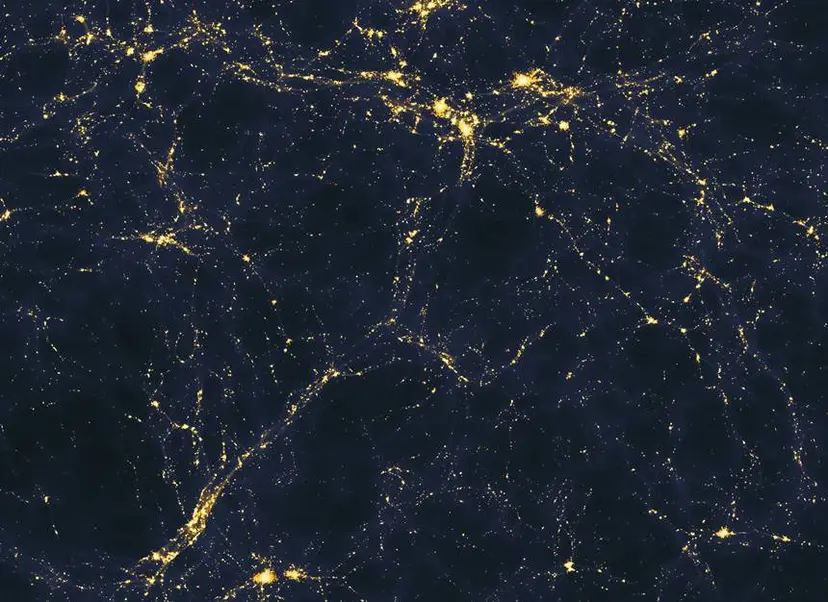
NGC 6789 demonstrates that interactions and collisions with other galaxies are not strictly necessary for a galaxy to steadily create new stars and maintain its vitality. Even in the middle of an empty, lonely void, a galaxy can survive on its own. With the help of invisible gas filaments, it devours the gas flowing in, continuing its own lonely yet brilliant journey. This provides us with a truly astonishing clue.
If this hypothesis is true, NGC 6789 becomes a site that devours the purest gas, untouched since the birth of the universe. Because there are no other galaxies in the empty void, there was no chance for the gas to be contaminated by exploding supernovae there. The gas filling the void likely retains the exact composition from the moment the universe was born. If we can determine the chemical composition of the gas and understand how it is distributed and flows, we will be able to reminisce about the earliest, purest days of the universe right after the Big Bang. Just as we imagine the infancy of the solar system by finding the pure traces of its formation in frozen asteroids and comets at the edge of the solar system, we will be able to imagine the childhood of the universe through the pure gas that may be filling the void.
Reference
https://iopscience.iop.org/article/10.3847/2515-5172/ae1cbe
Who is the writer, Ung-Bae Ji? He loves cats and the universe. After watching 'Galaxy Express 999' as a child, he dreamed of sharing the beauty of the universe. He is currently an assistant professor in the Faculty of Liberal Arts at Sejong University, engaging in various science communication activities such as lectures and writing. He has authored books such as 'A Piece of the Universe Every Day', 'Scientists of the Starry Universe', 'Things I Can Know Even Though I Cannot Go', and 'Strange Questions That Come to Mind When Looking at the Universe', and translated books including 'The Hitchhiker's Guide to the Real Universe', 'How I Killed Pluto', 'Quantum Life', and 'Cosmigraphics'.