

[비즈한국] The animation 'Zootopia 2' was expected to be a box-office success simply because it was a sequel. However, considering that 'Now You See Me 3' and 'Wicked Part Two', which were released around the same time, dropped out of the box office race early, it is clear that even with initial interest, audience engagement won't last without differentiated content. 'Zootopia 2' fully leveraged the strengths of the animation genre, allowing it to capture attention and draw in audiences once again as a sequel.
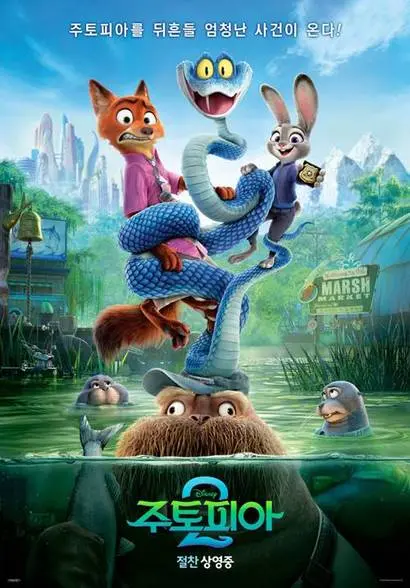
For animation, the realization of an imagination different from live-action films is crucial. In 'Zootopia 2', that 'different' imagination is the anthropomorphism of animals. The appearance of animal characters with diverse expressions is a key strength of animation. Even with advanced cinematic visual effects, it remains difficult to diversify animals the way animation can.
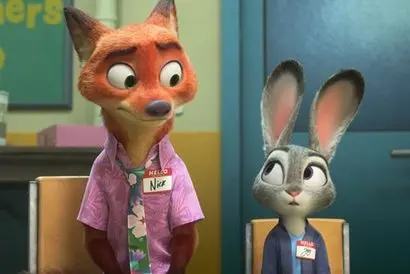
'Zootopia 2' is not merely an extension of the first film, but rather an intensification. The story doesn't skip ahead or expand into a narrative where Judy and Nick, having already solved their case in the first film, simply go on grand adventures. Judy has the essential characteristics and identity of a rabbit, and Nick, those of a fox. Judy is passionate and impetuous, while Nick tends to procrastinate and maintains a cynical, lukewarm attitude. It is impossible for these two characters to become perfectly synchronized easily. Since humans are the same way, this is highly relatable.
This relationship dynamic adds realism. The sequel is set just one week after they became partners, showing Nick and Judy still struggling to get along. Through this process of getting to know each other better, the chemistry between the two is further reinforced. Ultimately, the focus is on their growth. There was a reason for them to return after 9 years.
In particular, it shows that to be a great police officer, it is important not only to work alone but also to function within a team, especially in sync with a partner. In Korean films featuring police or detectives, main characters are often portrayed as lone wolves or heroes who command the scene. The process of conflict, adjustment, and synergy between them is frequently omitted. Consequently, such films tend to rely heavily on violent and sensational scenes, which weakens the audience's empathy and the lasting impression of the work.
There is also plenty of room to think about the multicultural elements. In this context, the appearance of animal characters is not just for cuteness or comedy. The appearance of various animals represents a multicultural setting, which symbolizes the multi-racial nature of reality. In the second film, prejudice and discrimination against snakes are shown through the character Gary, which can be seen as symbolizing discrimination and prejudice against specific minority races in the real world. In Korea, there is a tendency to deal less with multicultural elements, but for global expansion and resonance, such character composition is important. Especially if there are limitations in dealing with race from a realistic perspective, it is advantageous to produce it through animation using animal characters.
Korean animations tend to center their characters and storylines around humans. Near examples include 'Run Hani: Bad Girl' and 'The Letter from Yeonhee', both released in October 2025. (It is also questionable whether the term 'gaejib-ae'—a derogatory term for a girl—fits modern sensibilities.) 'Made in this Star', released on Netflix in May 2025, also combined the sci-fi genre but remained centered on human characters. 'Leafie, A Hen into the Wild', which featured animal characters, has yet to see a sequel. Recent Korean animations can be described as tending toward realism.
However, 'Demon Slayer: The Infinity Castle' showed well that even with realism, surreal space settings and directing effects are entirely possible. While the genre itself is based on action-martial arts, it caught the audience's attention through realistic depictions, expressions, emotional empathy-inducing settings, and messages. In terms of specific direction, it utilized space freely and provided various impacts, leading to visual immersion. It showed competitiveness that differentiates it from live-action films. That is why it could be watched by both teenagers and adults.
Our animation is still stuck in a juvenile or adolescent stage. This is likely because the perception that animation is the exclusive property of teenagers or people in their early 20s remains strong. 'Zootopia 2' is aimed at the eye level of children, but it is full of social messages and meaning. It shows the ideal society that future generations should create. Korean animation also needs change from this perspective. Taking this opportunity, it seems urgent to produce a sequel to 'Leafie, A Hen into the Wild' by leveraging the advantages of a sequel. Of course, it should refrain from the haste committed by countless other sequels and instead be allowed to ferment slowly before being released.
Author Kim Heon-sik has been walking through or navigating the forest of popular culture phenomena since his 20s, with the expectation that there is a way to make the world a better place through culture. He continues on the same path with the same belief in the 21st century, where artificial intelligence and quantum computers are active.